The plan for Sunday was an early 7am departure to cover 40 miles & 4 Locks (#19/20/21/22).
40 Miles = about 5 hrs at 8mph
4 Locks = 15-20 min/Lock = 1-1.5 hrs
Total = 6 to 6.5 hour travel day.
We woke at 6:30am to a pouring rain. It rained heavy all night. About 7am, the rain let up to a drissle – so off we went. Fire up the Engines, pull in the Power Cables, prep the lines for release While-on-the-Boat. Off we go !
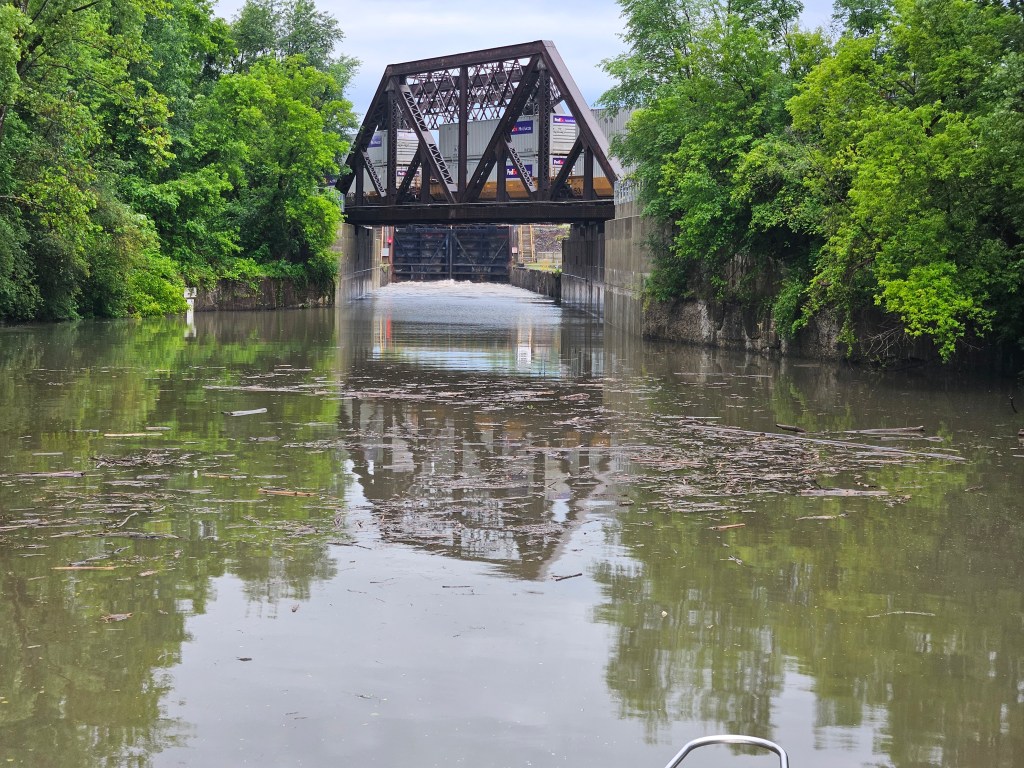
Step 1 = Lock #19 Complete ✔️
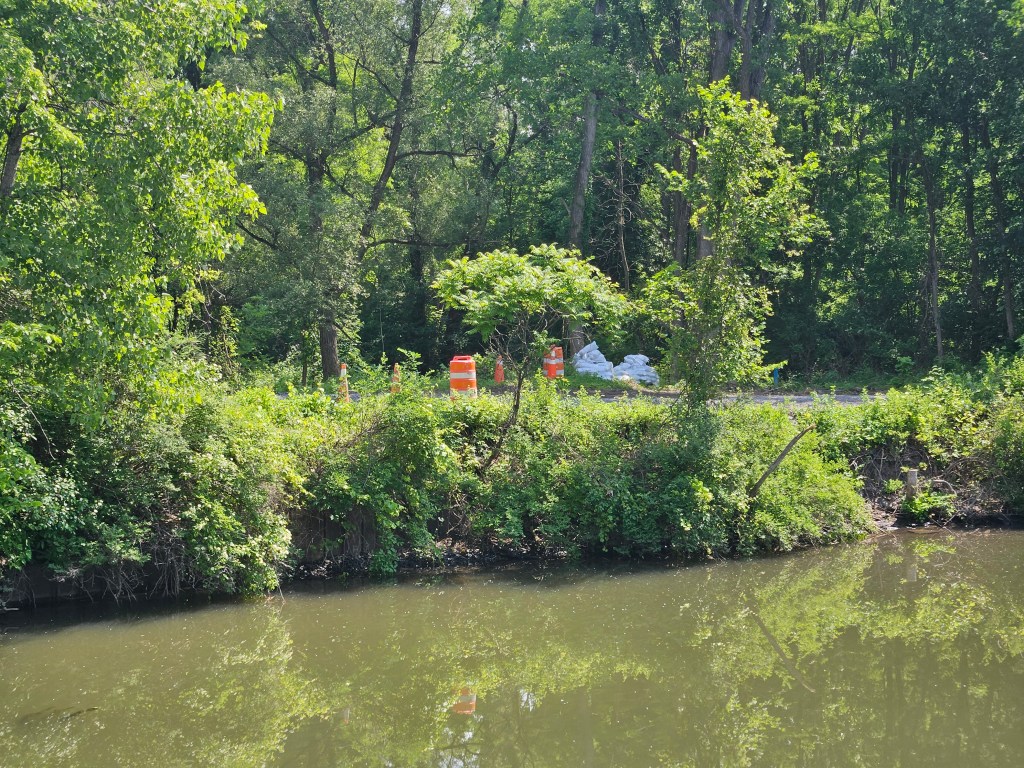
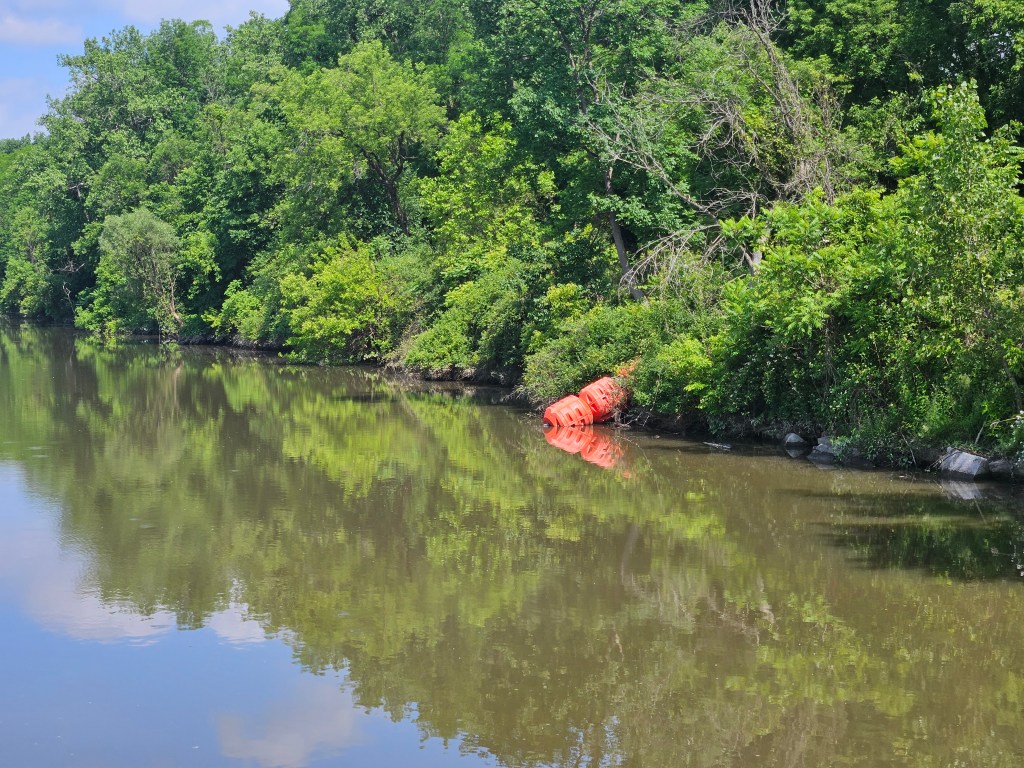
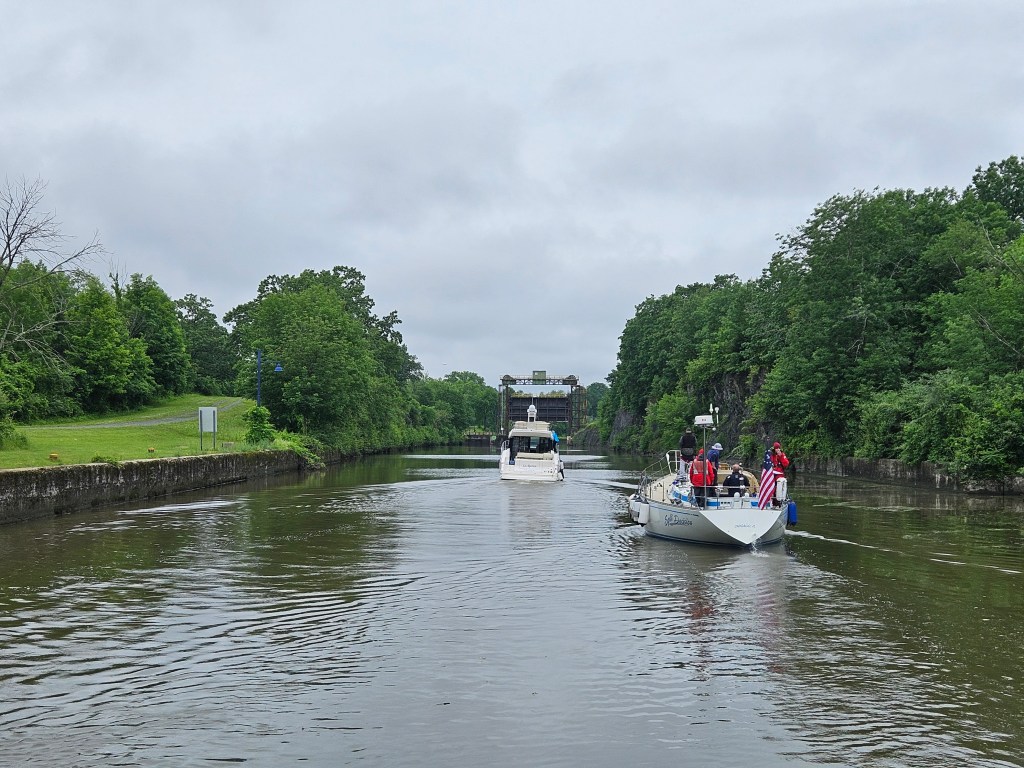
In case you didn’t notice in the photo above, after the heavy rains last night the entire Erie Canal was full FULL OF DEBRIS, it was like a mine field of crap in the water !!!
There were several places that we had to go to idle speed, shift to neutral, and coast thru the debris, to prevent potential damage to the props.
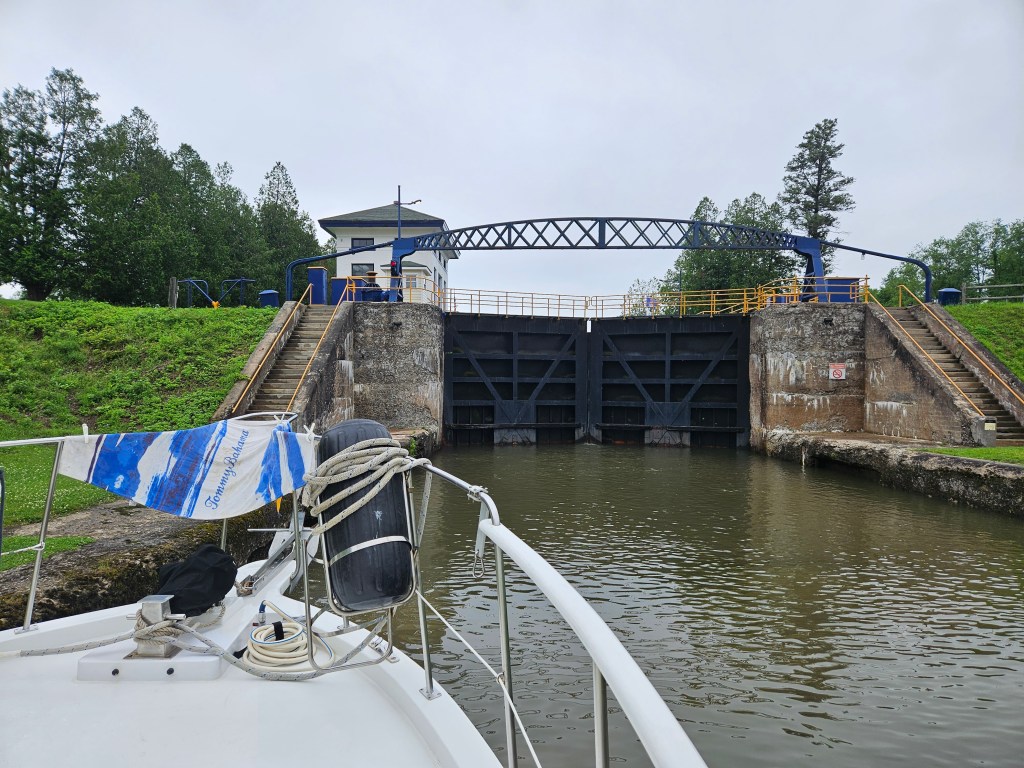
So after making it thru Lock #19, and having the entire lock to ourselves, we thought that today was going to be a great day. If you get into the 1st lock of the day by yourself, you usually are alone in the rest of the locks for the day. Even the weather was starting to clear up.
When we arrived at Lock #20 and called the Lock operator for westbound passage, he gave us the BAD NEWS – ALL LOCKS BETWEEN 16-22 are now shut down due to the heavy rains last night.
I guess we were lucky to have even clicked off 16 miles & 1 lock due to our early start, before they shut everything down.
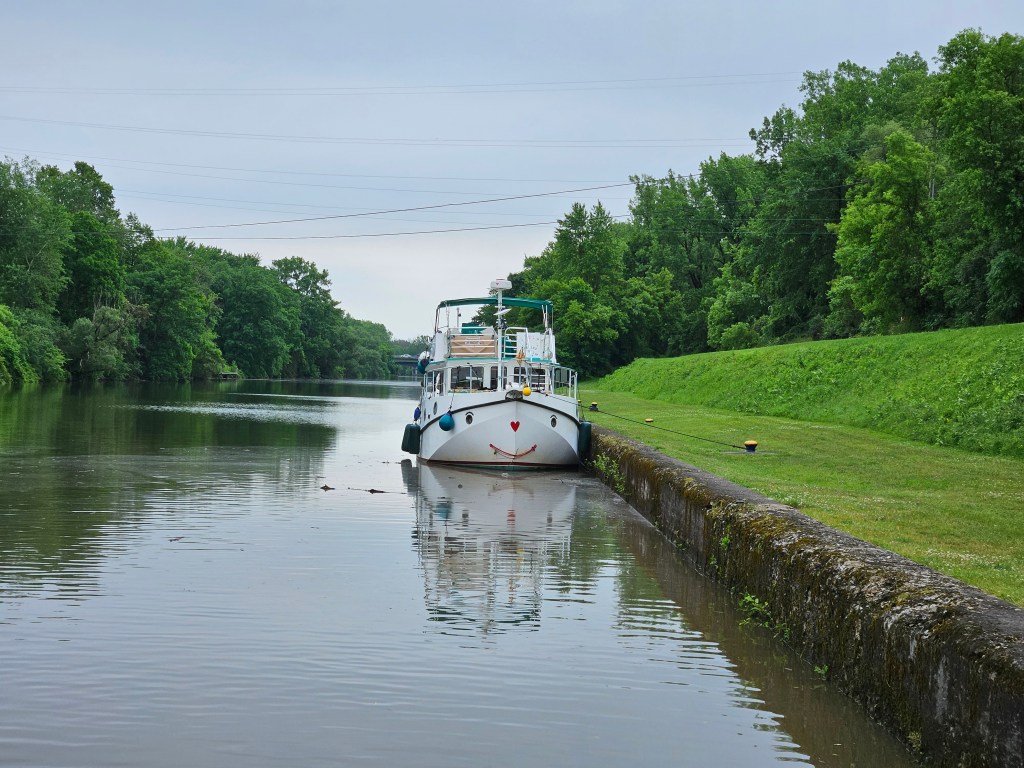
Now we will spend another night on another lock wall, but with no power. Gotta run the generator. We belive it will be only a 1-day delay, based on the feedback from the lock operator.
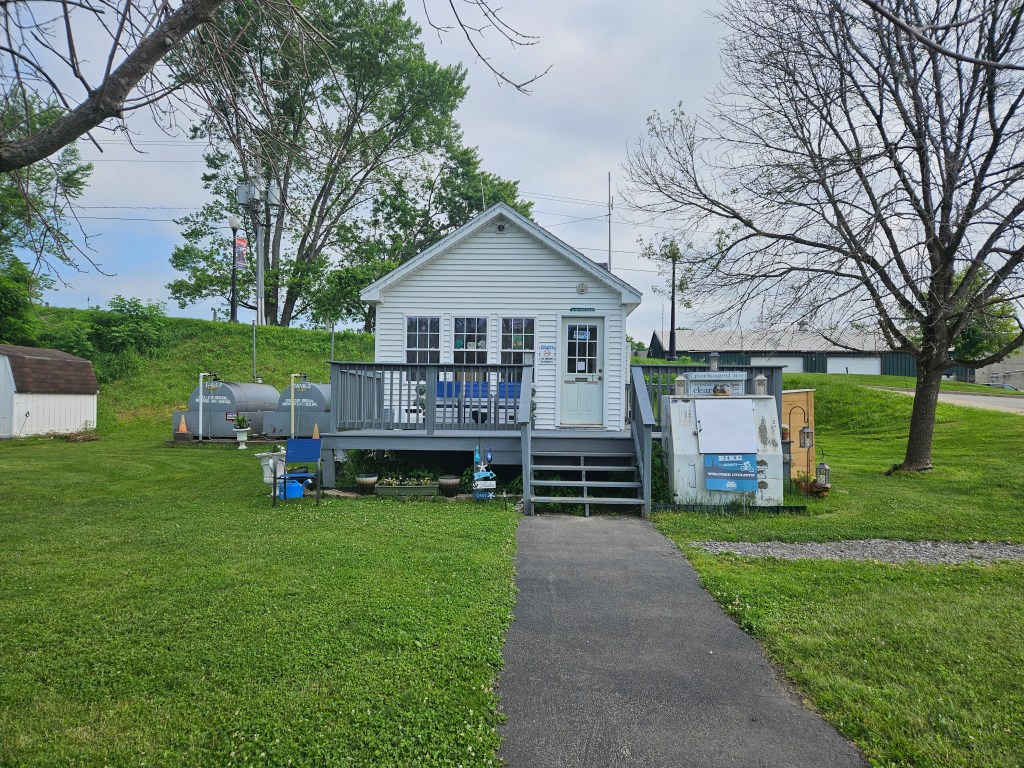
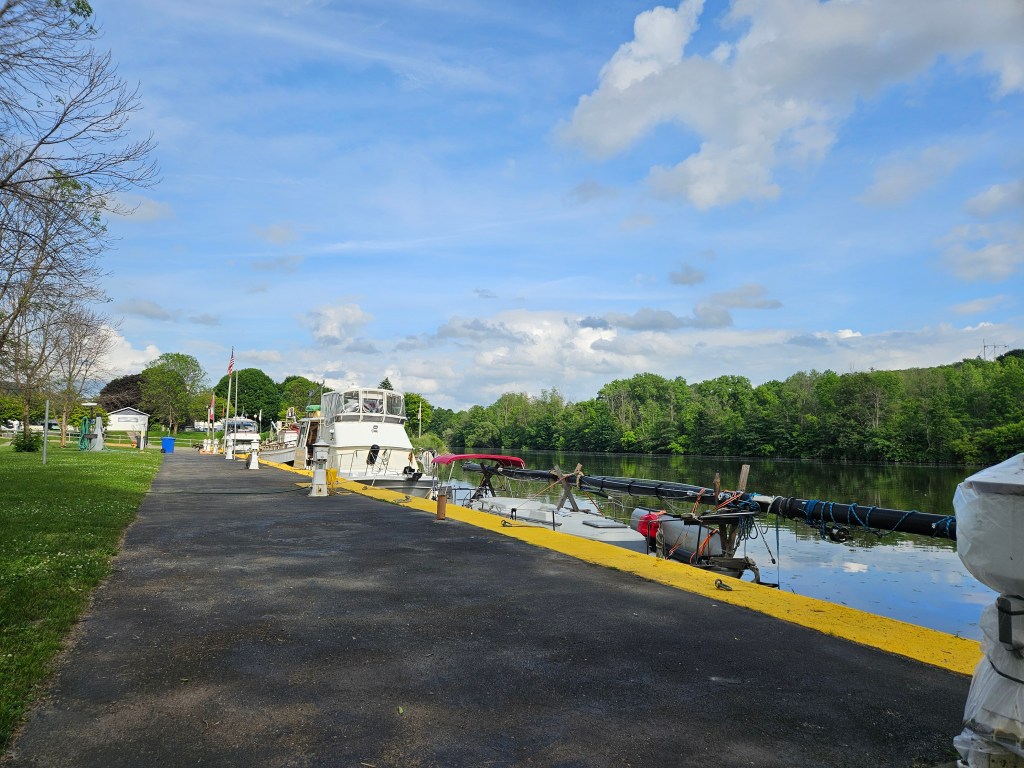
Here are the surroundings for tonight – it’s just us and a late wall arrival “Sweet Dreams”, with their smiley face bow. They are a nice ole couple who also made it thru Lock #19, after us but before they shut down the canal.
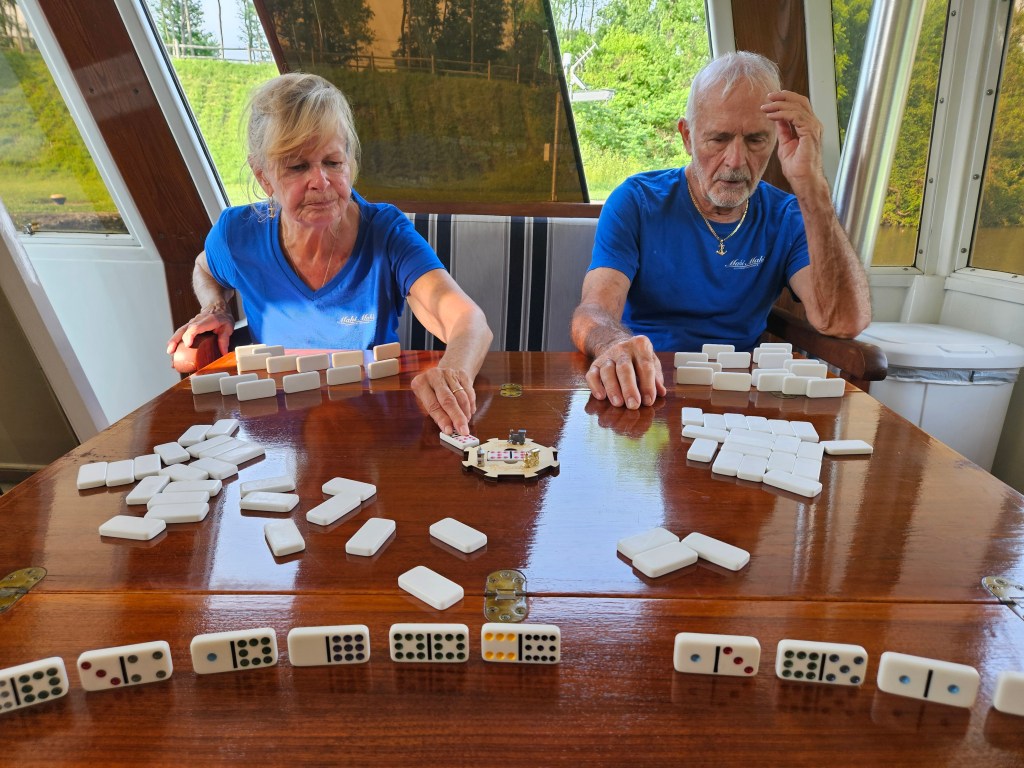
To kill all the free time we now had on our hands, we went for a walk around the lock & played the Mexican Train domino type game.
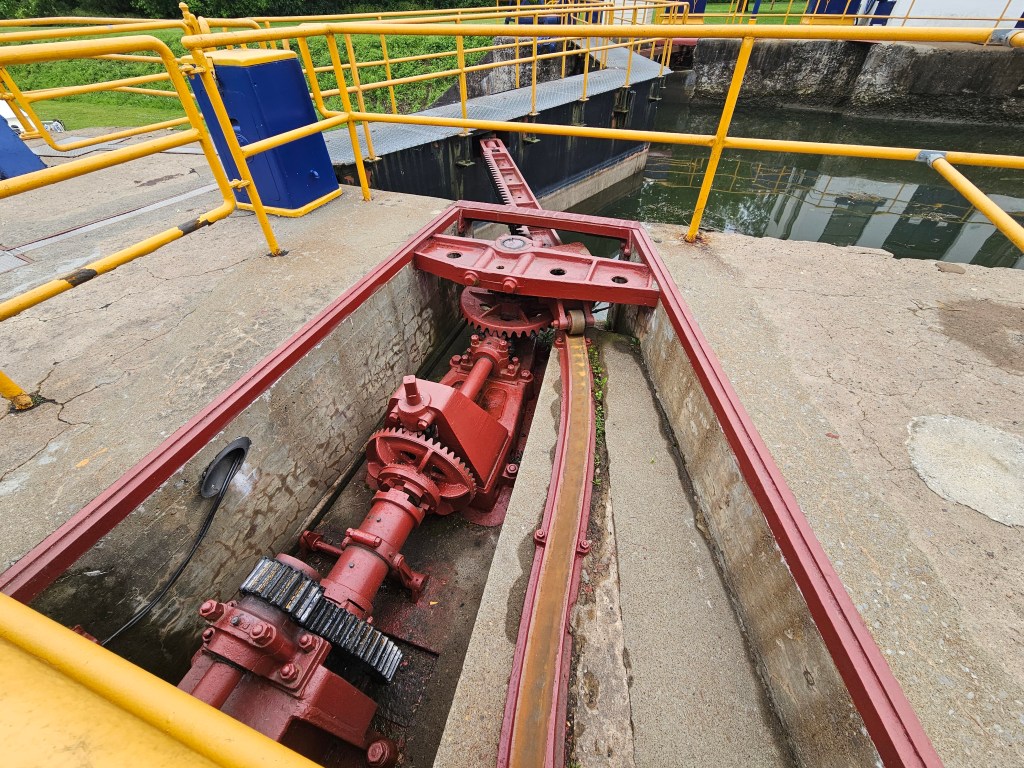
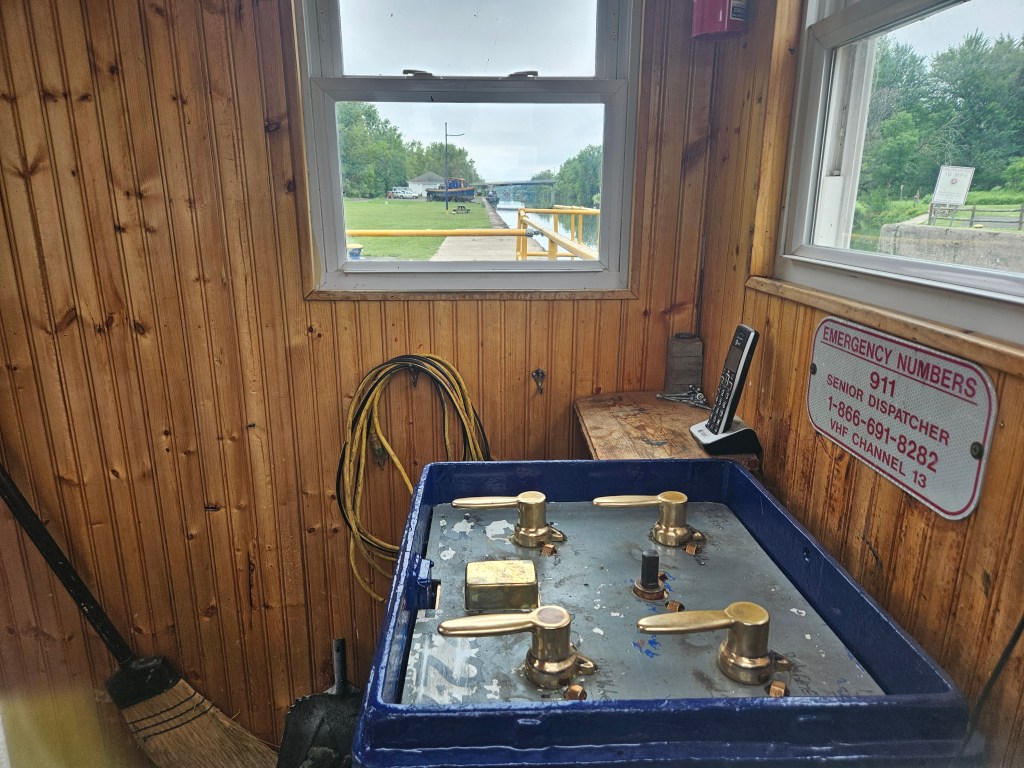
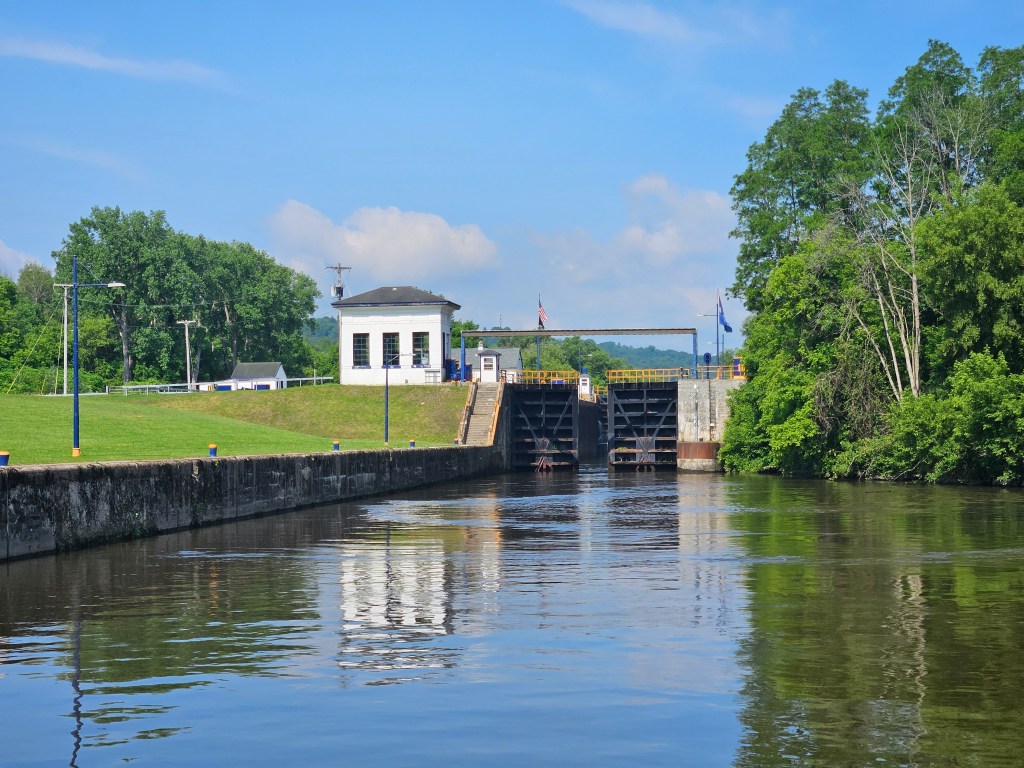
Here are some photos that we normally cannot not get because we are “IN” the Lock, not walking on top of it. Below is shown the gearing which opens/ closes the lock door & a photo of the lock operators station.
It was a highly competitive game of Mexican Train, I did win of course, but I have the advantage of drinking Tequila most days.
Our plan is to hopefully get thru Lake Onieda tomorrow (Mon) & hopefully make it to Lake Ontario on Tuesday.
After waiting 2.5 days for the Slave Assembly Lock Out Valve, in spite of paying for Next Day Air, the part finally arrived at 5pm yesterday (Fri-20th).
Installation took about 30 minutes, bleeding took about 1 hour, and celebration with Tequila & Deena Burgers took about 2 hours.
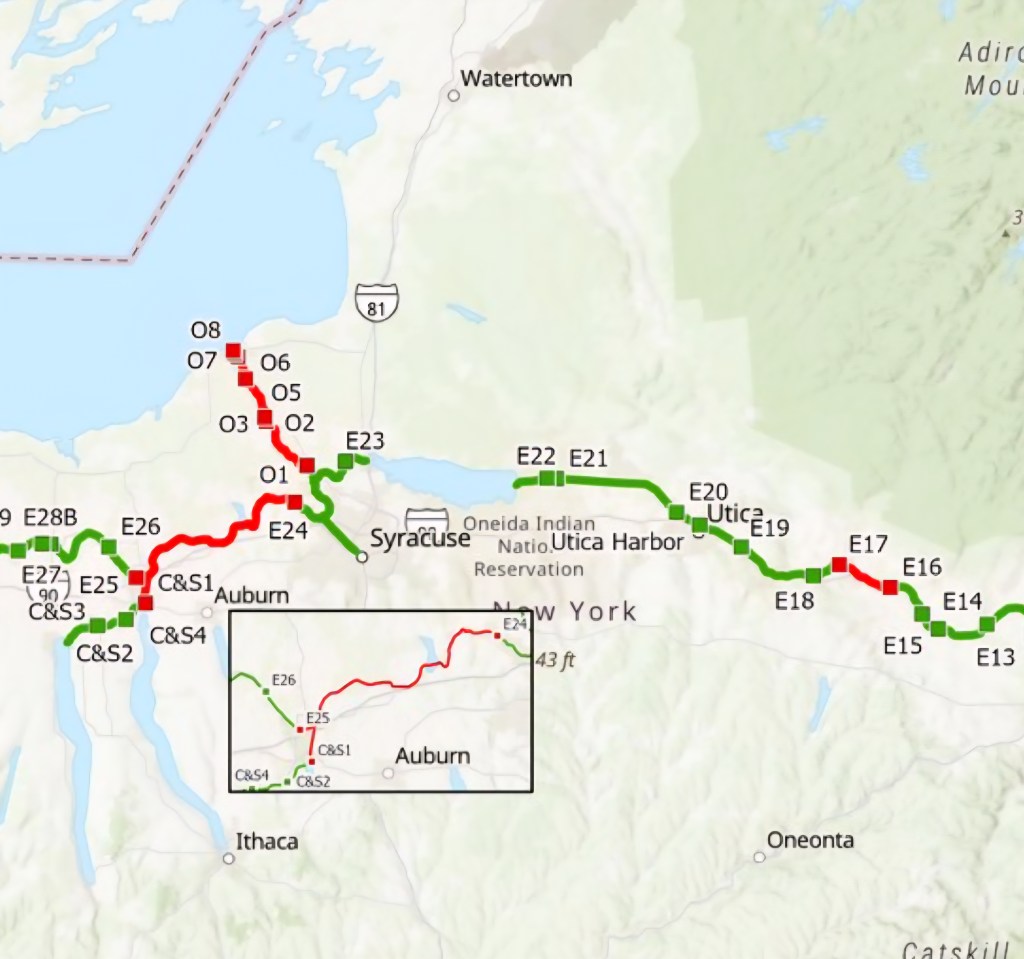
Today we finally left St Johnsonville after 5 days & moved a short 20 miles to The Village of Ilion. We purposely selected a short mileage day for a couple reasons; 1) We were going thru the infamous Locks #16 & 17, and you can only go idle speed for 8 miles, between these 2 locks (due to the embankment repair a couple weeks ago).
Reason 2) The next Village of Ilion is supposed to be a small little town with lots to see in walking distance.
But first back to St Johnsonville. We cannot leave without thanking a couple special people. Harbormaster Frannie, who treated us like royalty, gave us 3 free days of dockage, and the first use of the newly repaired pump out machine ♥️.
Sorry, we never did get a photo of Frannie.
Second, was our on-call driver Carrie. She would drop what she was doing anytime we called, to transport us to: the hydraulics shop, the grocery store, & the ATM. She also made several pickups for us, even using her own money to advance pay for what we needed. She is one of the many special people we have met on this journey.
Ok, back to today’s Voyage. It seemed like a long 20 miles going thru only 3 locks. But like I said, there are still special “idle speed only” rules between #16 & 17.
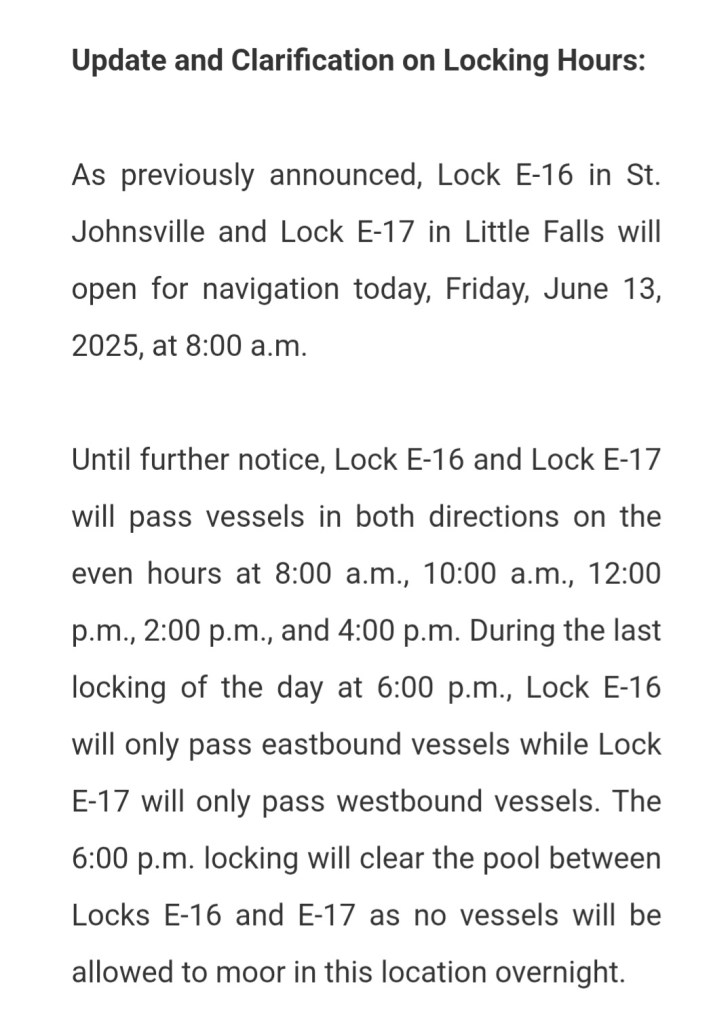
We made our way to Lock 16. They had special arrival times – you could only pass thru westbound at 8am/10am/12pm/2pm/etc.
There was nothing special about lock #16, but I felt compelled to take a photo of one of the two locks that gave us so much anxiety a couple weeks ago, regarding – when would the lock open and allow us thru. Little did we know about the hydraulic throttle problem that would ultimately be our biggest issue.
The entrance gate to lock#16
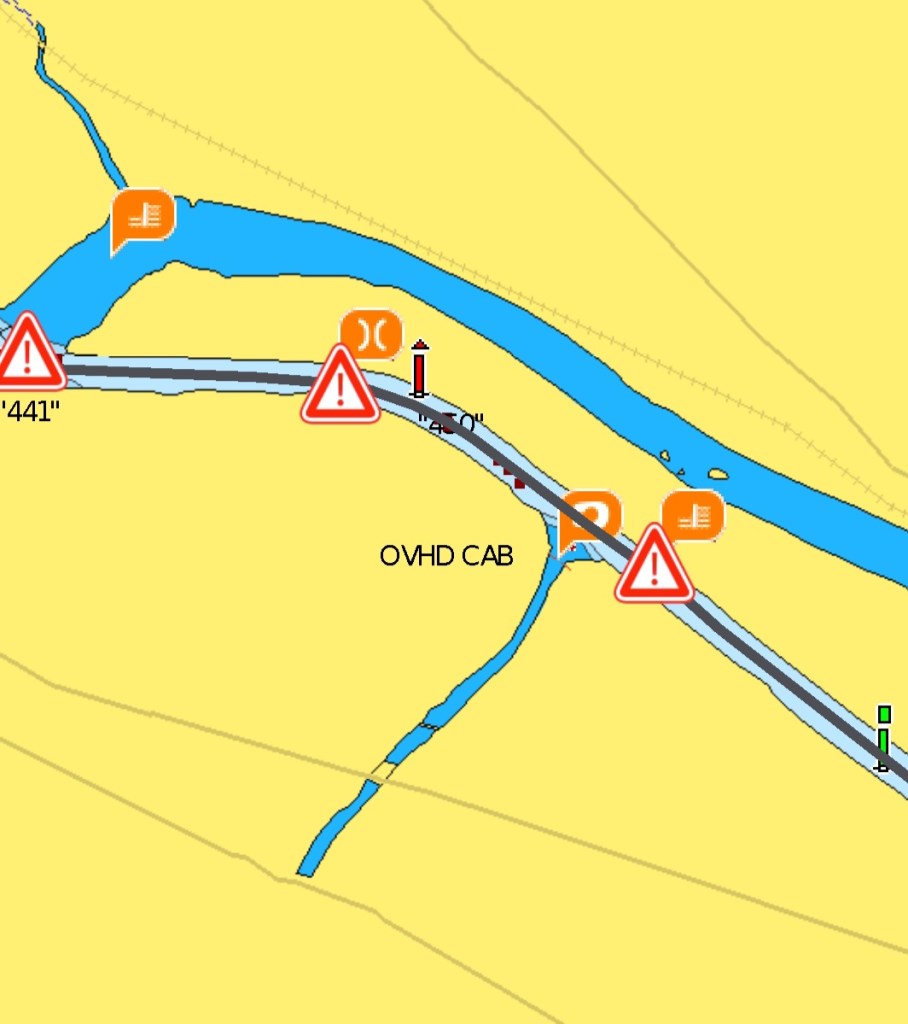
After lock #16, when we finally reached the area of the embankment rupture, it was anticlimactic. There did not seem to be a very big repair area. The embankment looked solid, there was still a lot of trees & greenerie to absorb boat wakes. But the Erie Canal is parallel & very close to another small tributary of water. There was a section of road between the canal & the tributary that looked like it had been washed out.
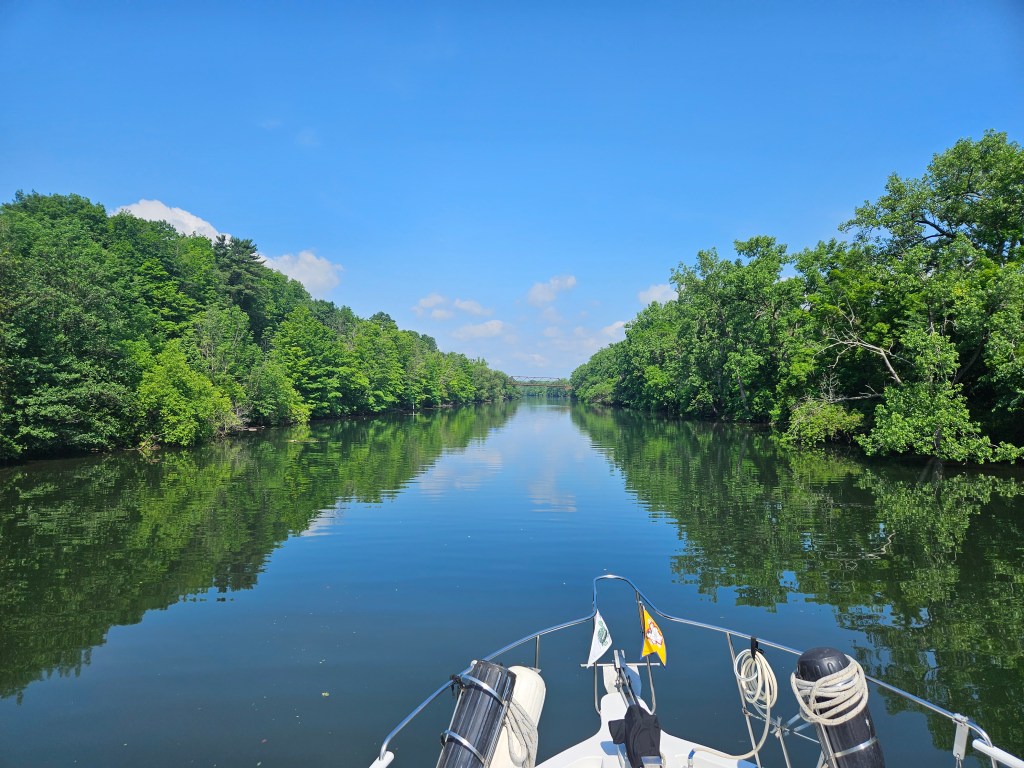
The slow ride from #16 to #17 again felt like we were on the Amazon or Congo Rivers, nothing but water & greenerie.
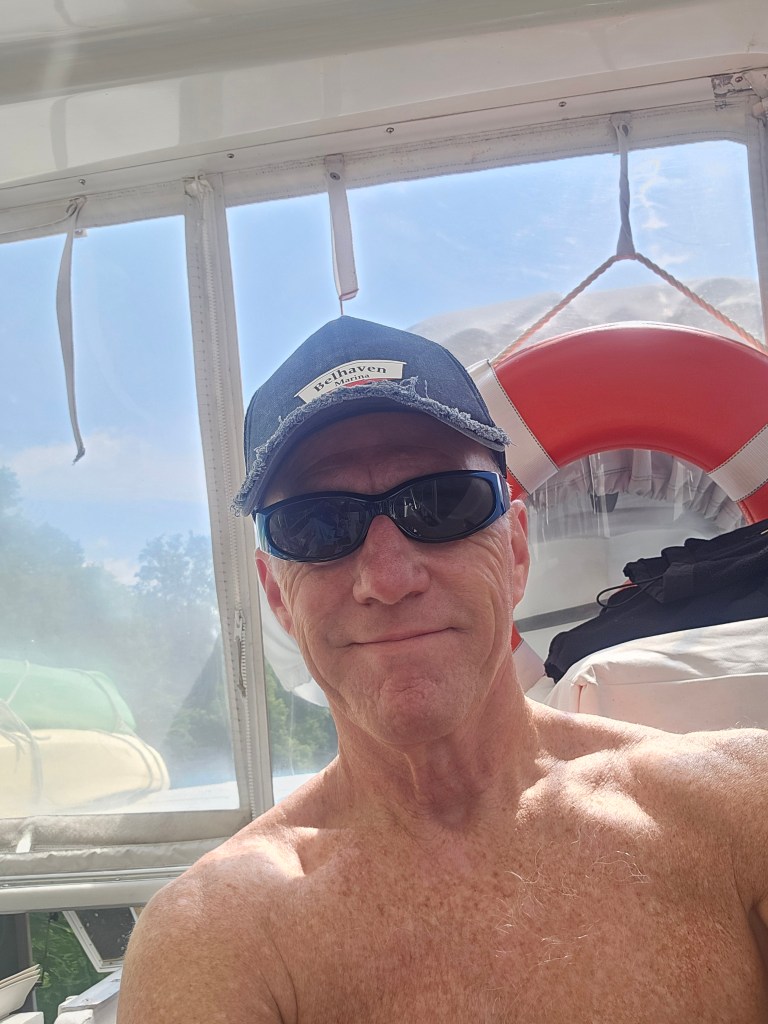
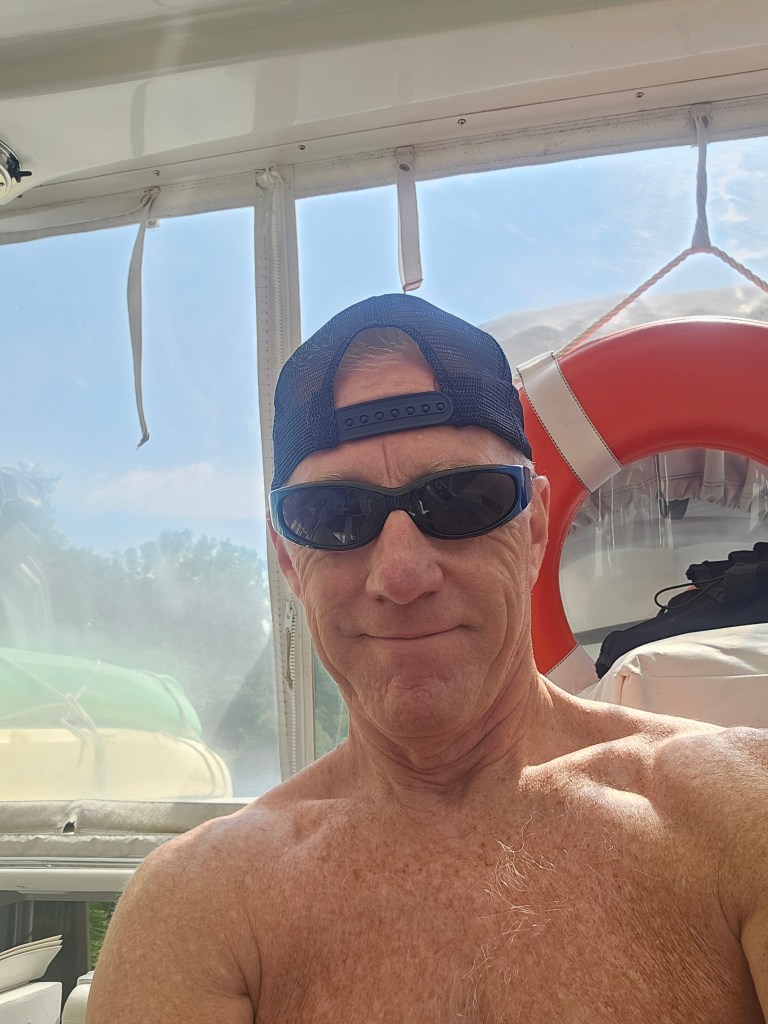
During the long/slow ride, Deena told me that I should be wearing a hat while locking in the hot sun. I told her that the headset would not fit over my Tilley hat. So she offered me one of her hats, the ballcap from Belhaven. What do you think – should I wear it traditional front, or backwards like the sports athletes.
Ok, we finally made it to Lock #17.
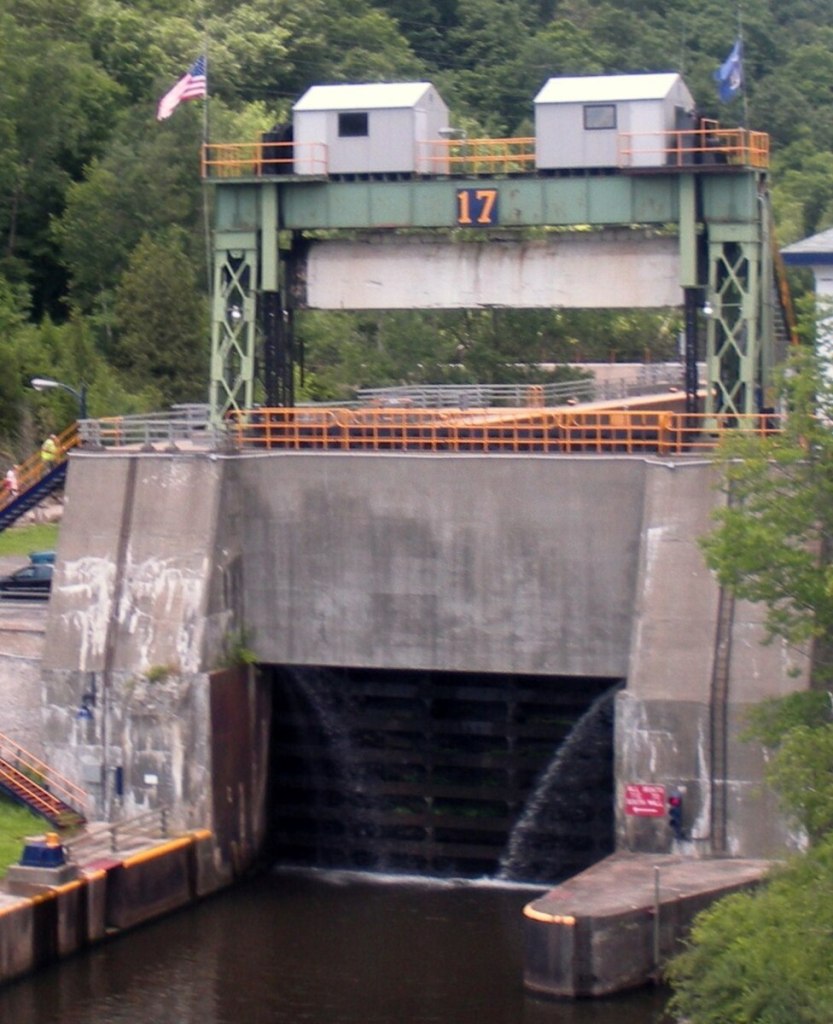
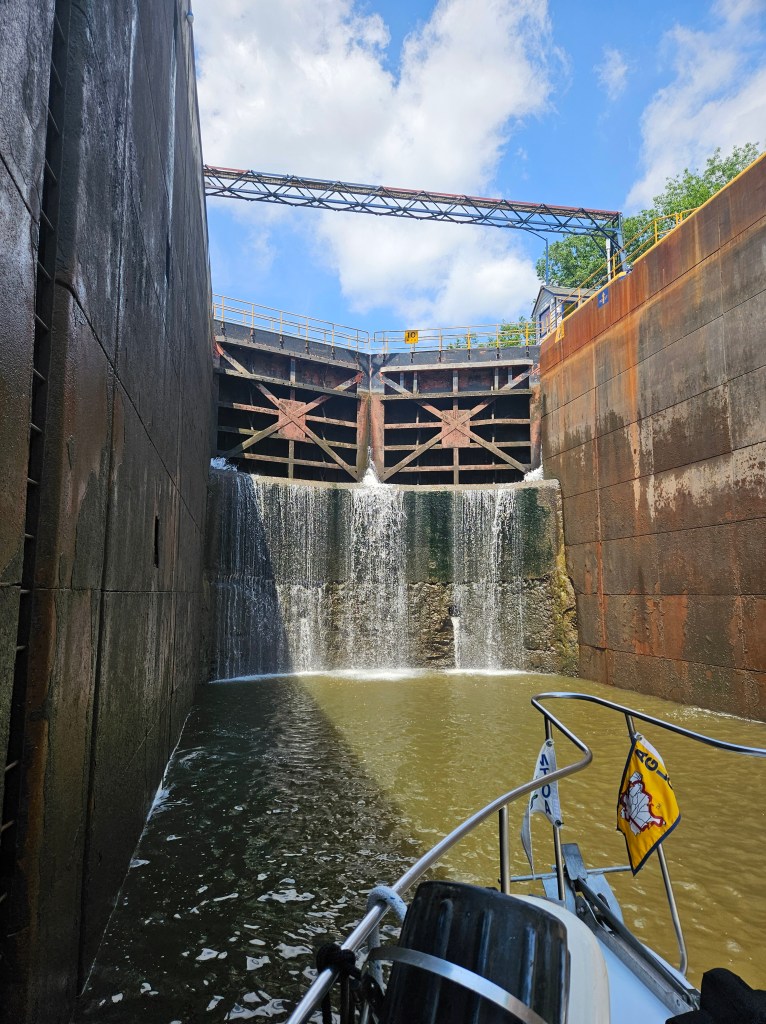
Lock #17 is a little special, in that it is the highest lift/drop on the NY Canal System (40ft) & it has a guillotine gate vs a swing gate. Note for reference – there are other very high locks with swing gates. The Wilson Lock in Alabama with over a 100ft rise/drop (Ken/Carla- do you remember it, Dave Sylver, do you remember our ride thru the Wilson Lock). The 3 photos below are from the Erie Canal Lock #17.
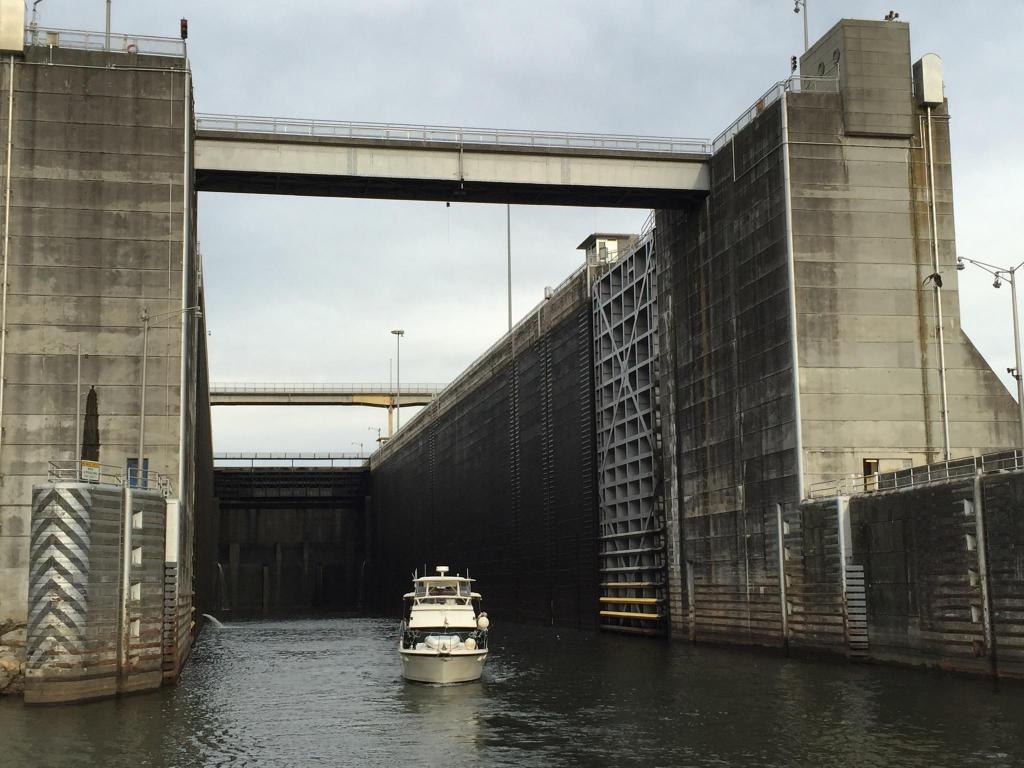
For reference, here is a photo of the Wilson Lock in Florence Alabama – 100ft lift/drop. Look how small the 43ft Gettin’ Looped looked in this massive lock.
As we exited #17, we were treated to some rock climbers on Moss Island, also know as Pot-Hole Island (Ashley/Dave/Nellie – do you remember).
Rick climbers, Moss Island
Finally after only 20 miles and only 3 locks, we arrived in The Village of Ilion after 4.5 hours of travel.
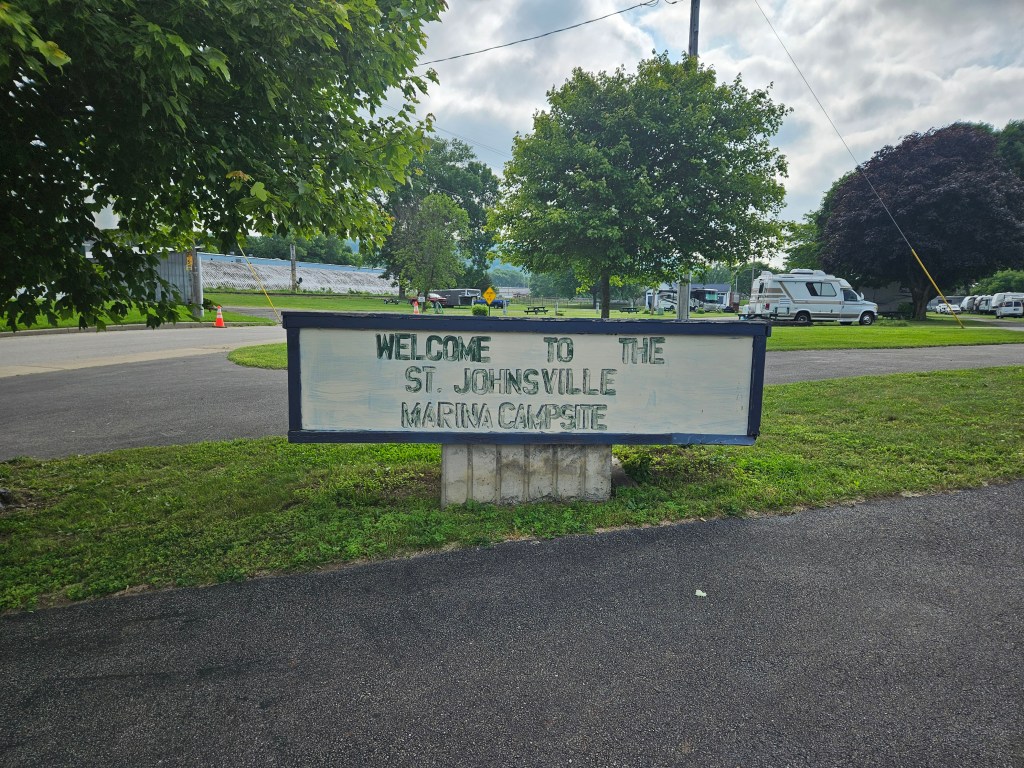
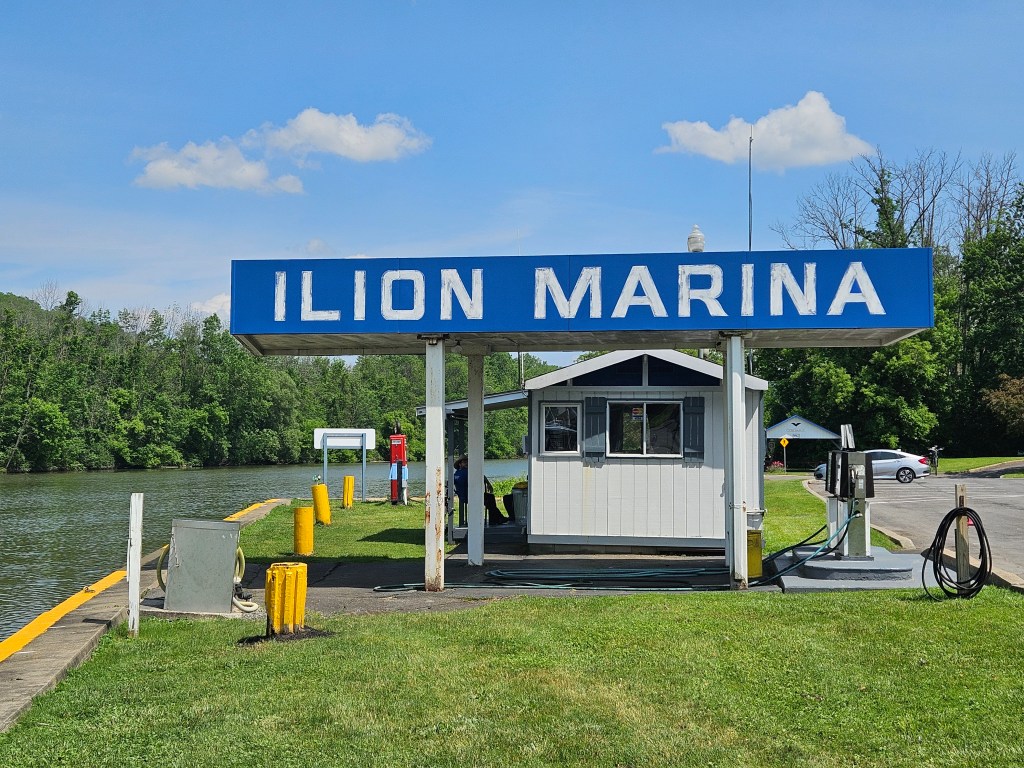
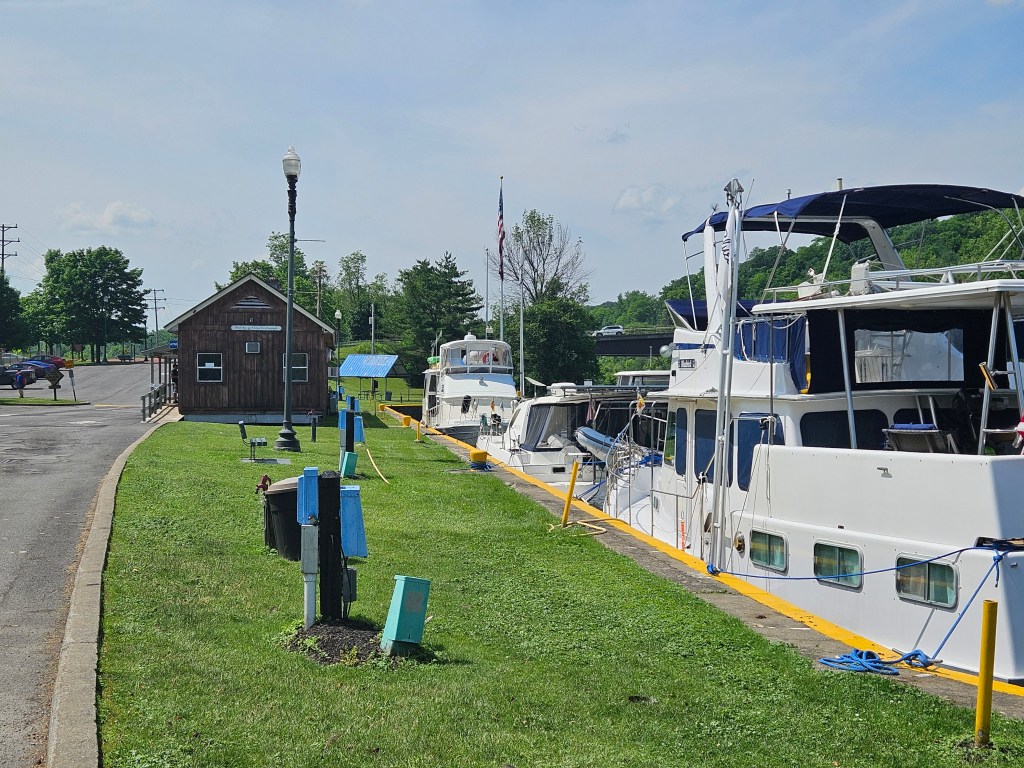
The “Village of Ilion Marina” looks a lot like our last marina at St. Johnsville. They are both really trailer parks, with a small marina attached, right on the Erie Canal. And we love them both vs the mega-marinas.
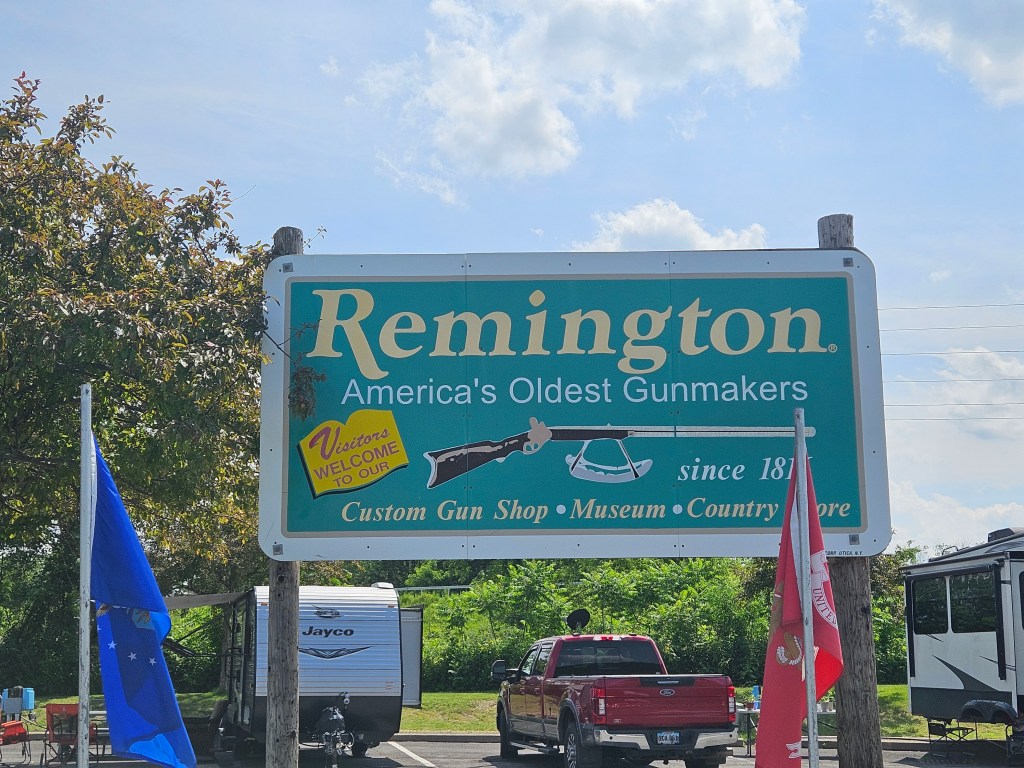
We did learn of a relatively significant distinction for the Village of Ilion. It was the original home to Remington firearms for over 200 years. Founded in 1816 by Eliphalet Remington as E. Remington and Sons in Ilion, New York, it was one of the oldest gun makers in the United States and claimed to be the oldest factory in the country that still made its original product. Remington relocated to LaGrange Georgia in 2024, to a much more “gun-friendly” state.
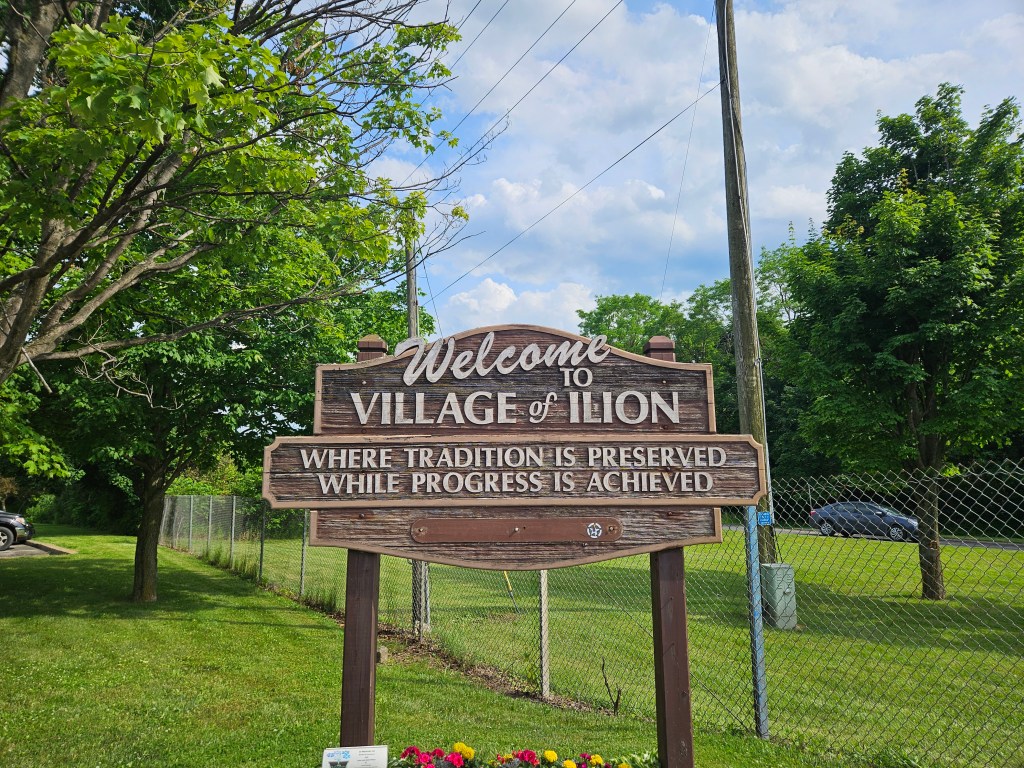
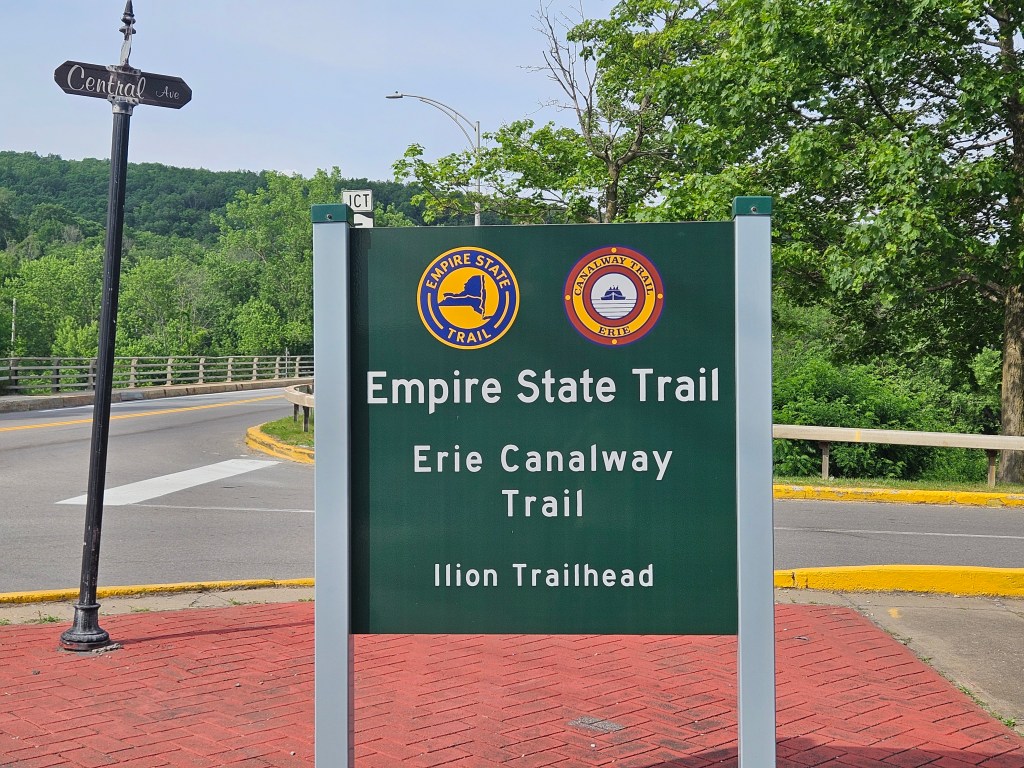
After a short cat nap, we headed into town for dinner at Sorrento’s Italian & some grocery items from Aldi. A short 3 minute walk from the marina. Here are a couple shots from Ilion.
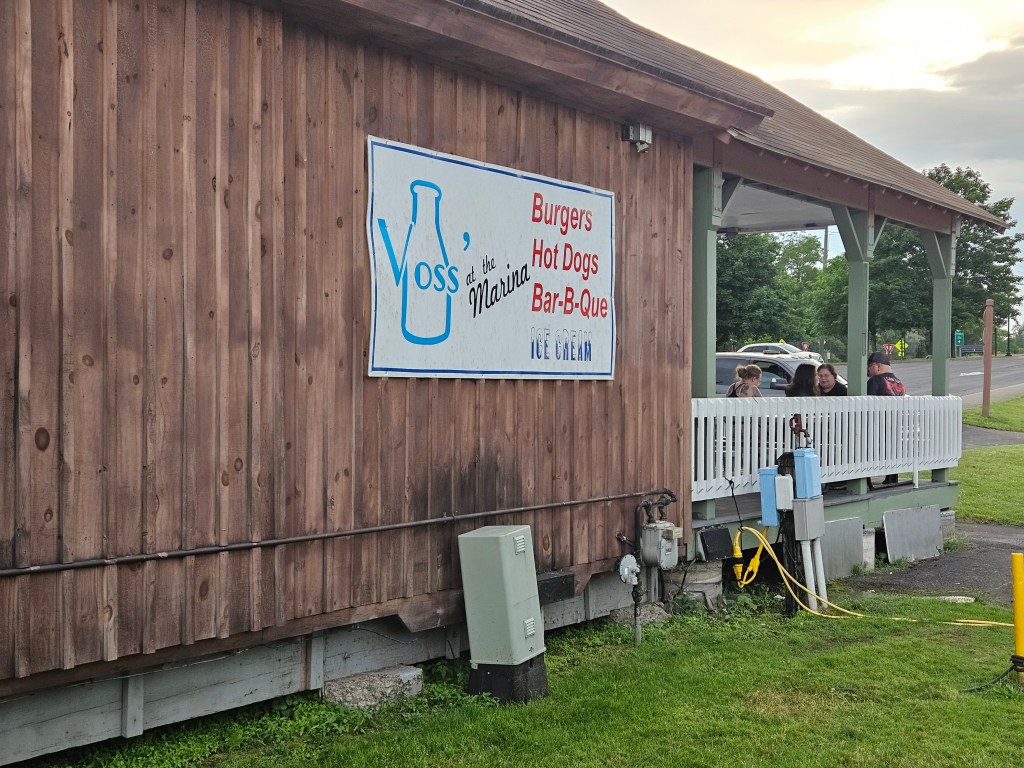
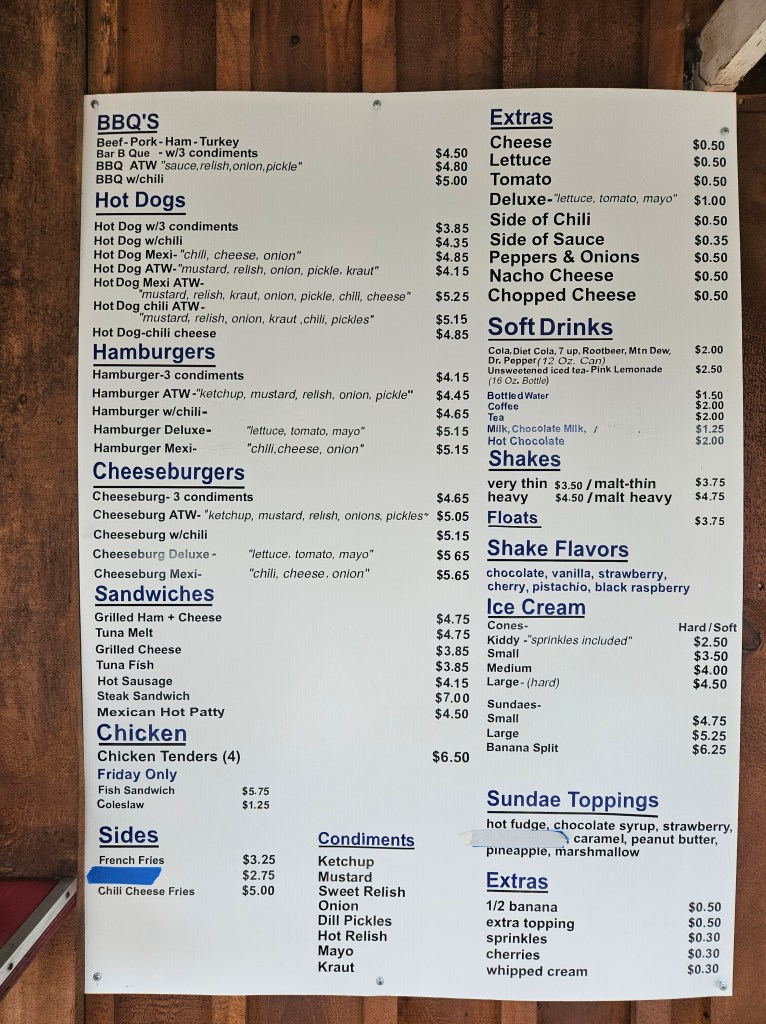
Deena & I ended the night with a Milk Shake (Mikie) & a Malt (Deena). Captain Luck is watching his manly figure. This Burger/Hot Dog joint is right next to our boat. They make an excellent Shake, and check out these prices, I thought that I was back in the 1950’s.
Tomorrow (Sun-22), we will go thru our last 4 Erie Canal Locks (#19/20/21/22). Then it’s a short 55 miles and 8 locks on the Oswego Canal – to Lake Ontario !
Finally, I would like to end this post with some prayers & blessings for our dear friend and Detroit Power Squadron comrade- Joanie Stoll.
Joanie passed away back on May 3rd. Her family, and many of our Power Squadron friends attended her memorial on Saturday in Michigan.
RIP Joanie, she was a wonderful person, always smiling and always in a good mood. ❤️
This blog post is for all you – mechanically inclined, problem solver folks.
If this is not your bag, you may want to skip this post.
As I sit here and write this blog, I am feeling blessed. The Mahi crew has been thru a lot in the last 3 days, but we are at piece now. Jerry & Deena went for a 20 min walk, on a hot day, to a place without Beer, Wine, Alcohol – so I stayed back to watch the boat 😃.
I had left over Pizza, a Bag of Chips, and Tequila. Look at my dinner surroundings, it is so peaceful & beautiful !
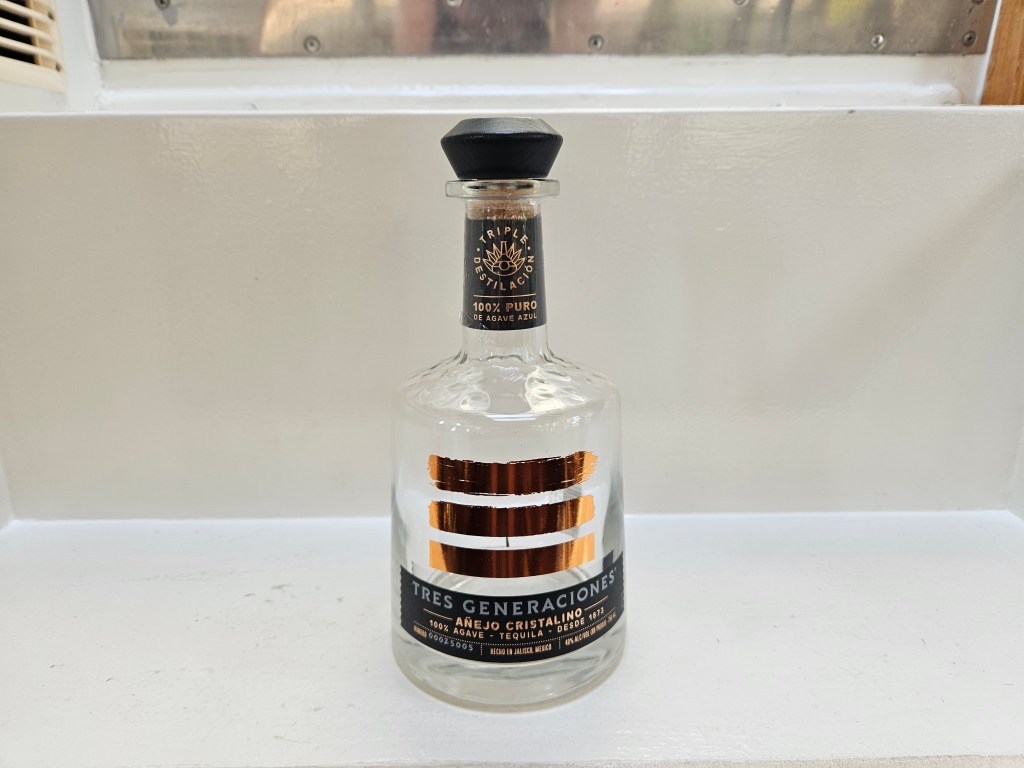
So today, one more Tequila bottle bites the dust. I think the Lucks have been dipping into my reserves.😁
So back to our last 3 days, and our current situation.
Current situation = we have been disabled for 3 days, and are waiting on a “Hynautics Check Valve” from a place in North Carolina.
Here is our story from the last 3 days.
3 days ago (Mon 16th) – Jerry is entering a lock, he throttles up to get past the swirling current at the entrance to the lock, and when he tries to come back down to idle the starboard throttle lever will not come back down to idle. Jerry puts the starboard transmission into neutral and uses one engine and steering to get us to the lock wall.
We made it thru the lock and got safely tied up on a free overnight wall, just after the lock.
We spent the night on the lock wall and discovered that one of the nylon lines going to the throttle slave assembly had a small on hole in it leaking a lot of hydraulic fluid. The line had been rubbing on a nearby bolt head. The photo cannot show the pin hole.
Luckily we had enough slack in the line to cut off 1″ of line, past the pin hole, and attach a new fitting onto the line (YES – Jerry had the spare parts).
After reviewing some of Jerry’s paperwork and doing some googling, we figured out how to bleed the system.
It was a long labor intensive process to bleed the system (1-2 hours). But we got the system bled and headed out the next day. We made it 10 miles and thru 1 lock, and then a similar event happened again. This time there were No Leaks, and the throttle slave assembly was frozen up. The throttle would not move from its elevated 1200rpm position (idle is 700rpm). So again, Captain Luck had to come into the lock on 1 engine + steering. But this time the throttle slave cylinder was completely locked up, it would not move.
Now is a good time to describe the Mahi’s throttle system. It is called a Hynautics Throttle Control System. Here are the major components –
The Mahi’s throttle & transmission system is a mechanical/hydraulic system, with trade name Hynautics. It is a very old system. There are 2 Transmission levers & 2 Throttle levers. Basically, when you move one of the levers, like the Starboard Throttle, it sends hydraulic fluid down to a slave cylinder attached to the engine. The hydraulic slave cylinder then moves a rod on the engine to raise or lower the engine speed.
Here are the components of the system
The Resevoir – this holds all the fluid for both transmission & both throttle controls. It has a sight glass to let you know how much fluid & how much air pressure is in the system.
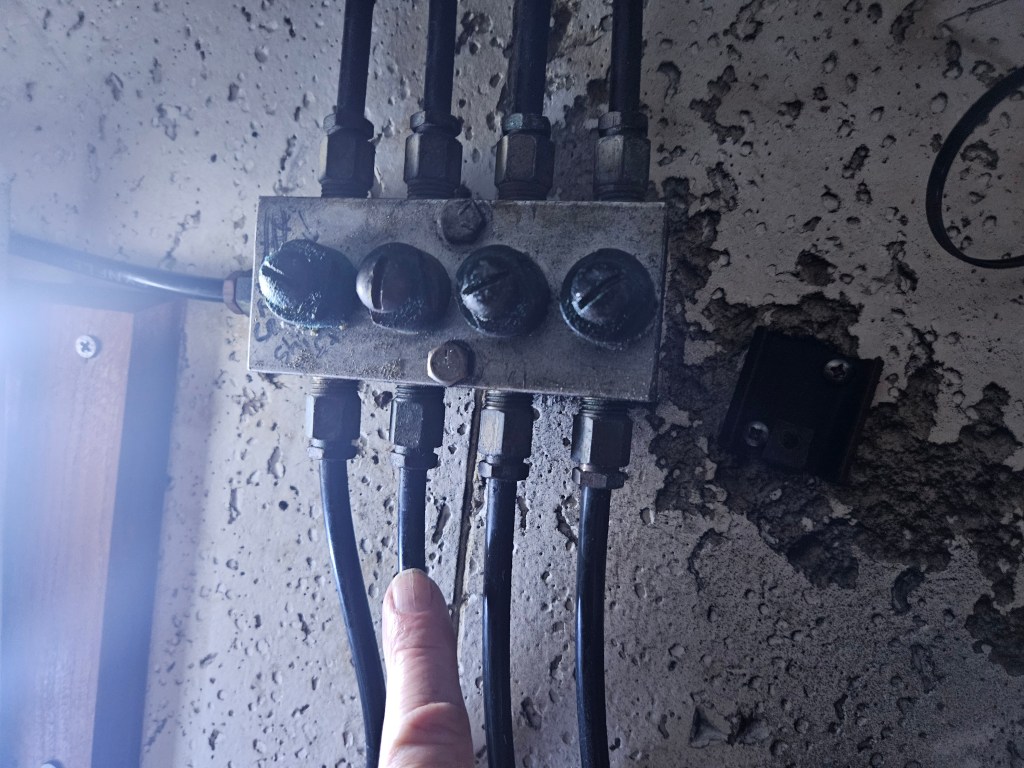
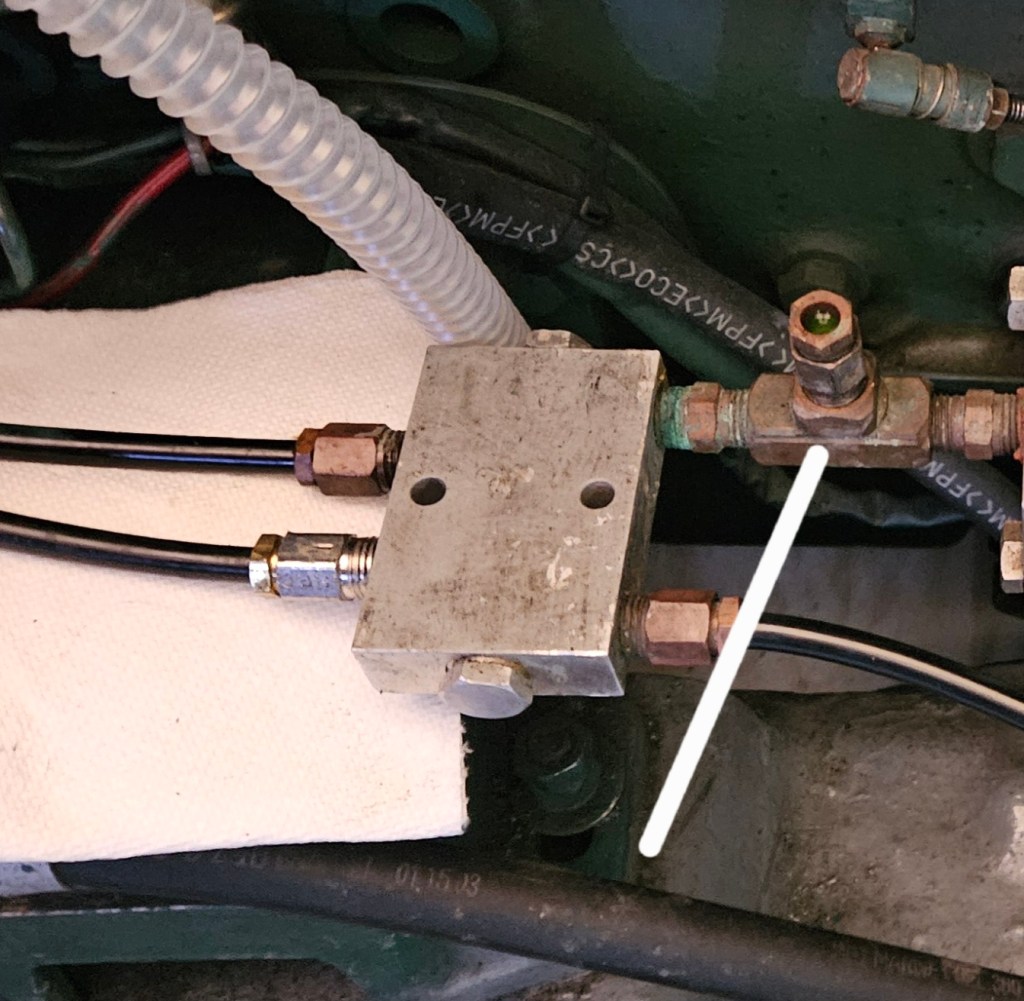
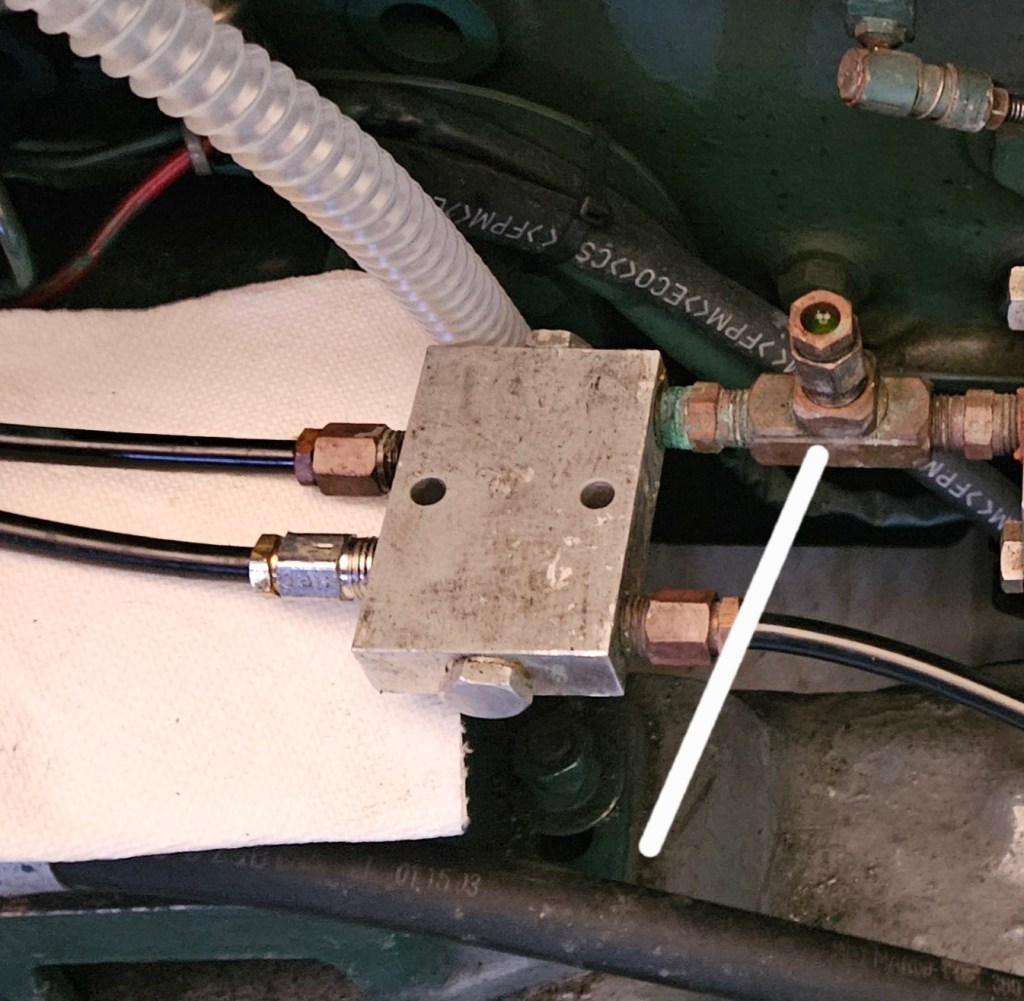
2) The Charging Block – this block distributes the fluid to the 2 Trans shift systems & 2 throttle systems. By great design – all 4 systems are separated hydraulically from each other. If one system fails, the others are not affected. There are 9 hydraulic lines going into/out of the charging block – 4 trans lines, 4 throttle lines, and 1 supply line from the fluid Resevoir. The line with my finger & the line directly across, are the 2 lines involved in our problem – the Starboard Throttle.
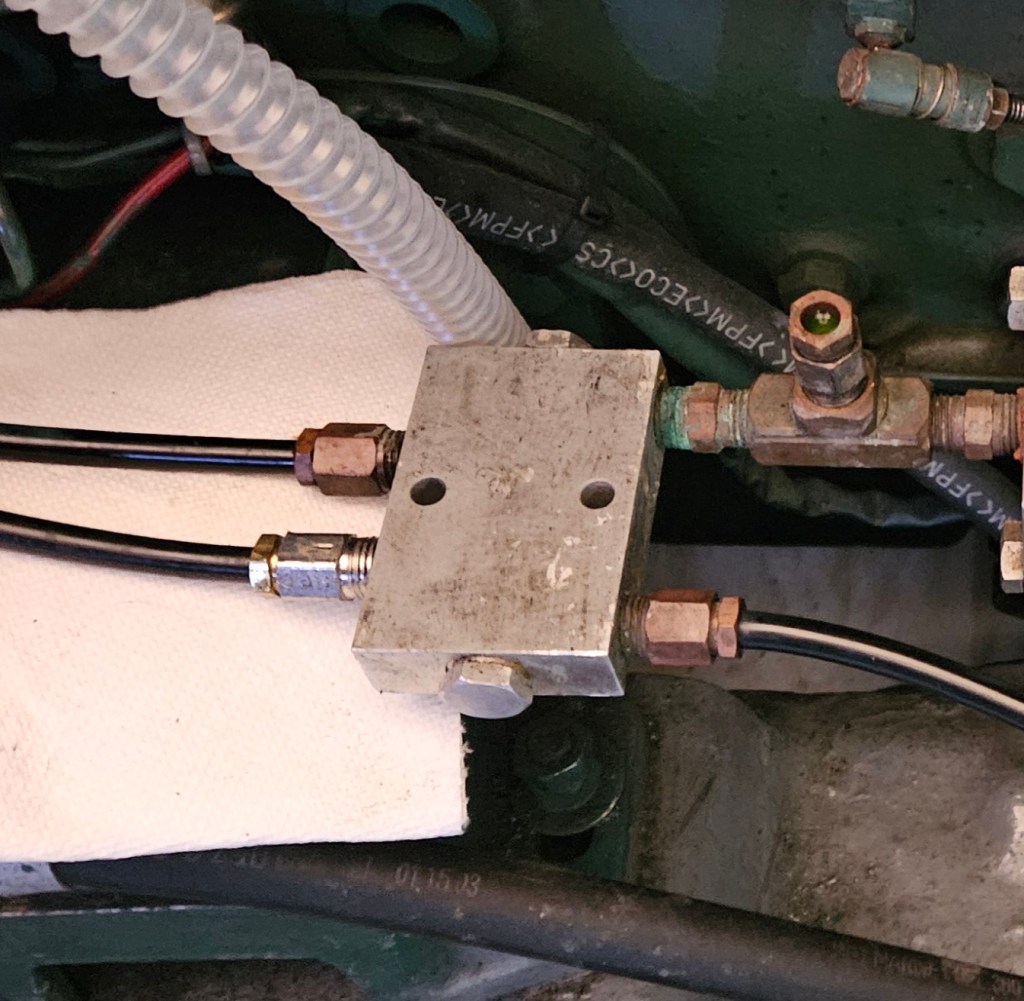
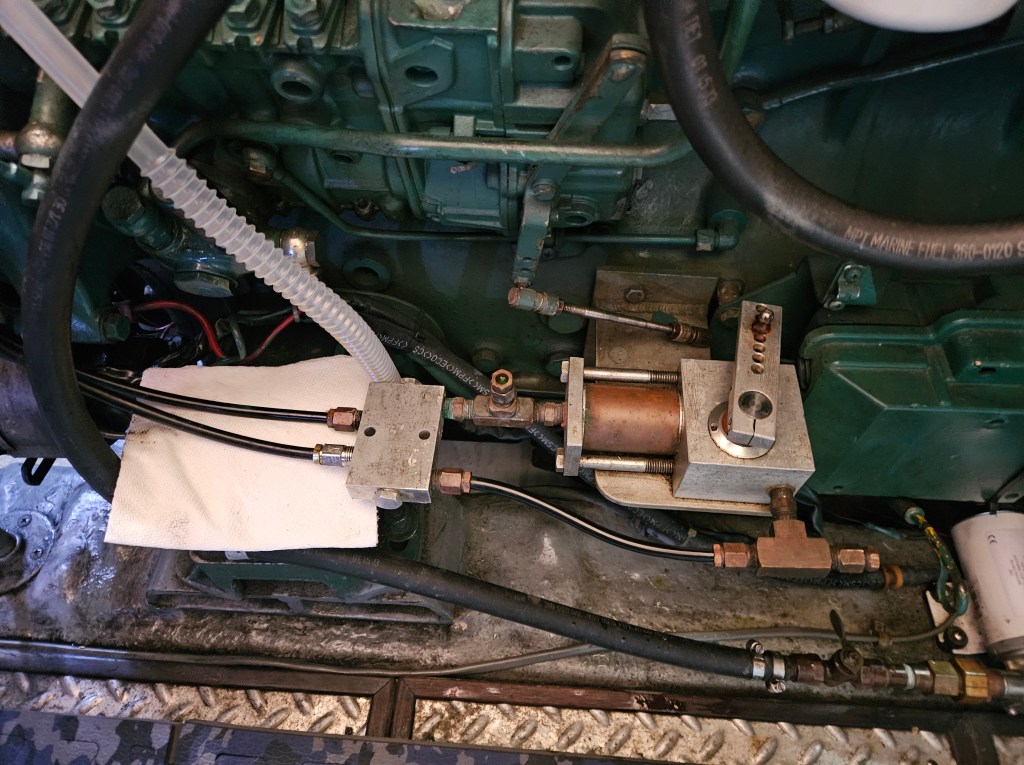
3) The Throttle Slave “Lock Out Valve” –
This is the part that Gary from Marine Systems Controls said has gone bad.
The primary function of the STV-10 is to prevent unwanted engine retardation caused by heavy-duty governor springs or vibrations. OK- I don’t really understand this either, it sounds like it is a buffer Bergen the engine and throttle control systems.
The STV-10 locks the throttle slave’s arm, allowing it to be moved only by the sender (the sender is the throttle). This means that the throttle position is held in place by the control lever at the helm and is not affected by forces like engine vibration or the opposing force of the governor springs. This valve/block helps to isolate the throttle slave assembly from external diesel engine forces, that could affect the throttle position. It helps maintain a more precise engine speed control.
This may be good when it works properly, but seems like a terrible design when it fails.
Here is what the Google search result says – ultimately, the most serious consequence of a locked STV-10 is a loss of precise control over the engine’s throttle, potentially affecting the vessel’s maneuverability and speed.
The 2 lines on the LHS are from the Charging Block & Helm, the 2 lines on the RHS go to the Throttle Slave Assembly.
4) The Throttle Slave Assembly – this unit does all the hard work. It receives hydraulic fluid from the helm throttle lever, thru the Charging Block, then thru the Lock Out Valve, and turns the hydraulic fluid movement into a mechanical force, moving a lever that is connected to the engine throttle. Note – the throttle lever is disconnected from the Slave Assembly in this photo.
Now that we have all the components, let’s discuss our last 3 days.
Mon – 16th = we found the Slave Assembly frozen up, it would not move until we removed all the air & hydraulic pressure. And then it took a lot of force to move the throttle lever & piston.
Tue- 16th = So we thought we had an issue with the Slave Assembly. We found a company in San Diego that would rebuild the Slave for $500, but their 2 techs were on vacation until Thursday.
We found a local hydraulic guy that tried to help. He replaced the piston O-Ring & and retaining nylon Rings for $50. I thought the rings seemed loose, and the hydraulic guy agreed. Could this lock up a throttle, IDK ?
We returned back to the boat, installed the Slave with new rings, and began bleeding the system. After 1 hour of bleeding, we gave up for the night. Reminder – the original system bleeding that worked for 10 miles, also took a long time before it worked correctly.
Wed- 18th = We again tried more bleeding, and as we got further into the process, one of the 2 bleed ports began to flow really slow – OMG, what did we do !
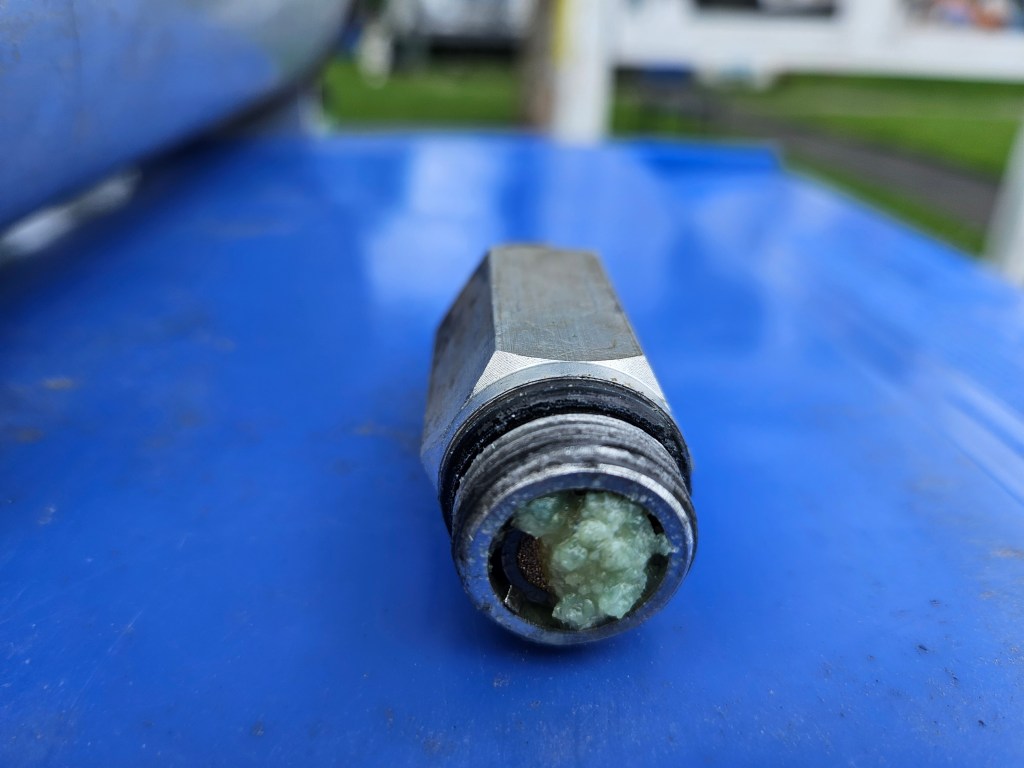
Here is a photo of 1 of the 2 bleed ports.
So now we’re thinking “what have we done”, we have created contamination and blocked a port or valve in the system. How are we gunna find the blockage, how are we gunna clean the system without compressed air, we’re gunna have to disassemble the entire system, clean it, and bleed all over again.
After 30 minutes of panic, we settled down and began to make MORE phone calls. One of the calls that Jerry made got us to a second guy that turned out to be our savior (well 3rd place to God & JC).
Gary Thornsburg, out of North Carolina – Marine Control Systems, was the guy we needed the last 2 days. He knew everything about our Hynautics Throttle Control System.
After describing our initial problem and current status of no flow from the one bleed port, Gary told us the following –
Issue #1 – The original problem of the stuck throttle was not the Slave Assembly, it was in the Lock Out Valve. Remember that it’s purpose is to hold the throttle in position to counteract engine governor spring & vibration forces. In this case it “Locked Out” the throttle from talking to the Slave Assembly. This “lock-up” continued until we released the air & hydraulic pressure.
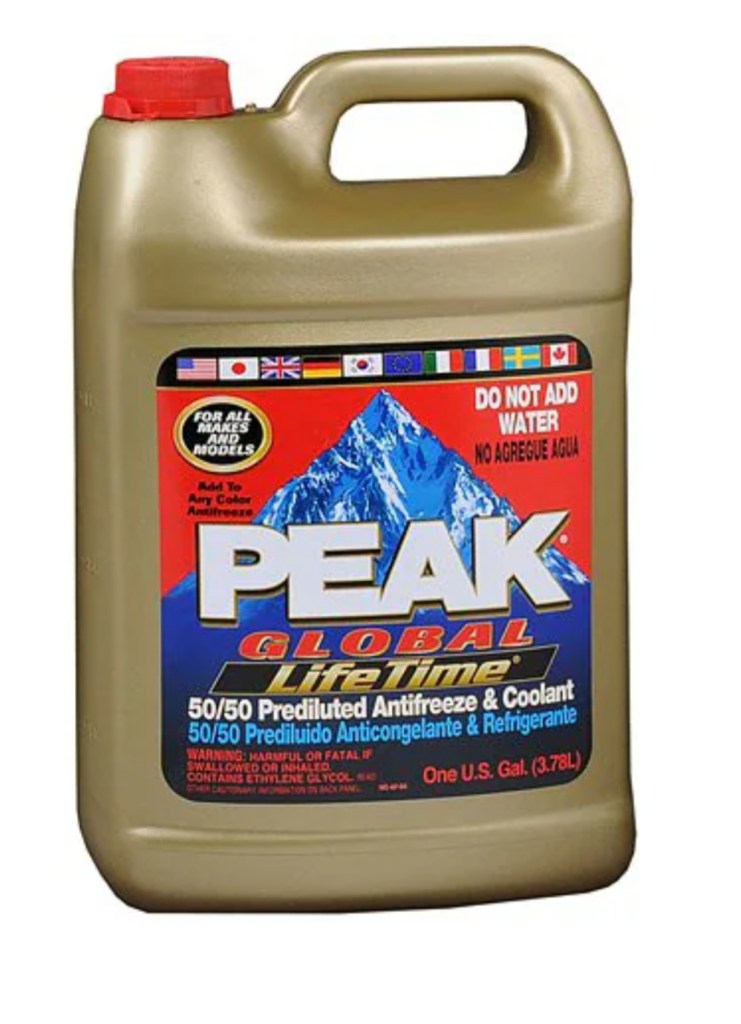
Issue #2 – Our lack of flow during last bleeding bleeding process was due to coagulated fluid collecting at the resevoir filter, from using an incorrect antifreeze in place of the no longer available Hynautic fluid. The other throttles and trans shifters were working due to the 100 psi pressure in the system, but potentially could have been shortly behind the starboard throttle, due to the restricted flow. Here are some photos of the Resevoir Filter & the Resevoir Tank that holds all the fluid (ok Dave Sylver, you had hinted about this). There is also a photo of the recommended replacement fluid for the Hynautic system to prevent the coagulation.
Note – this coagulation takes months or years of time to occur.
So back to The Root Cause of the throttle not being allowed to return to idle. Gary is sure, that the root cause is a bad Throttle Slave ” Lock Out Valve”. We were planning to UPS him our valve to be rebuilt, but as luck would have it – Gary had “1 NEW Lock Out Valve” left. It was more expensive than a rebuild, but to save time we ordered the new valve (from Gary), we also ordered the correct fluid (from Napa), and both items will be here tomorrow.
Gary advised us that the other 3 systems ( 2 trans shifters & the port throttle, will not have to be bled, because the Charging Valve hydraulically separates the 4 circuits.
Keep your fingers crossed for us, we should get the part & correct fluid tomorrow.
We have been blessed every step of this journey, Gary was just the most recent and currently most important blessing to be sent to us.
Oh, BTW – we have had some really cool stuff going on at this very low-key small marina.
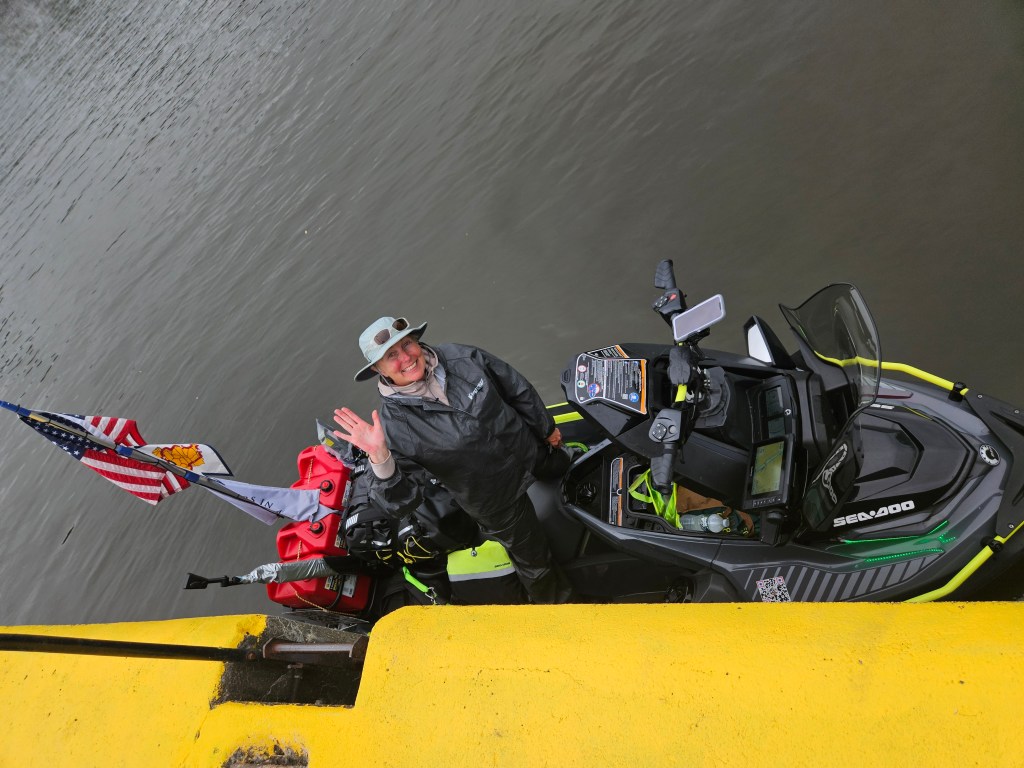
We had a woman on a Jet Ski – DOING AMERICA’S GREAT LOOP. I had heard about her in the AGLCA forum, and today got to meet her. Look at the 4 cans of Fuel & the Chart Plotter on her jet ski.
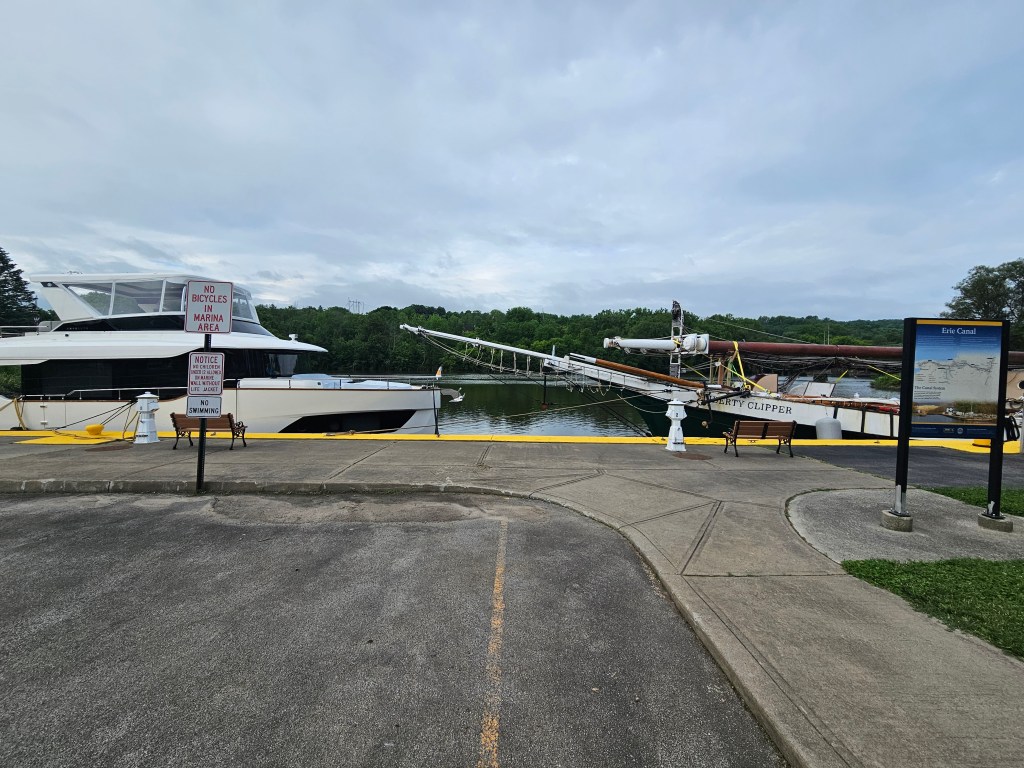
We also have a 125ft sailboat touring the eastern half of the USA participating in the Tall Ships shows, The Liberty Clipper.
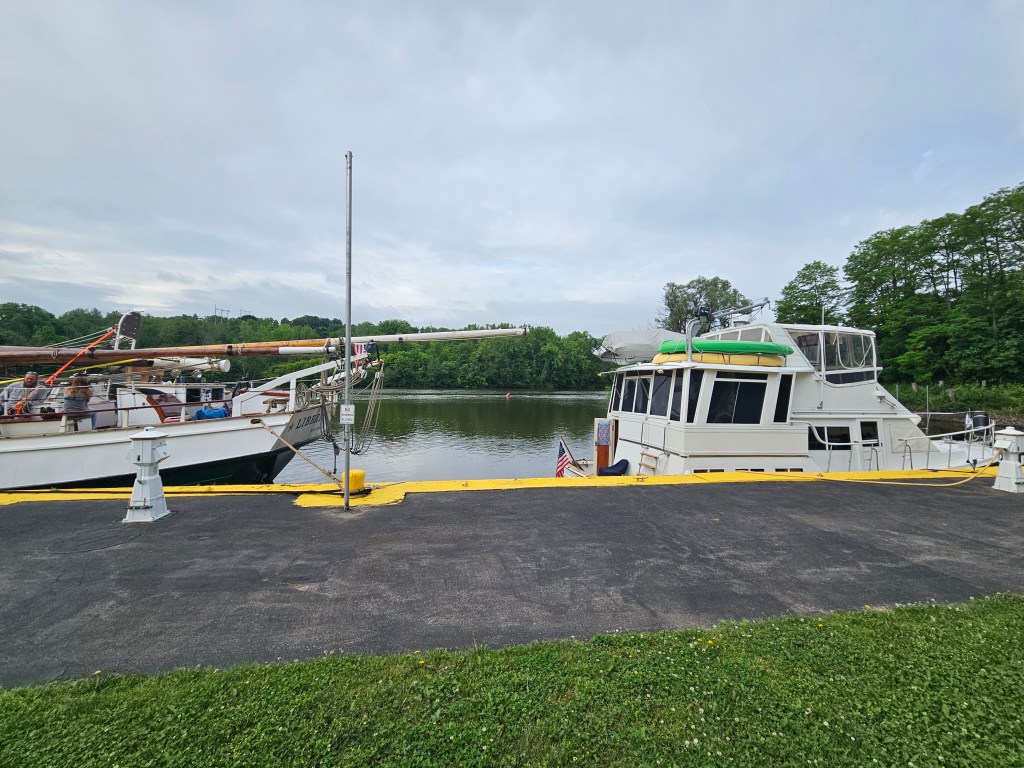
Harbormaster Frannie had told us the Liberty Clipper was coming prior to her arrival. In fact we had to move the Mahi forward to make room before the sailboat arrived. When the ship arrived, I thought that there was NoWay that she was gunna fit in the available space. The Captain did an incredible job at docking this vessel between two 40ft boats.
With only 1 engine and no thrusters. It was a very impressive docking . Look at how the forward and aft spires hang over the boat behind The Clipper, and over our Mahi in front.
That’s all for now, thanks for reading, wish us “LUCK” fixing our throttle issue and gettin back underway soon.
As we reported on the last post, the time has finally come to enter the Erie Canal.
Our infamous locks #16 & #17 finally opened up on Friday the 13th 😲.
Many Loopers at the Albany Yacht Club were planning on waiting until Monday, to hopefully let the rush/chaos of the initial boats, pass over the weekend.
The crew of the Mahi had other ideas. Saturday the 14th was gunna be a rainy/dreary day, all day. We knew that the poor weather would scare off many other boaters. But we still have fears that the locks 16 & 17 could again be shut down if the repaired embankment fails again with the ongoing rain.
So our plan is ; Saturday =Locks 1-7, Sunday=Locks 8-15, Monday=Locks 16/17/18.
Today, Saturday the 14, as predicted – the weather was salty & the boat traffic was indeed very low. We were the 2nd boat at Lock #1, and only had 5 other boats to travel with thru the first 7 Locks. It was a great plan to start the Locks today, and a great day.
The scenery on the Erie Canal was very cool, sometimes making you feel that you were thousands of miles away on the Amazon River.
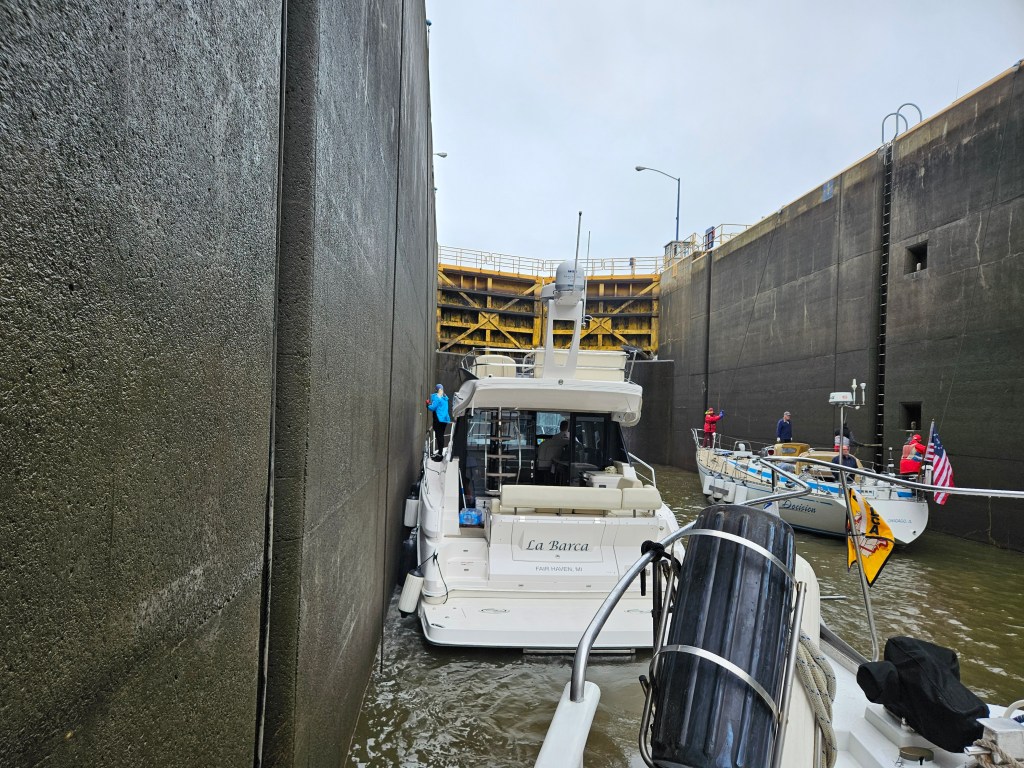
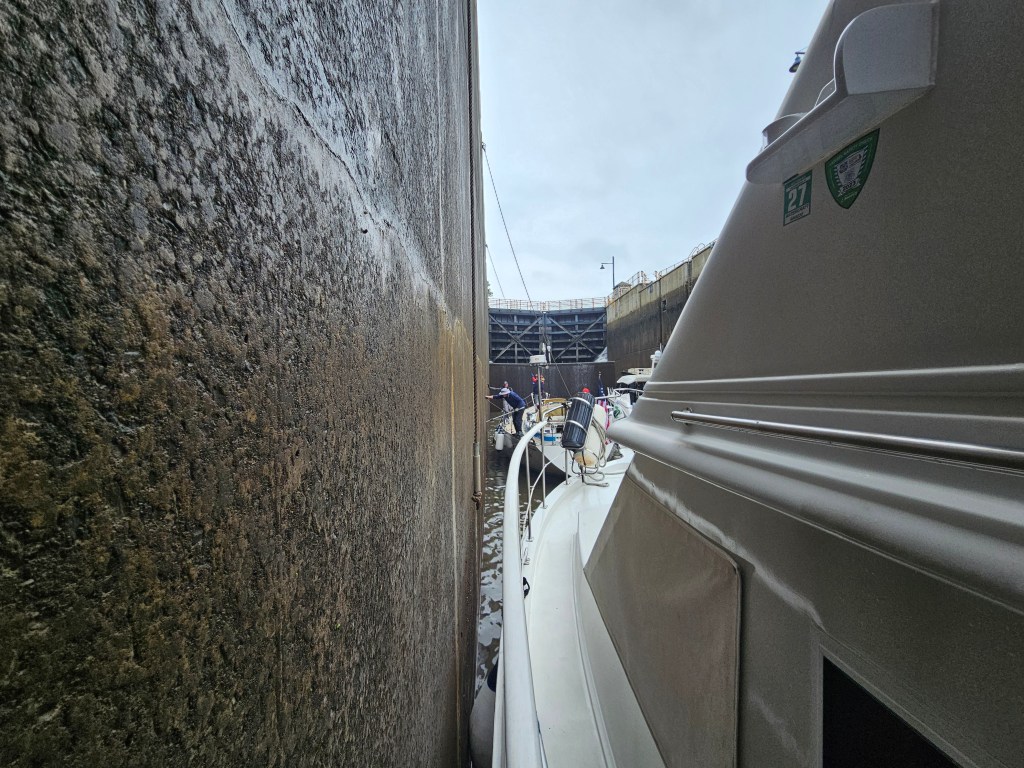
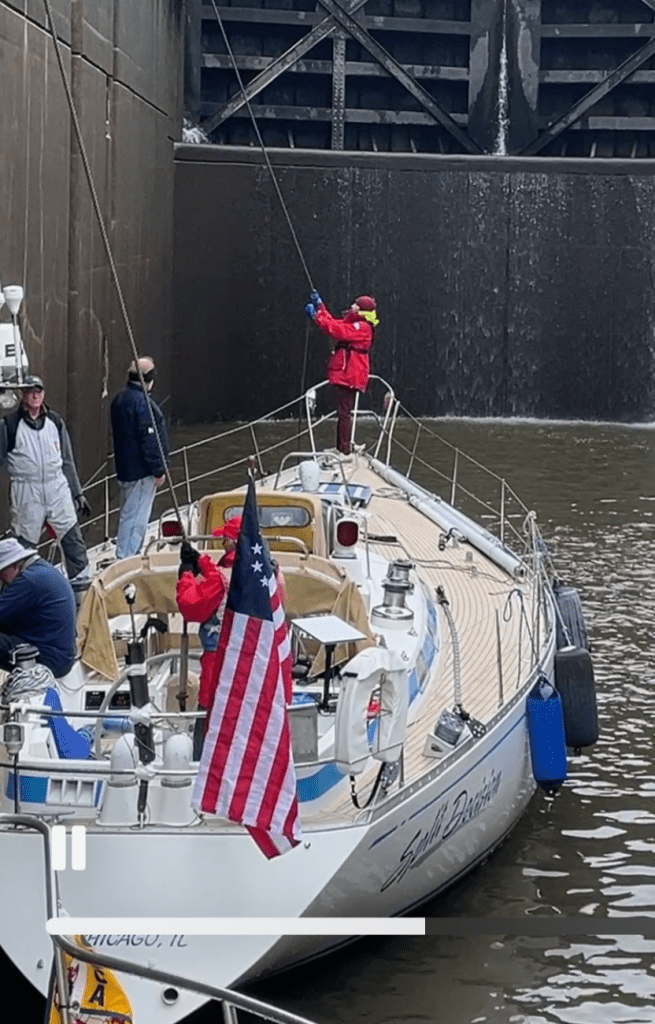
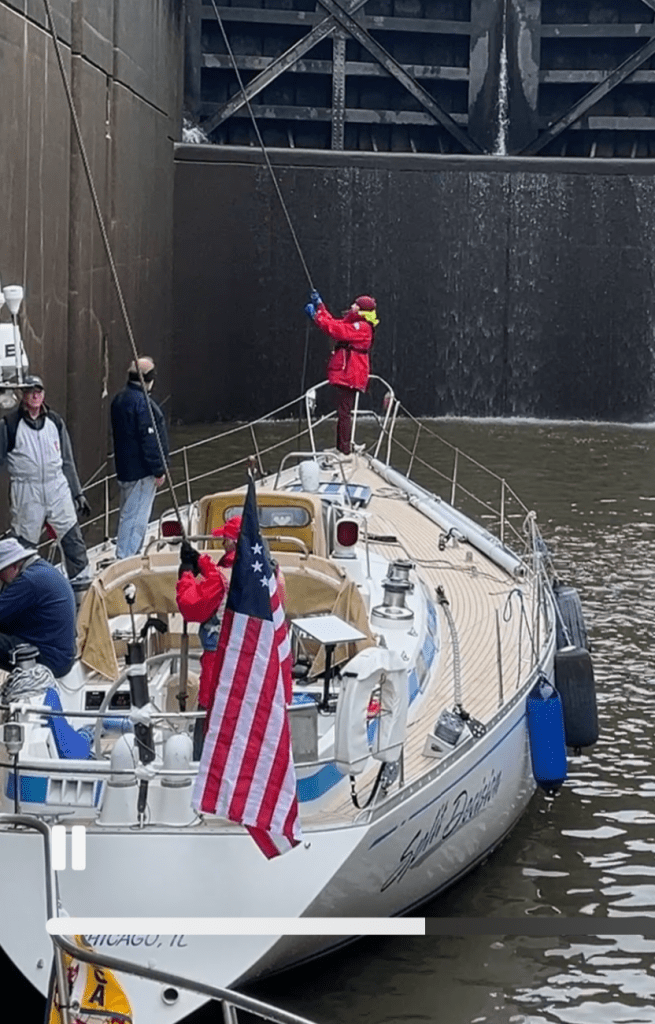
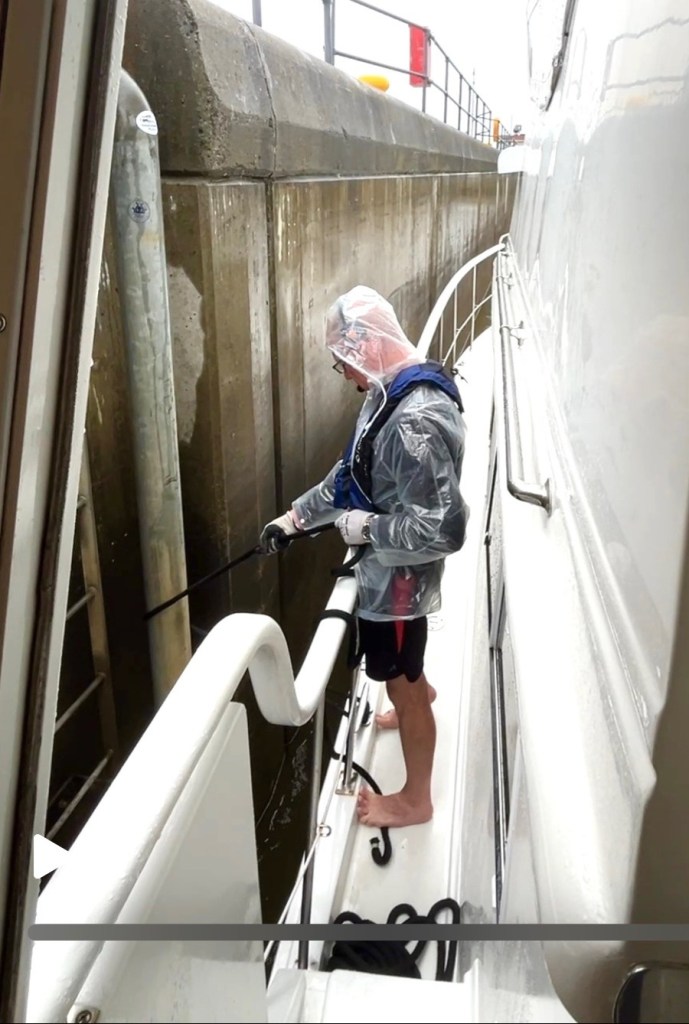
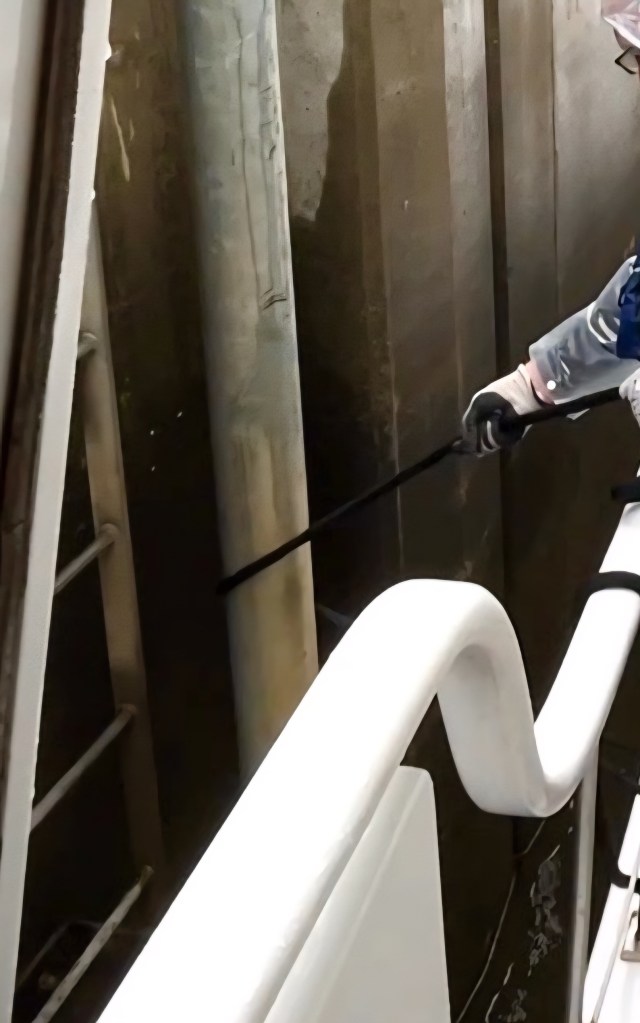
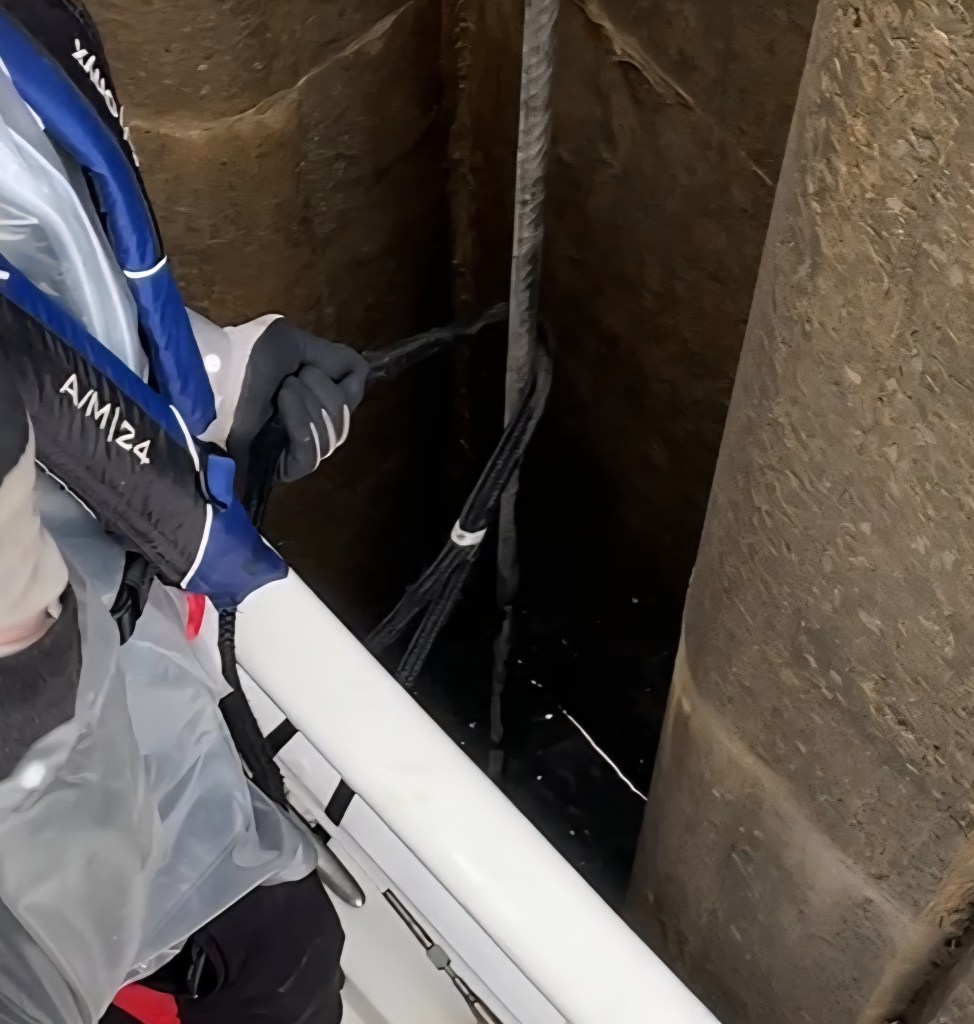
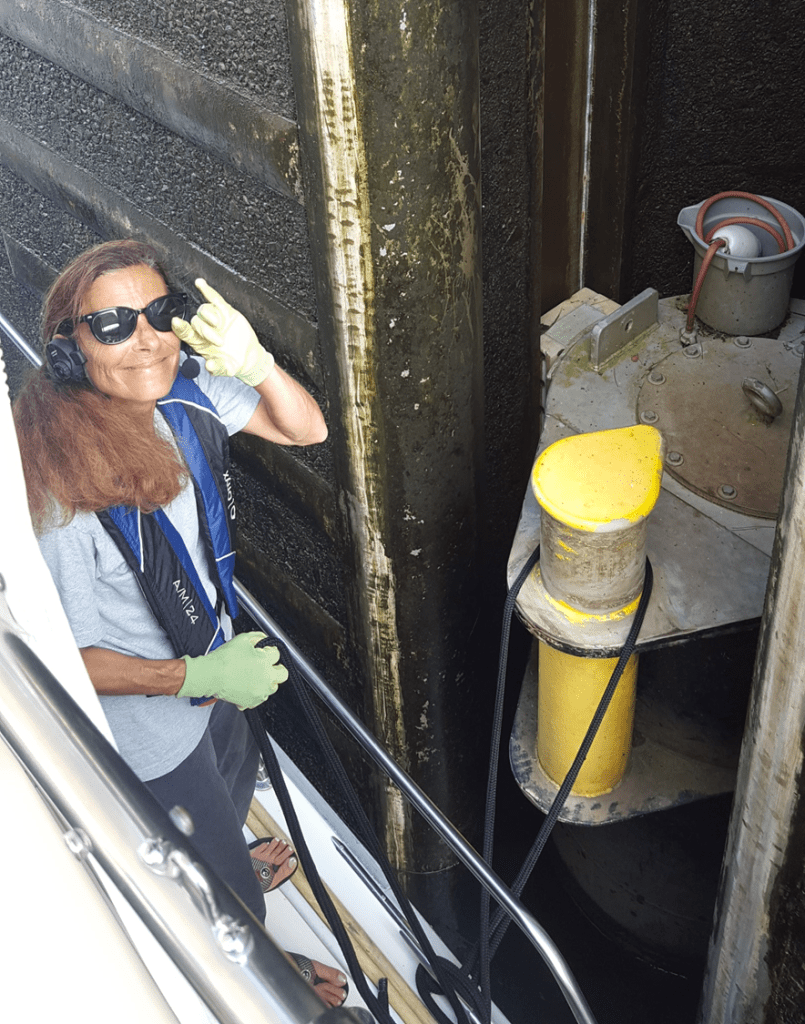
Back to the Locks, here are some action shots. The first photo is in a short 8ft lift Lock (wood doors). Photos 2/3/4 are all in a 40ft lift Lock (steel doors).
In the following video, water is filling, coming up about 40ft
Since we are starting to go thru a lot of Locks now on the Erie Canal & Later on the Trent Severn Waterway – it seems like a good time to talk about Locks and what you have to do when traveling thru a Lock.
A waterway Lock is essentially transporting you between 2 bodies of water at different heights. As we mentioned in the last blog, Lake Erie is about 500 ft higher than the Hudson River. If there were no locks, the Erie Canal would be good for White Water Rafting.
There are about 4 different ways to tie up in a lock – 1) Drop Cables, 2) Poles , 3) Steel Cables, & 4) Floating Bollards. These 4 methods exclude some very special Locks called The Peterborough Lift-Lock & The Big Chute Railcar Lock both on the Trent Severn Waterway in Canada.
Drop Cables – they are just lines hanging from the top of the Lock with weights on the bottom. You simply use an extension pole to pull the drop lines towards the boat, then hold on as the water level goes up/down.
2) Drop Pipes/Poles – they are like they sound, just a pole recessed into the Lock wall. You pull up to the pole and wrap your docking line around the pole and hold on while the waters goes up/down, letting the dock line slide up the pole.
ScreenshotScreenshot
3) Steel Cables – they are similar to Drop Pipes, but are 1″ thick steel cables that go from the Top to Bottom of the lock. Just like the Pipes, you simply wrap your docking lines around the Cable and hold on, letting the dock line slide up the cable.
4) Floating Bollards – they are a big posts recessed into the lock wall that go up/down with the water level. You simply wrap your docking line around the bollard and hold on. The advantage to this Lock device is that the bollard will raise up with the water level, so you can actually clete the line during the ride.
The Peterborough Lift-Lock – It’s like 2 big trays of water on a teeter totter. To articulate the lock, they pump in 1 foot of extra water into the top tray & the valves in the lock lower the top tray and raise the bottom tray. Your boat is in the tray of water. In the photo below, we are driving the boat into the lower tray & you can see the piston of the top tray holding it at the higher water level. We will do this with the Mahi in a few weeks Lift-Lock Video = https://youtu.be/CWLnukSTvRY
Finally , The Big Chute (the most exciting lock for me) – it is essentially a Railcar that picks your boat up on straps, and transports your boat from one body of water, ACROSS LAND ON A RAILCAR, to another body of water. It is an amazing Lock. We will also do this Lock in the Mahi in a couple weeks
Well, that is your lesson on Locks for today, hope you enjoyed it.
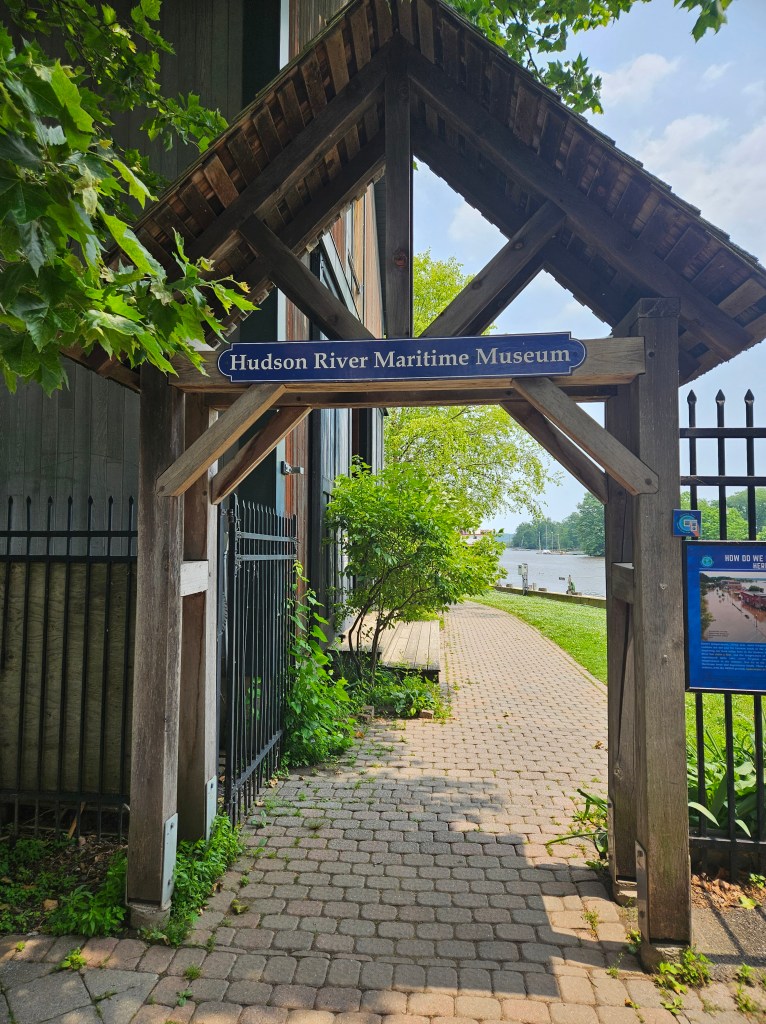
Thursday June 12th, we traveled 54 miles from the Hudson River Maritime Museum Marina to the Albany Yacht Club.
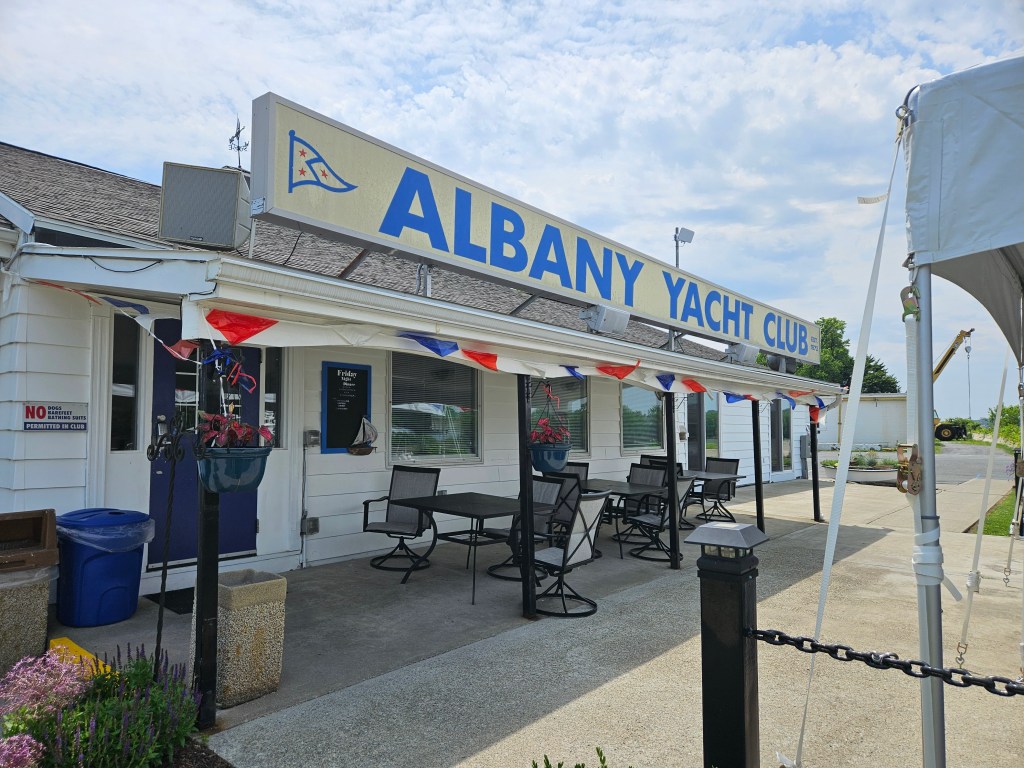
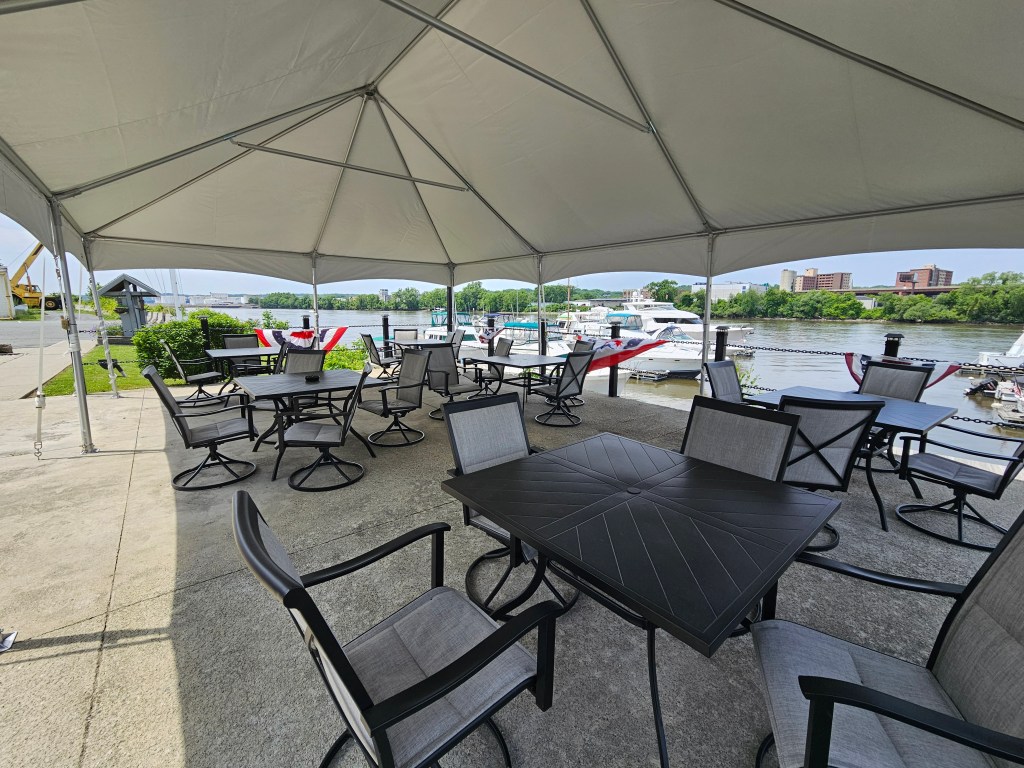
Unlike Marlboro, the Albany Yacht Club is a somewhat sleepy place, no big greetings from the Commodore here. But the harbormaster Ron was a great guy, and helped us get fueled & safely into our slip under somewhat high winds & no dock pilings between you and your neighbor boat.
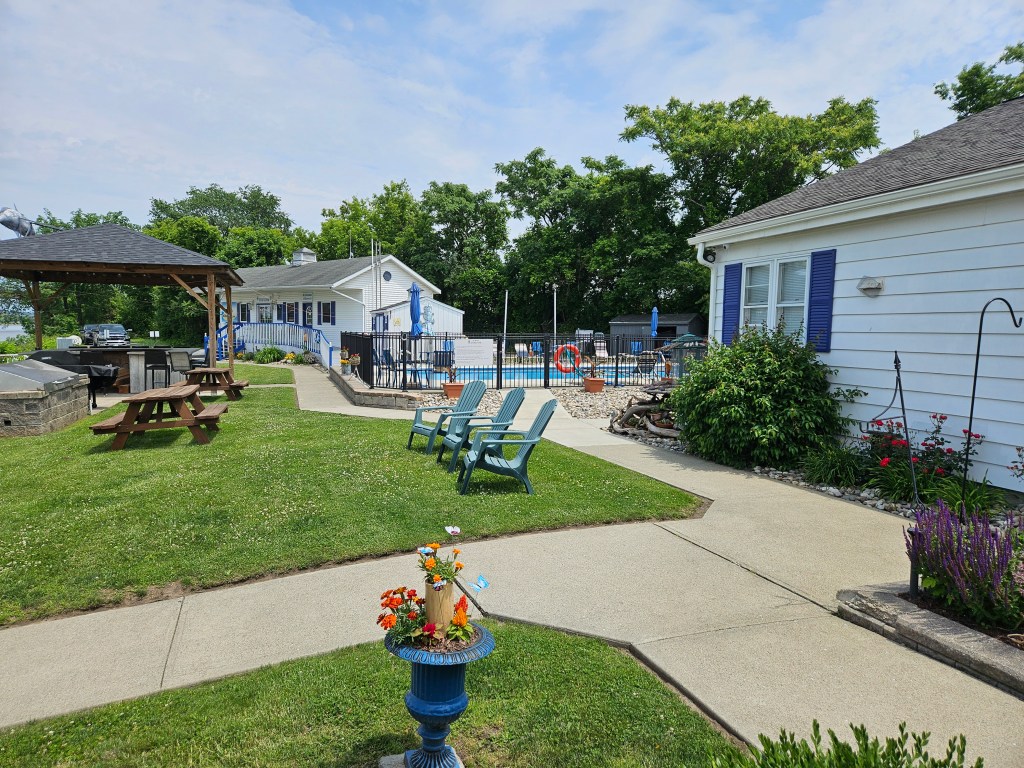
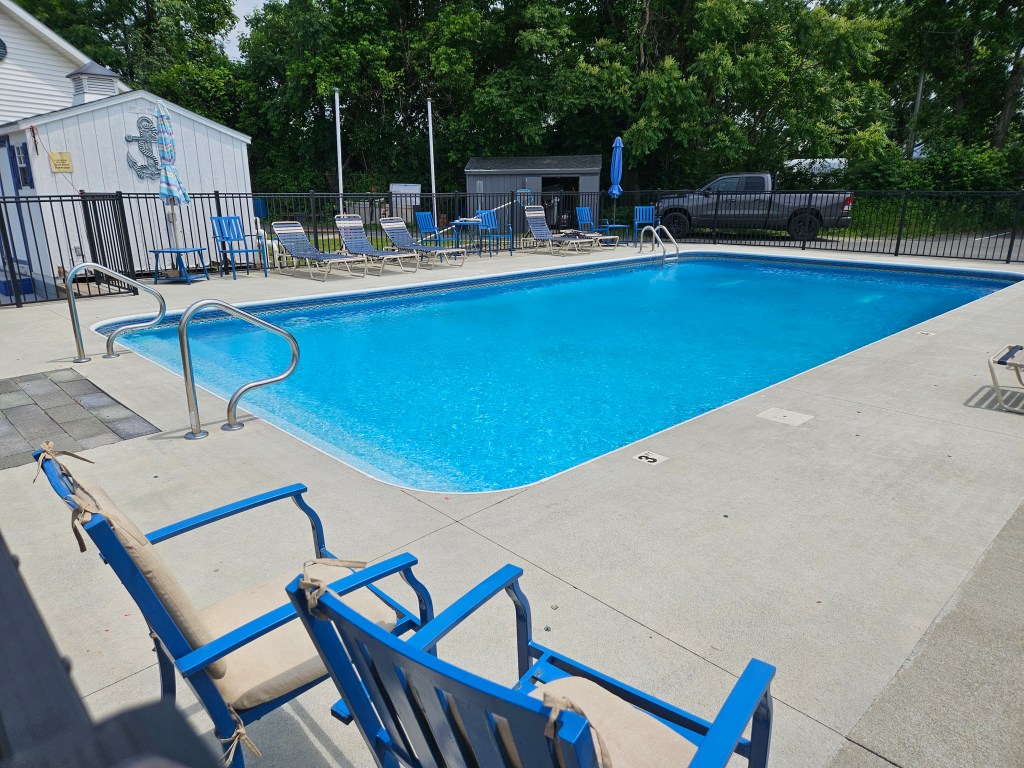
The Yacht Club is very pretty, has a nice pool, and supposedly great stuffed pork chops this Friday night.
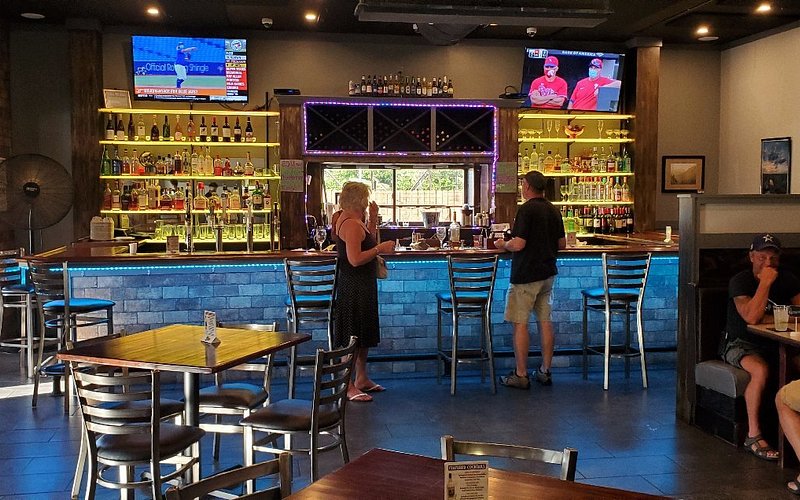
After getting settled in, doing some laundry, and cleaning up a bit – we strolled into town to a place called the Illusive Restaurant. It was not that illusion, because me & Jonell had been there in 2018. When we entered, we saw a guy at the bar from the Yacht Club named Dave. So we shinnied up to the bar and ate there. Dave was an awesome guy and bought the first round of drinks for us.
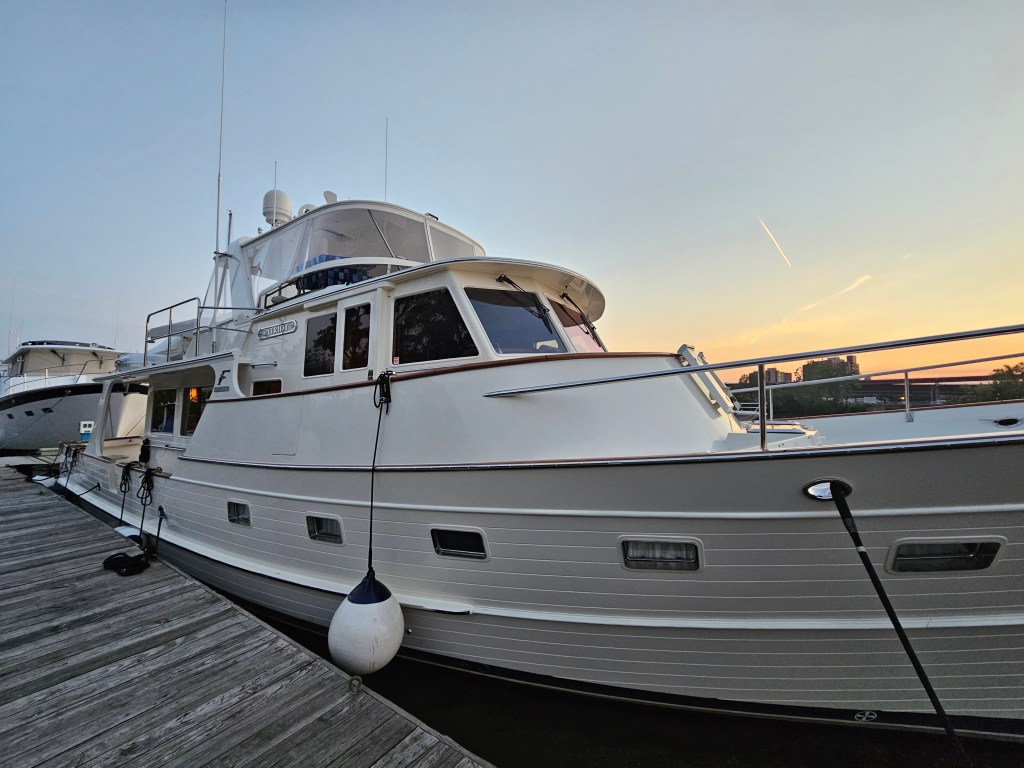
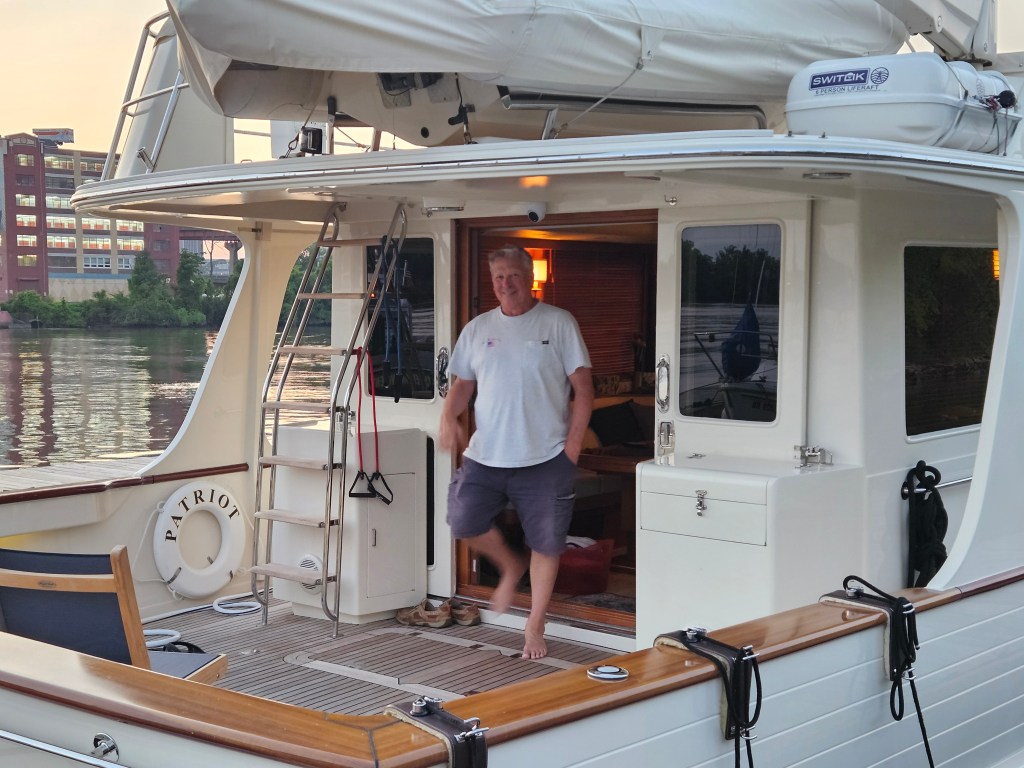
After dinner I had a special treat. I was able to hook up with my investment broker’s neighbor Steve Murdock & tour his beautiful 55ft Fleming. Kind of a strange story, but my broker Randy Eschels is following our trip. Randy’s next door neighbor in Bloomfield Hills Michigan is doing the Great Loop – his name is Steve Murdock. So a couple days ago Randy attempted to hook us up. As luck would have it, we both ended up at the Albany Yacht Club at the same time. To further amplify the coincidence, while getting to know Steve, I found out that Steve is also good friends with my Detroit Power Squadron pals – Vince & Delphine Cooley. Steve/Vince/Delphine are all members of the Great Lakes Yacht Club in St Clair Shores Michigan. Once again we find out that “IT’S A SMALL WORLD” in the boating community.
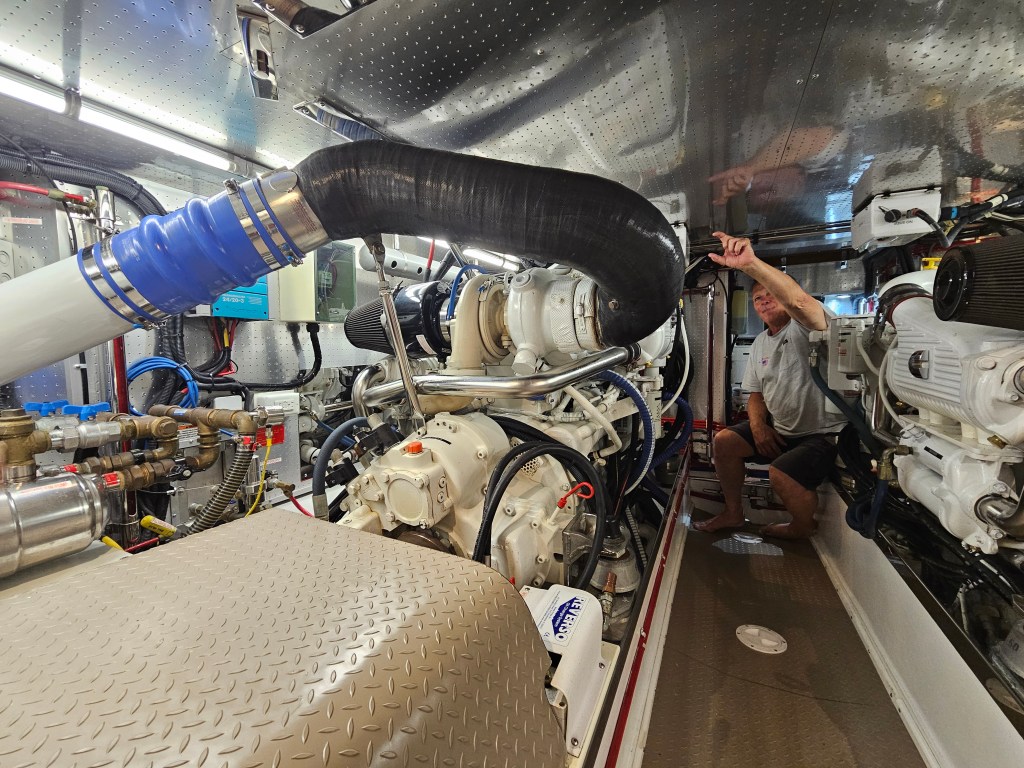
I spent about an hour on Steve’s beautiful 55ft Fleming Yacht – getting to know Steve, drinking Tequila, & touring the boat. The boat is beautiful, but the engine room is spectacular !!!
Ok , time for The Big News Update. We had heard rumors yesterday & confirmed this morning (Friday the 13th 😲), that the ERIE CANAL LOCKS #16 & #17 ARE NOW OPEN !!!
Fire up them motors, it’s time to roll on. We have a very aggressive schedule over the next few days, because they’re is always the ongoing risk that the locks could close again if the fixes to the embankment between Locks #16 & 17 leaks to much.
So our plan for the next 3 days is ; Sat = Locks #1-7 (7 Locks, 31 miles), Sun = Locks #8-15 (8 Locks, 50 miles), Mon = Locks #16/17/18 (3 Locks, 20 miles).
You may ask – why not just do a very long day and go from Lock #1 to Lock #17 ?
The answer is that going thru Locks & bridges that have to be raised, is a very time consuming process. Our 7-8 locks per day plan, will be full 8 hour days long. And you have to coordinate marina or anchorage stops along the way & the options are much less than on the Hudson River.
That’s all for now from Albany NY.
Oh, BTW – we did have the Stuffed Pork Chop at the Club tonight. It was very good. We were also treated to enjoy our dinner with our new Looper friends Ted/Beth from Wastin’ Away & Steve from the vessel Patriot.
This will be a long post covering 3 days of our expidention, so read it when you are bored and have nothing better to do.
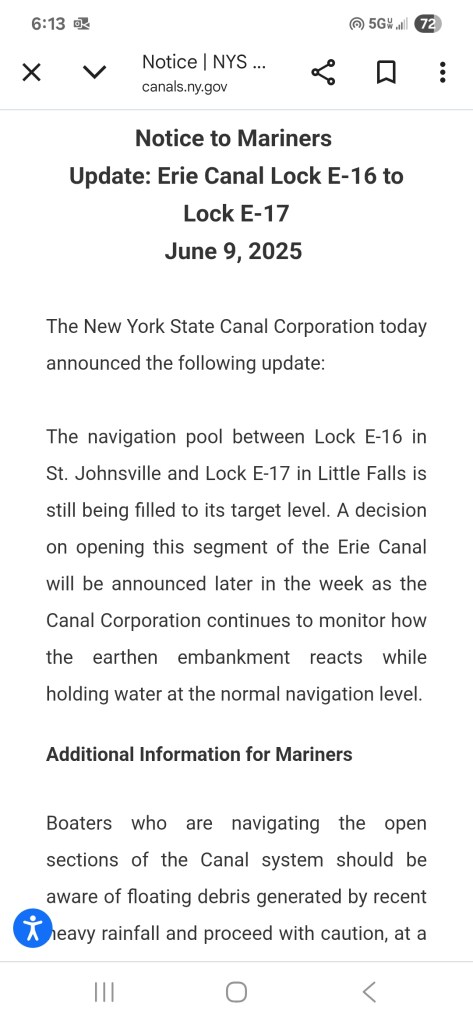
Today (June 9) was the day we had been waiting for – will the Erie Canal Locks #16/17 open up soon ?
Guess what – they made an announcement, that the announcement would be delayed.
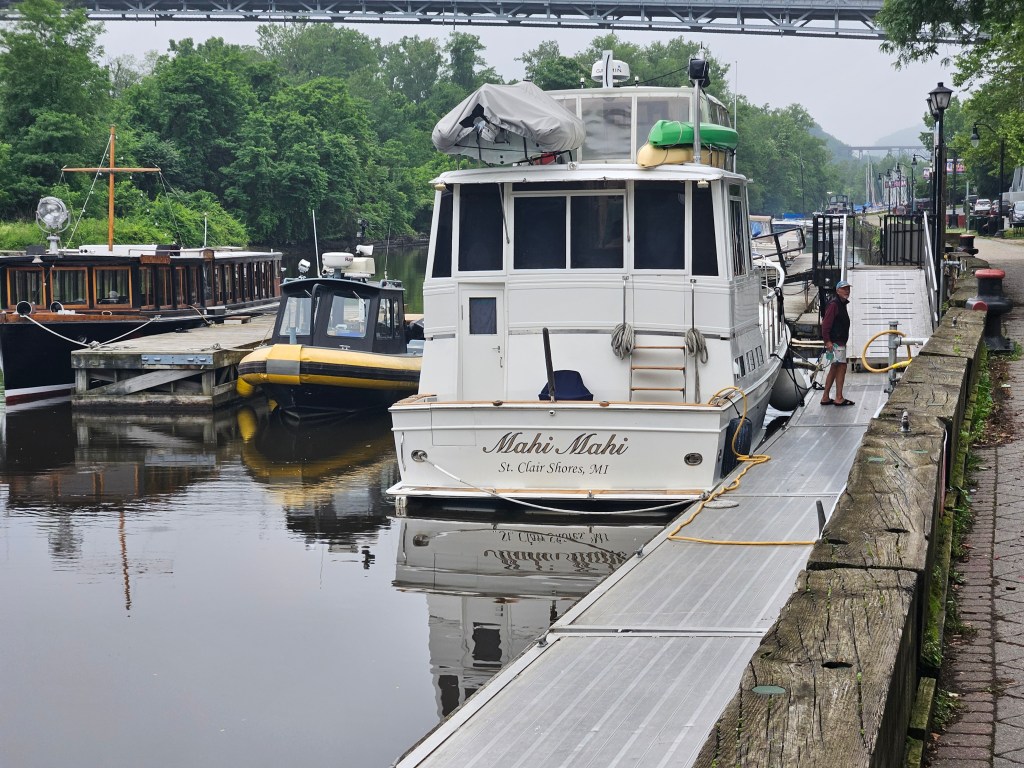
We were very sad to leave our friends from Marlboro Yacht Club, but we have to try to keep pressing on northward. So we called several marinas in Kingston NY. With all the Loopers starting to get bunched up, we were luckily to get 1 night at the Kingston City Dock & 2 nights at the Hudson River Maritime Museum Dock.
Prior to departure from Marlboro Yacht Club, in addition to all the great services they supply, they also have a great self/ serve Pump Out Machine 😃. It is simply my favorite thing to do in all of boating.
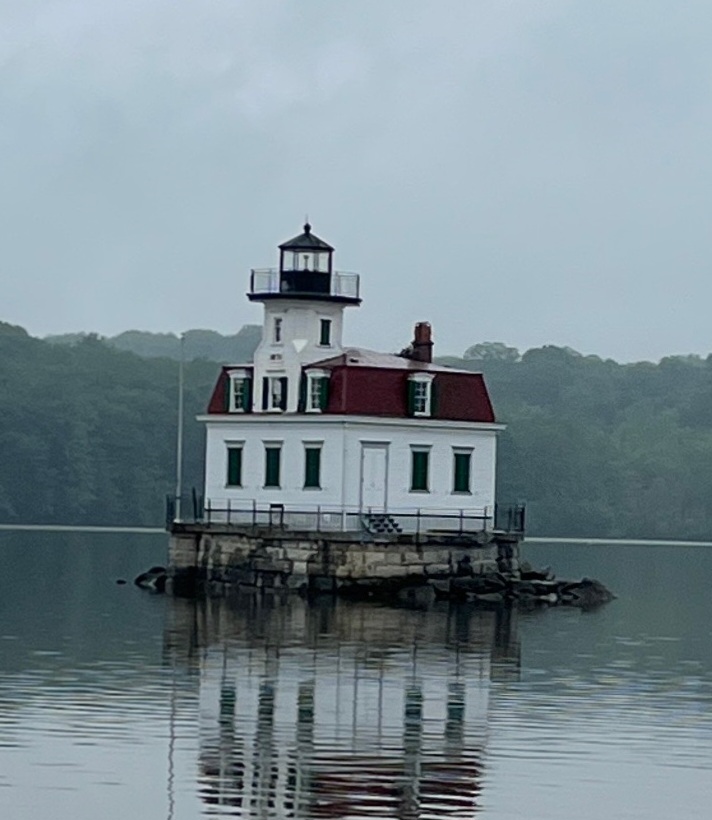
Our ride up the Hudson River was Rainy & very Hazy, visibility was only about a mile. During the ride we came across this beauty. The Esopus Meadows Lighthouse.
A few Google clicks later = The Esopus Meadows Lighthouse is a historic lighthouse located on the Hudson River in Ulster Park, New York. It is notable as the last surviving wooden lighthouse on the Hudson River. The current structure was built in 1871, replacing a stone lighthouse built in 1837. The lighthouse was originally designed to guide ships navigating the shallow Esopus Meadows flats. The US Coast Guard took over operations in 1939 but closed the lighthouse in 1965 after installing an automated navigation aid.
We arrived in Kingston NY about 3:30pm, got all settled in at the marina, and then went for a short stroll of the quaint little town.
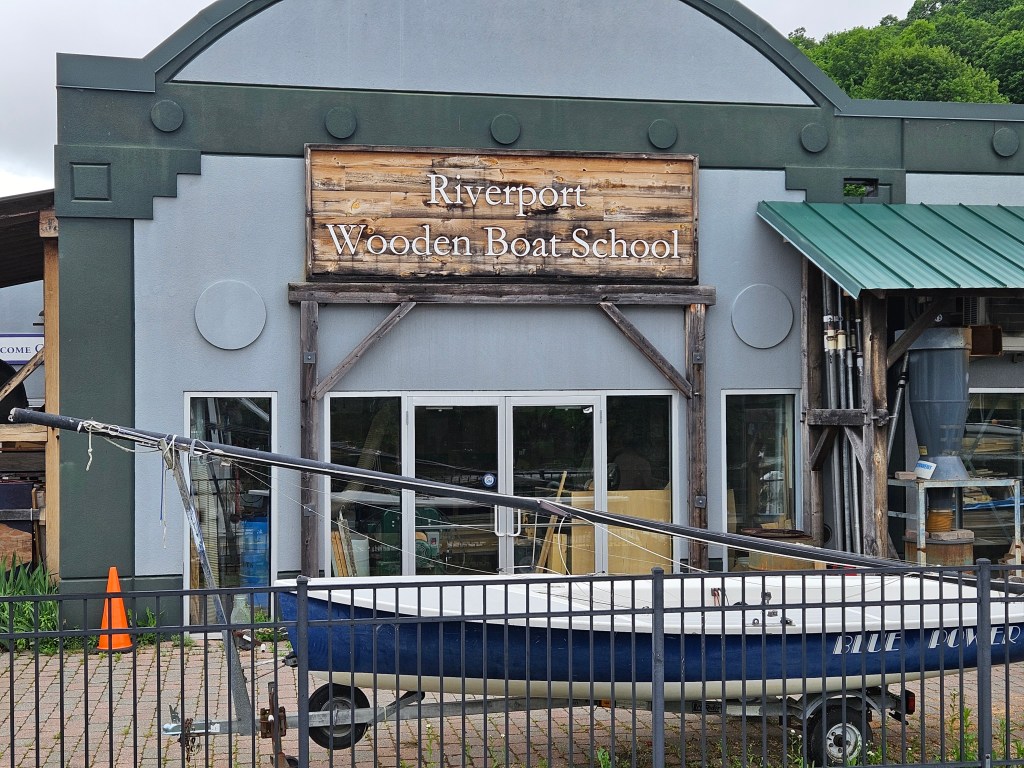
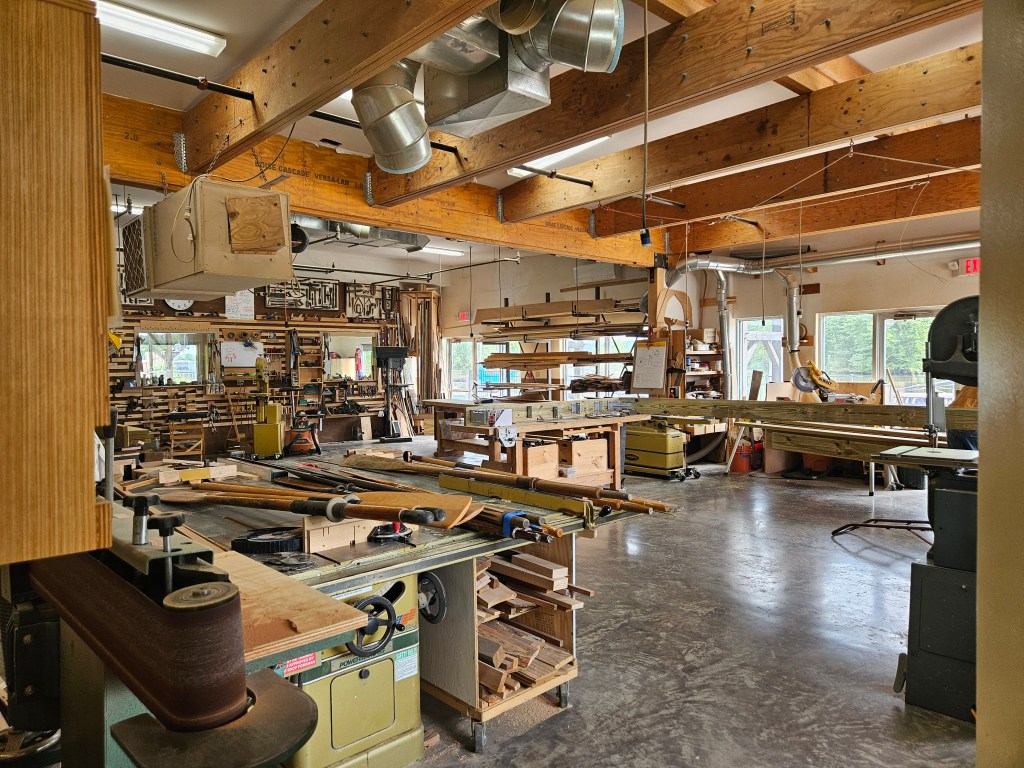
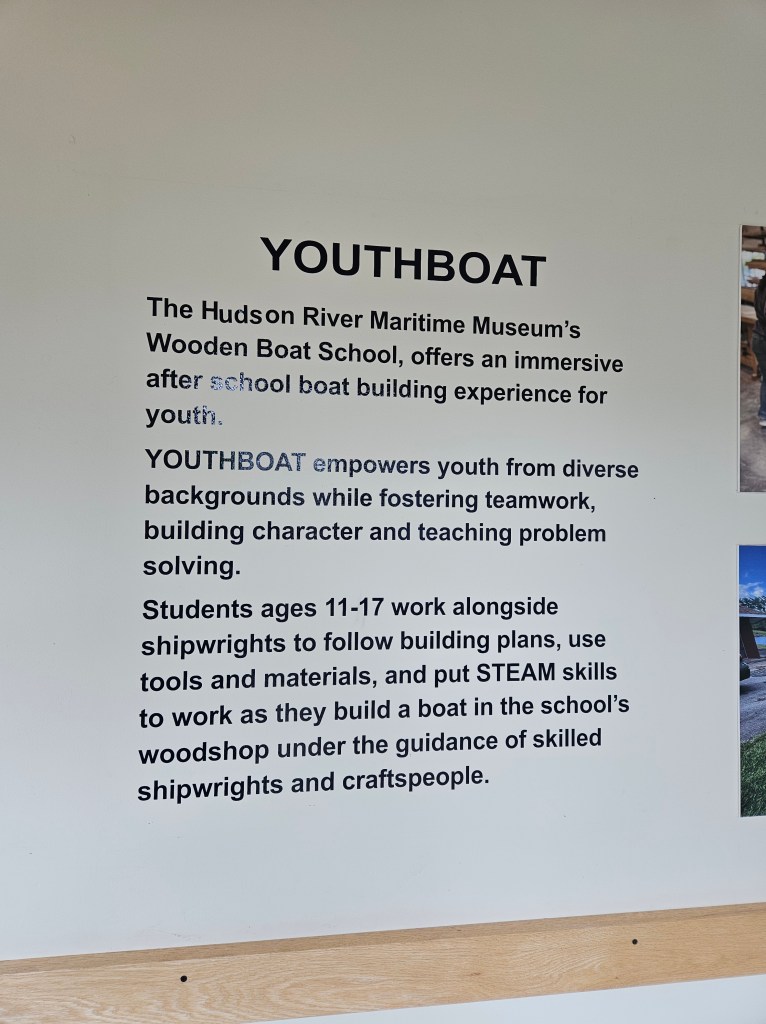
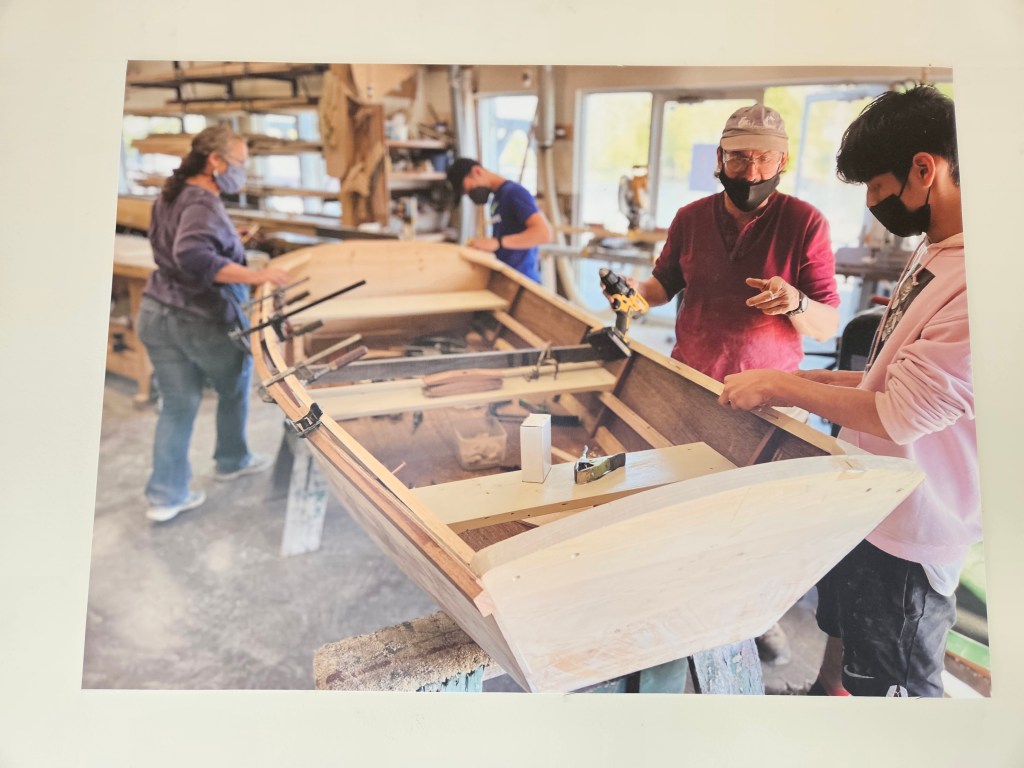
On the waterfront next to the marina, they have an extensive Wood Shop & actually run a Wooden Boat School, to teach young kids the art of making wooden boats. It appears that this town places significant value in teaching their kids about boats & boating.
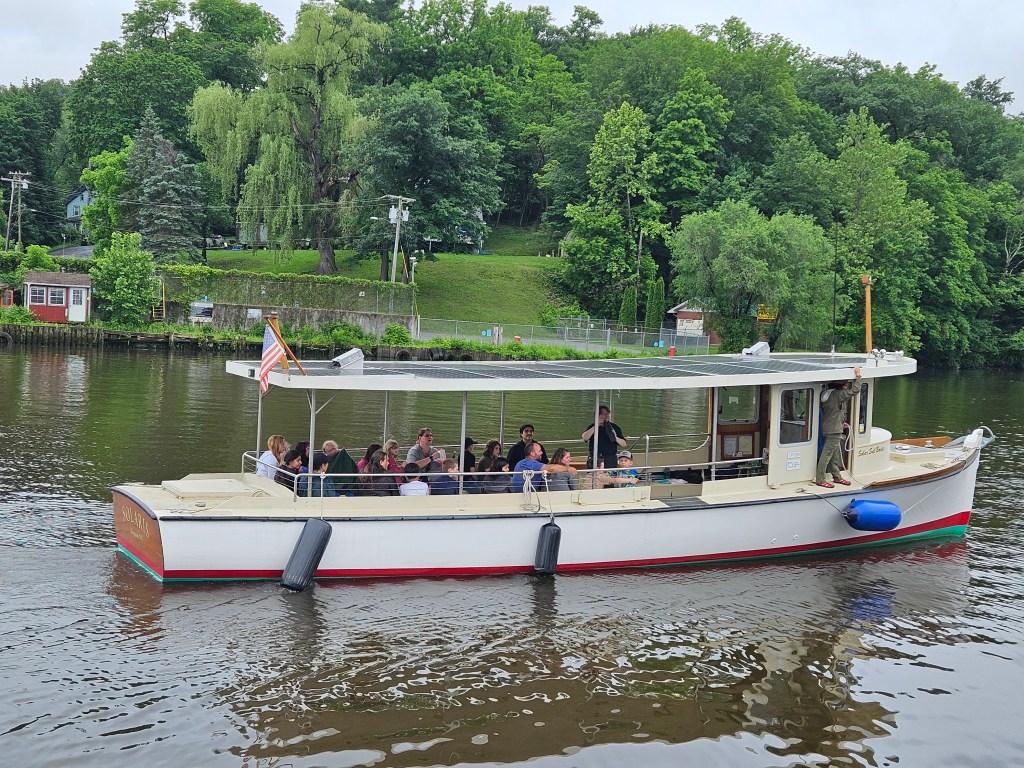
Our Harbormaster Jim, also takes the kids out for a boat ride on a solar powered vessel named Solaris, then takes them for a history lesson in the museum. Check out all the solar panels on top of the boat.
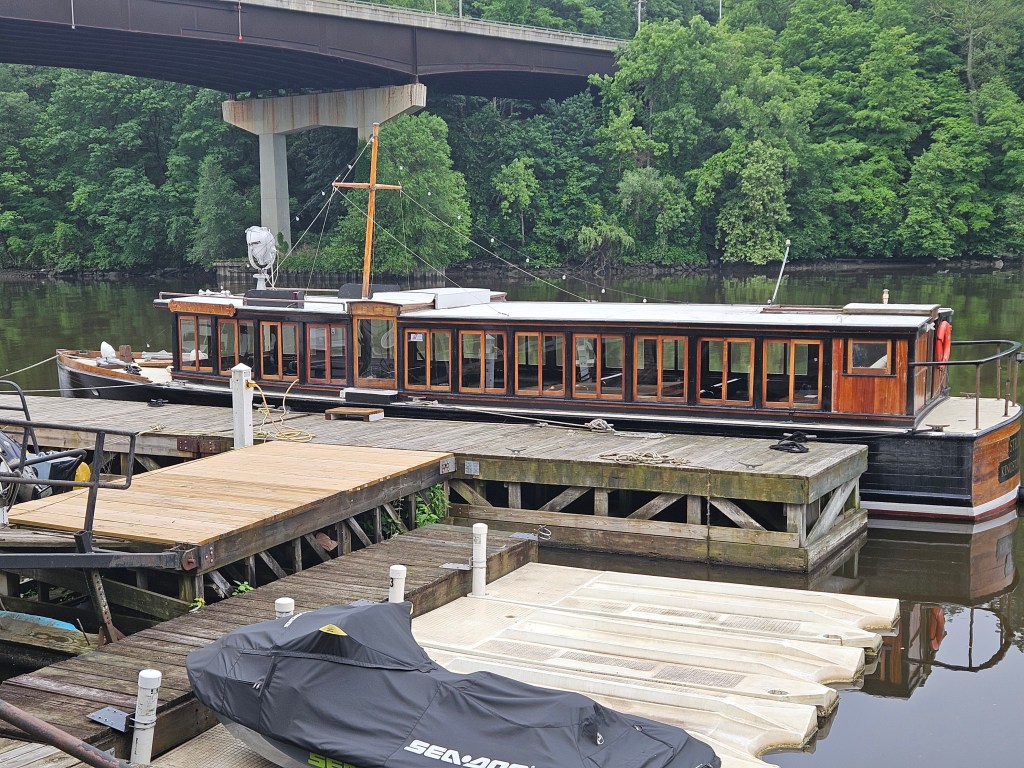
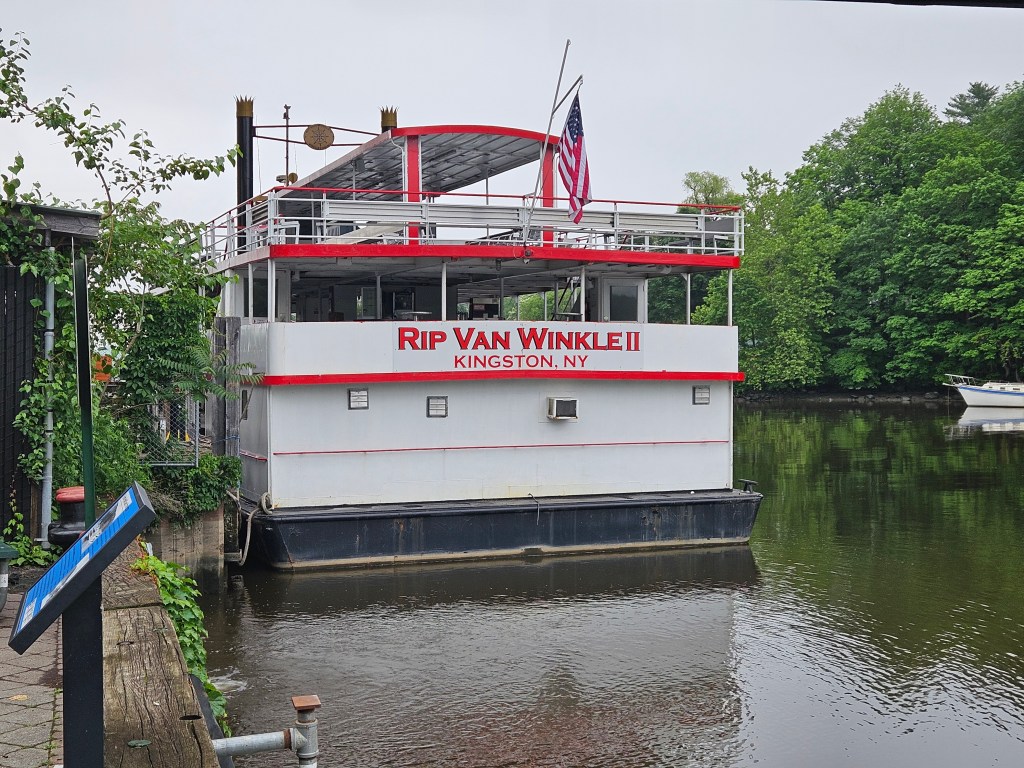
Everyday, we observed a tour boat taking kids for an afternoon ride. The Rip Van Winkle, originally an oil service boat, converted to a tour boat in 1982.
At our last marina, the Marlboro Yacht Club, we met a couple from Virginia – Ted and Beth Puchalski. When we arrived at the Kingston Historical Museum Marina, we again ran into Ted & Beth, so we asked them if they wanted to join us for dinner. We had a great dinner at a Mexican joint (Taco Tuesday) & then went back to their boat for some drinks.
After 2 days of rain on Monday & Tuesday, we woke up today (Wed-June 11) to a beautiful blue sky and SUNSHINE. Today we will visit the Hudson River Maritime Museum. It was too bad that the museum was not open on the past 2 rainy days, but we’ll take what we get.
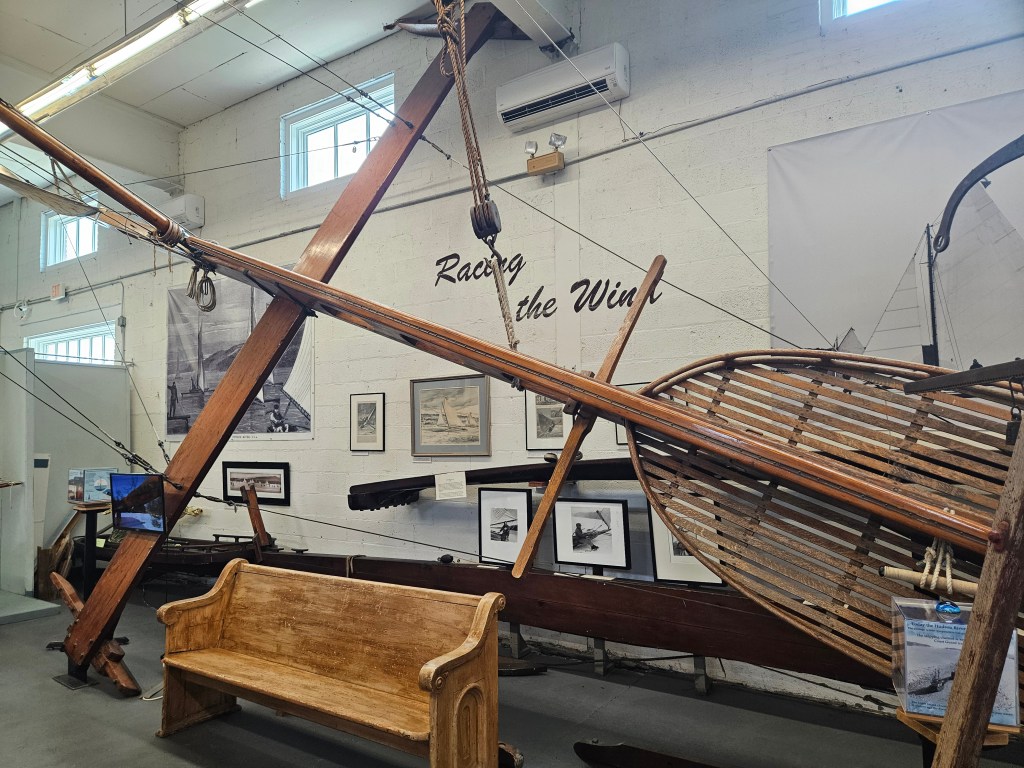
The Hudson River Maritime Museum The museum is somewhat small, but houses a significant amount of history on both the Hudson River & the Erie Canal.
For the small size of the museum, there were several rooms with different themes of history.
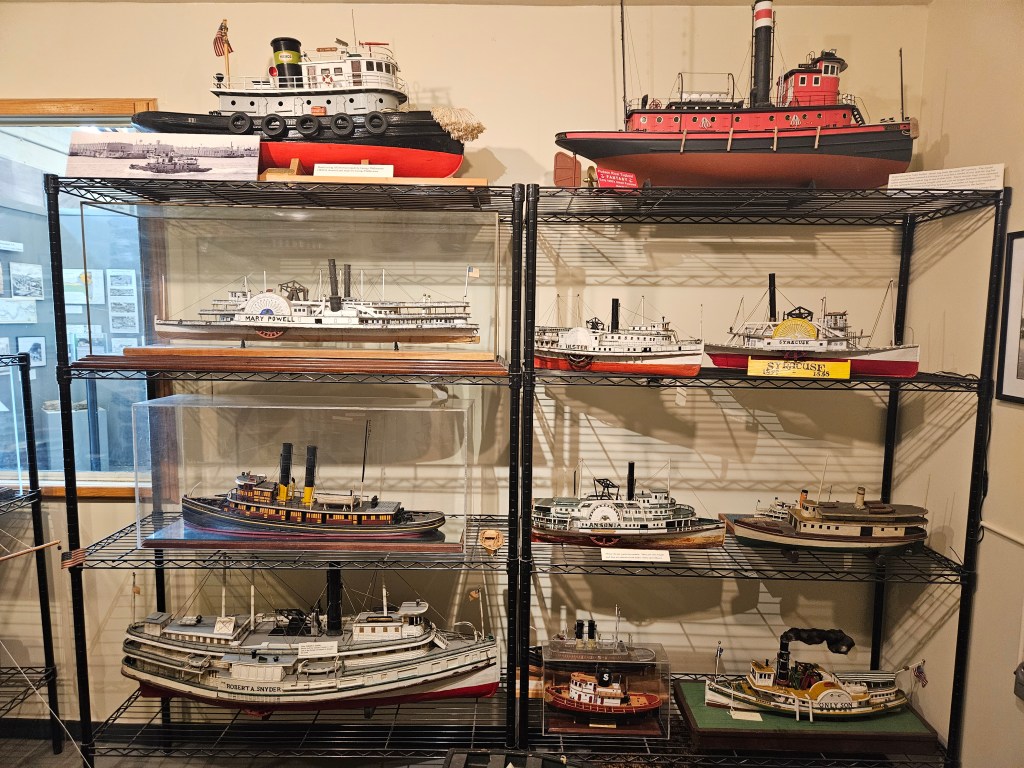
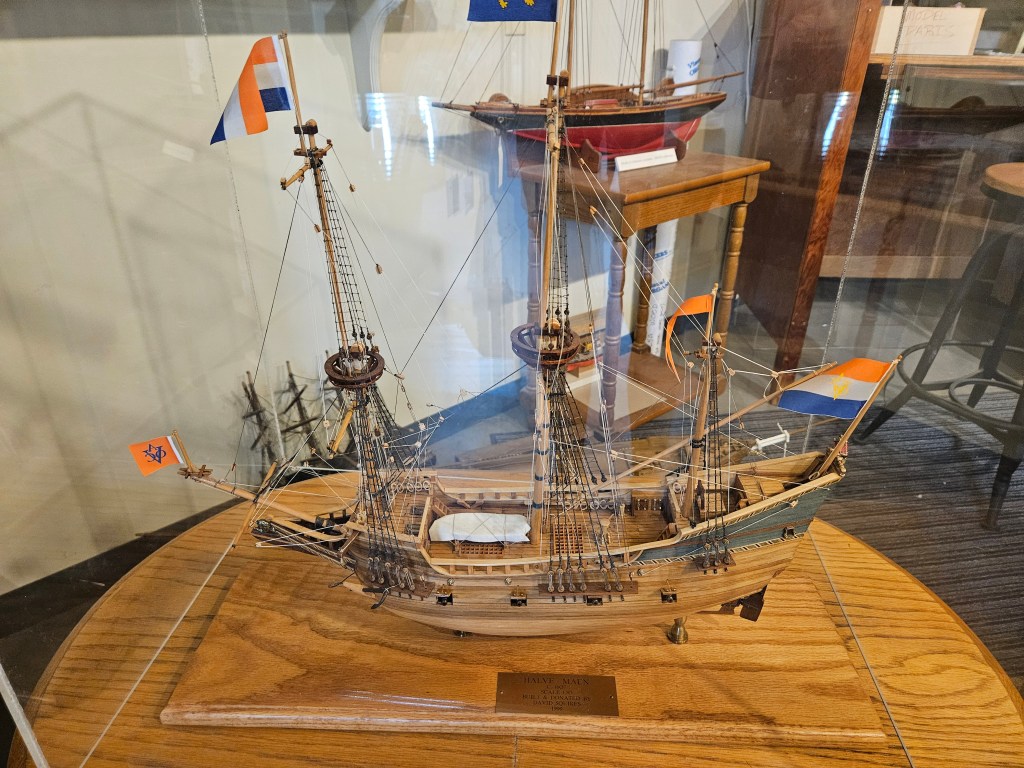
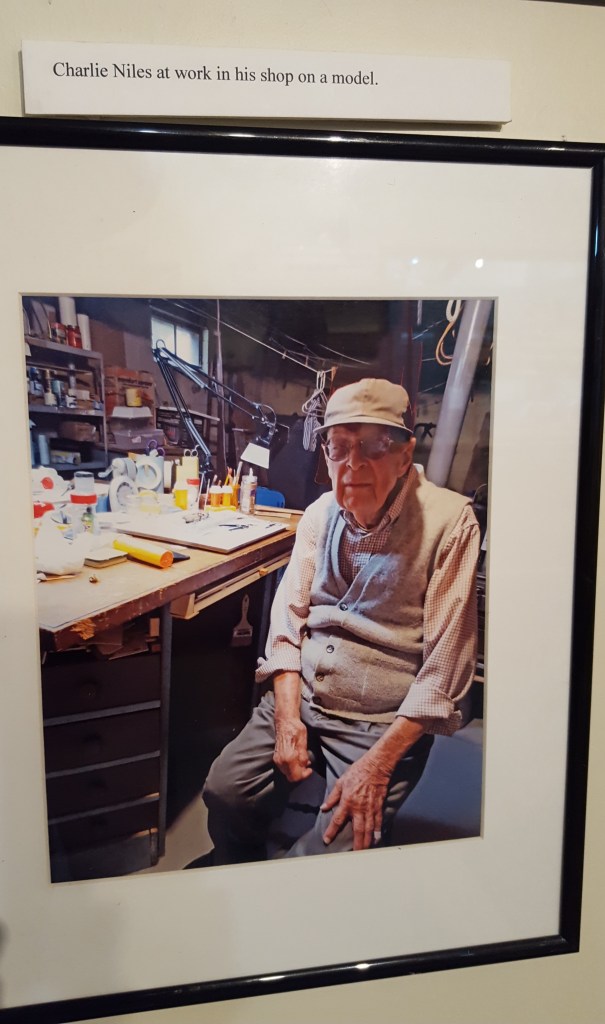
There was an entire room that contained MANY models of Historic Miniature Wooden Boats. The room was dedicated to the elderly model maker, a gentlemen named Charlie Niles. The ornate attention to detail in the minature models was impressive. Charlie passed away in 2015 at the age of 93.
There was a room dedicated to New York Governor DeWitt Clinton, and his endeavours to create the Erie Canal & link it to The Hudson River. Clinton was largely responsible for the construction of the Erie Canal. He was persuaded by Canal proponent Jesse Hawley to support construction of a canal from the eastern shore of Lake Erie to the upper Hudson River. When first built, the Erie Canal cut transportation costs by a whopping 95%. The contribution of the canal to the state of the New York is incalculable.
Upon completion of the canal, it was fact that DeWitt Clinton & dignitaries led the opening ceremonies for the Erie Canal and rode a ship named the “Seneca Chief” from Buffalo New York to New York City, with two flasks of Lake Erie fresh water. They poured the two flasks of Lake Erie fresh water into the New York Harbor, symbolically connecting the two bodies of water forever.
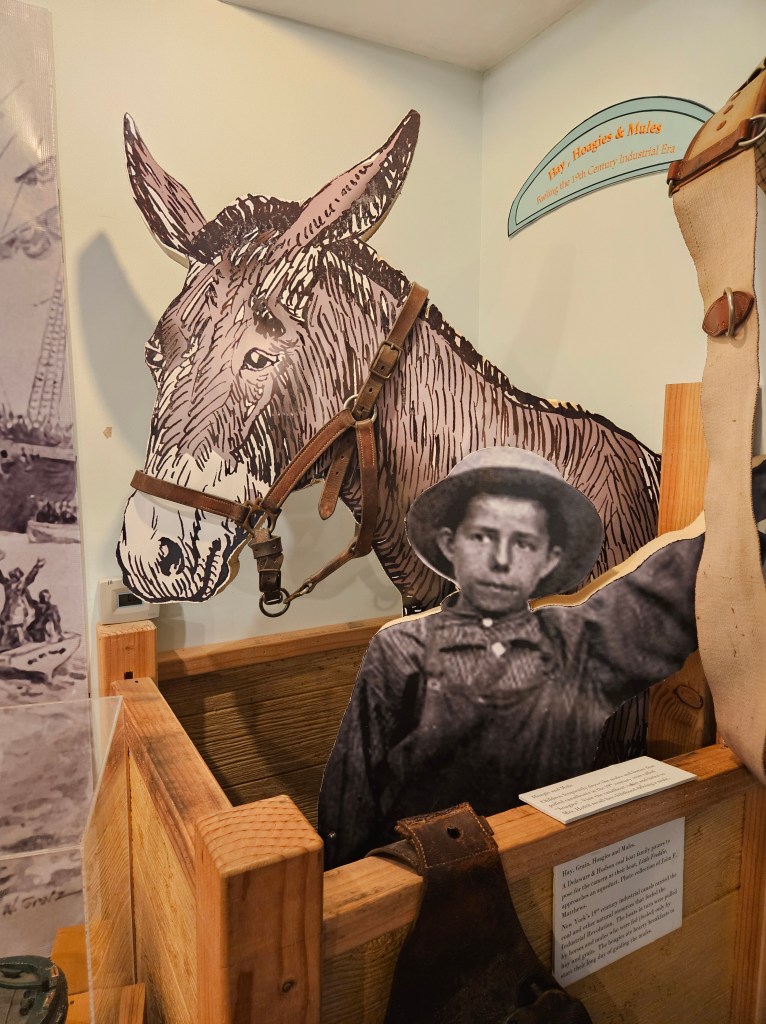
There was a room dedicated to The Erie Canal – videos of how the locks work, and even photos of the early days when horses would be used to pull boats thru the locks (all sailing vessels at that time). The Erie Canal is about 360 miles long and controls the waterway between Lake Erie & the Hudson River. Lake Erie is about 500ft higher than the Hudson River in elevation, and has 35 locks which control the elevation difference. The Canal was opened 1825, and is about to celebrate its 200th anniversary !!!
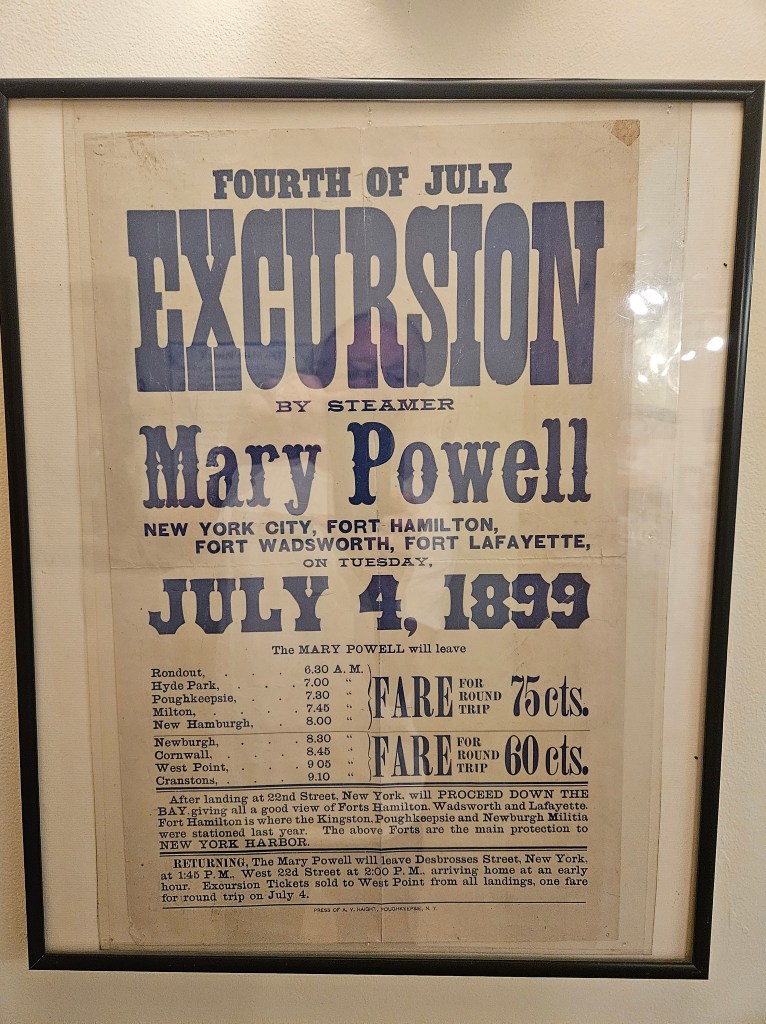
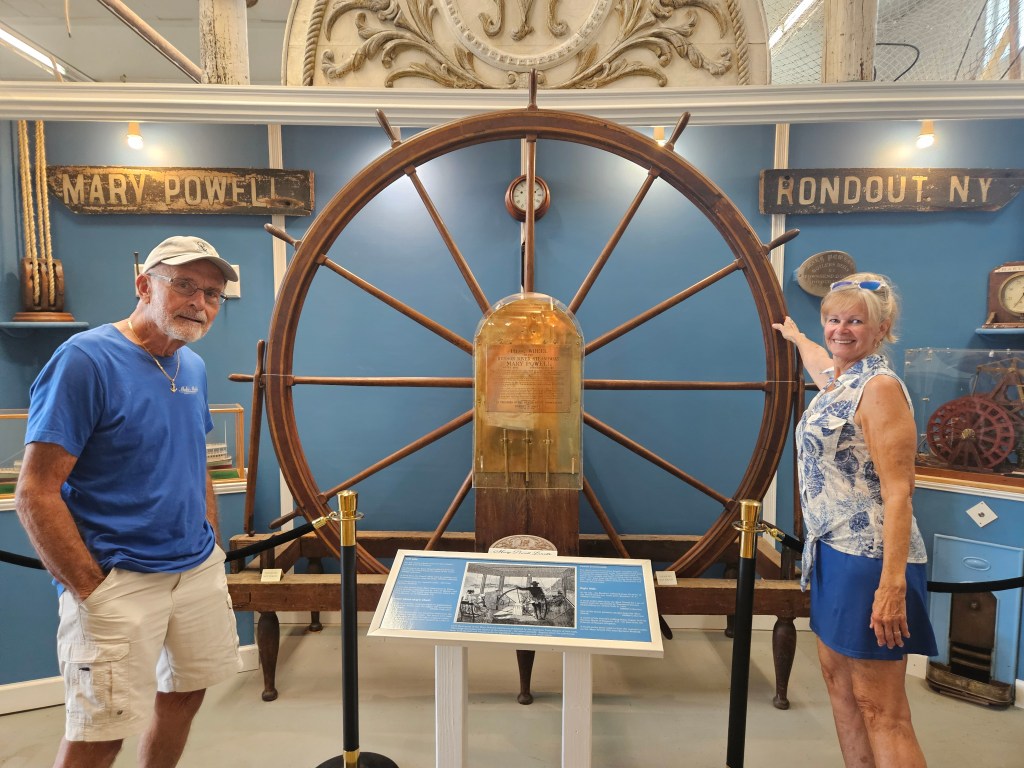
There was a lot of area in the museum covering Steamships that once traveled the Hudson River. The most famous being The Mary Powell. The steamboat “Mary Powell”, built in 1861, sailed on the waters of the Hudson River over a period of 55 years. She was one of the fastest steamboats of her time, was pleasing in appearance, and reliable. She became known as the “Queen of the Hudson”, proving daily trips up/down the Hudson River between Albany & NYC. The vessel was named after the wife of a NY businessman & steamboat owner Thomas Powell.
There were also a few displays showing several steam engines & how a steam engine works.
There were rooms dedicated to ;
Restoring the Hudson from Pollution and renewed fish populations.
Hurricanes & Flooding Histories of the Hudson & tributaries like Rondout.
Jobs created by The Hudson River – Cement, Bricks, Fishing
There was a very interesting exhibit on Ice Boat Racing. The material suggested that even back as far as the 1800’s there were ice racing boats that could do as much as 90-100 mph with only a 25mph wind (4:1 ratio), making them the fastest vehicles on earth in 1800s. There are records of an 83-year-old guy named Chuck Nevitt, who doesn’t look like the fastest man on earth, but many believe that in February 1947 Nevitt set a record as the world’s fastest naturally powered human during a remarkable iceboat sail across the flat, black ice of Lake Winnebago. Stopwatch-clutching spectators gazed slack-jawed as the Coast Guard veteran piloted his 42-foot Flying Dutchmen between two buoys set two miles apart. It took 53 seconds, and that included a tack he made in the middle of the course that added about a quarter-mile to the distance. “They figured somewhere in there I was doing 150 mph. Maybe 155,” Nevitt said. That would definitely shorten the time required to complete The Great Loop.
Google searches indicate the Guinness record as 143mph by a boat named Debutante in 1938 ???
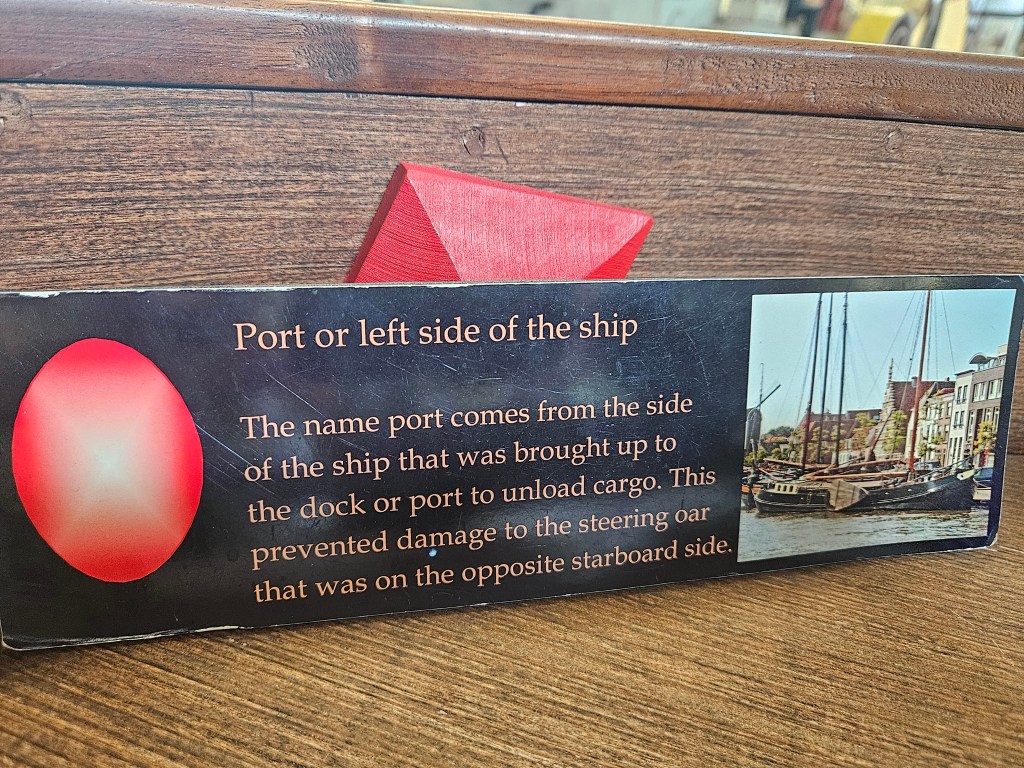
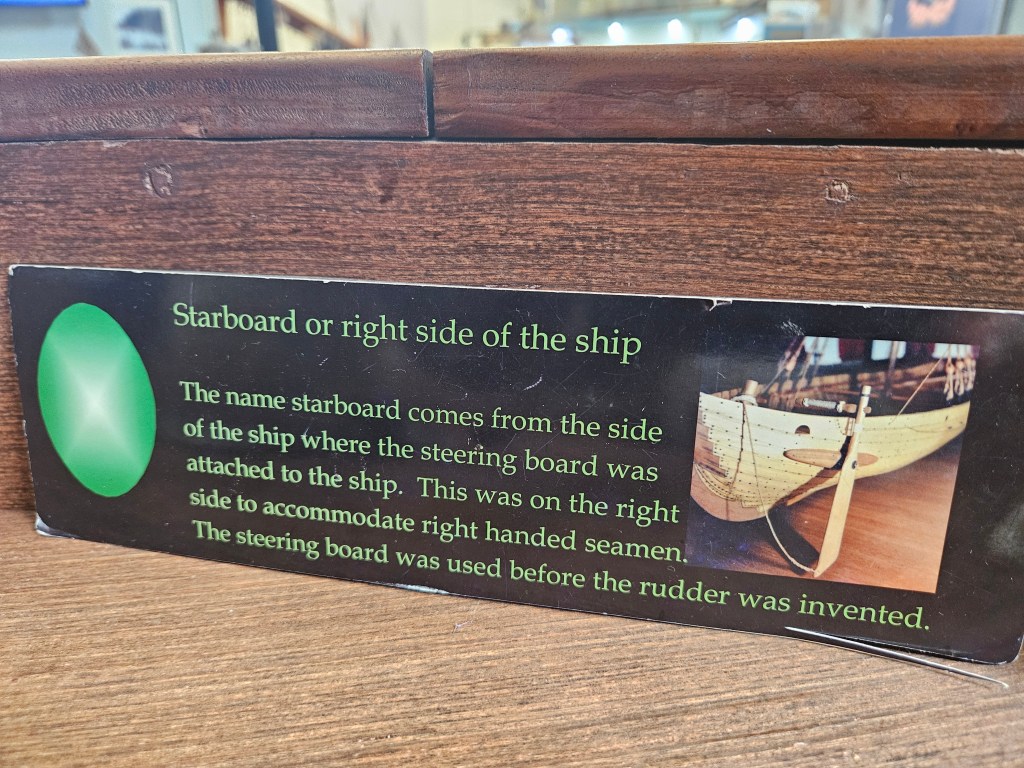
Finally – Do you know how the terms Port & Starboard sides of the ship were created ?
Well I think that’s enough history for now, back to our trip with the Mahi.
Unfortunately we got more bad news today about the Erie Canal Locks. They still have not made an announcement regarding locks 16/17. And due to high rains over the last couple of days, there are now some additional locks closed. We believe the additional locks will reopen with a couple days of dry weather, buy are still most concerned about locks 16/17.
The NY Canal System has promised another update “Later this week”.
That’s all for now. Thanks for reading this very long post.
Mike, Deena, Jerry.
But wait, there’s more – as I was gettin ready to hit the button to release this post, I was sitting on the back of the Mahi & was treated to the high school sculling team out for a practice run.
Today (Thu/Jun 5) we had a short 35 Mile ride up the Hudson River, from Crouton on the Hudson to Marlboro NY.
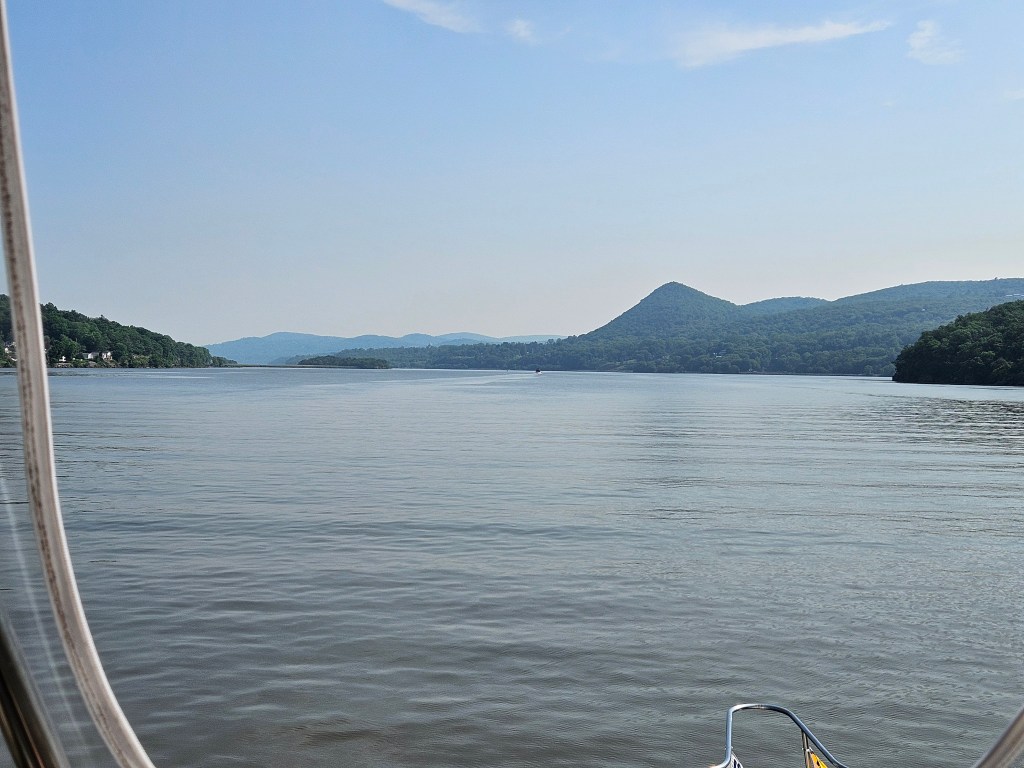
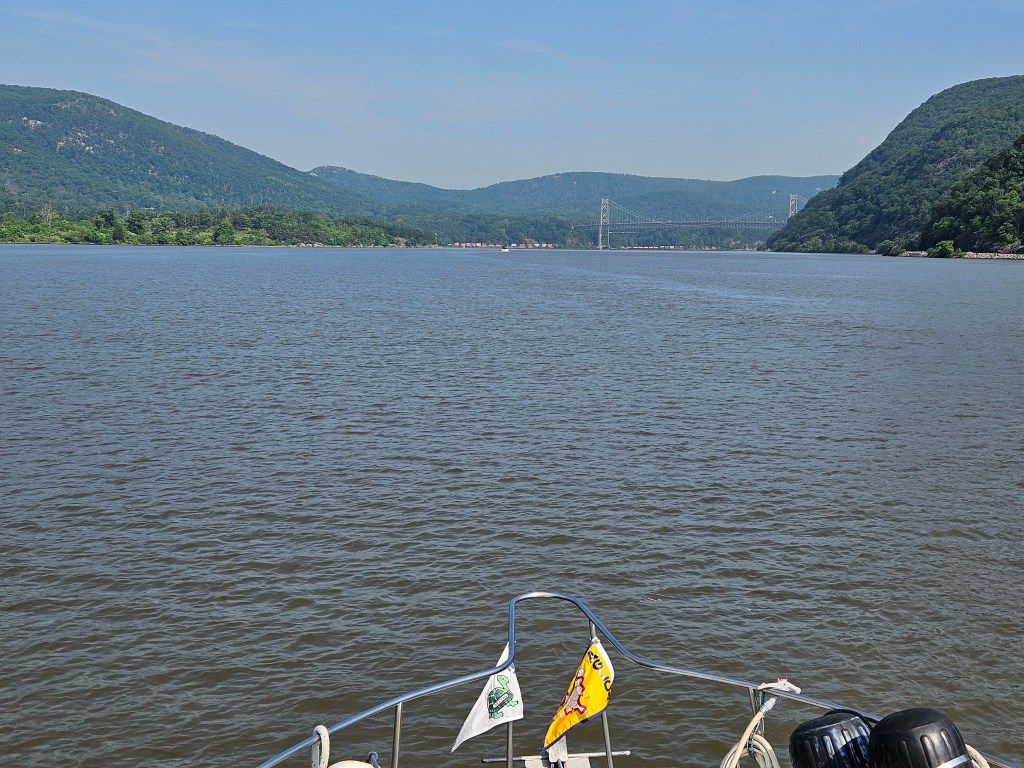
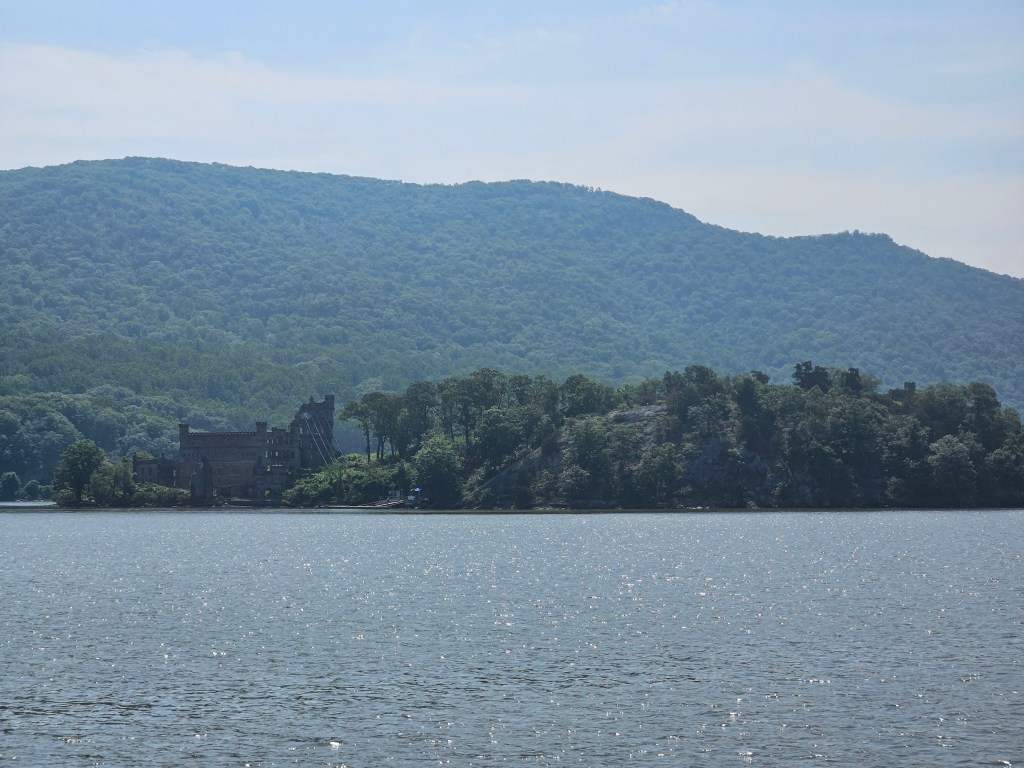
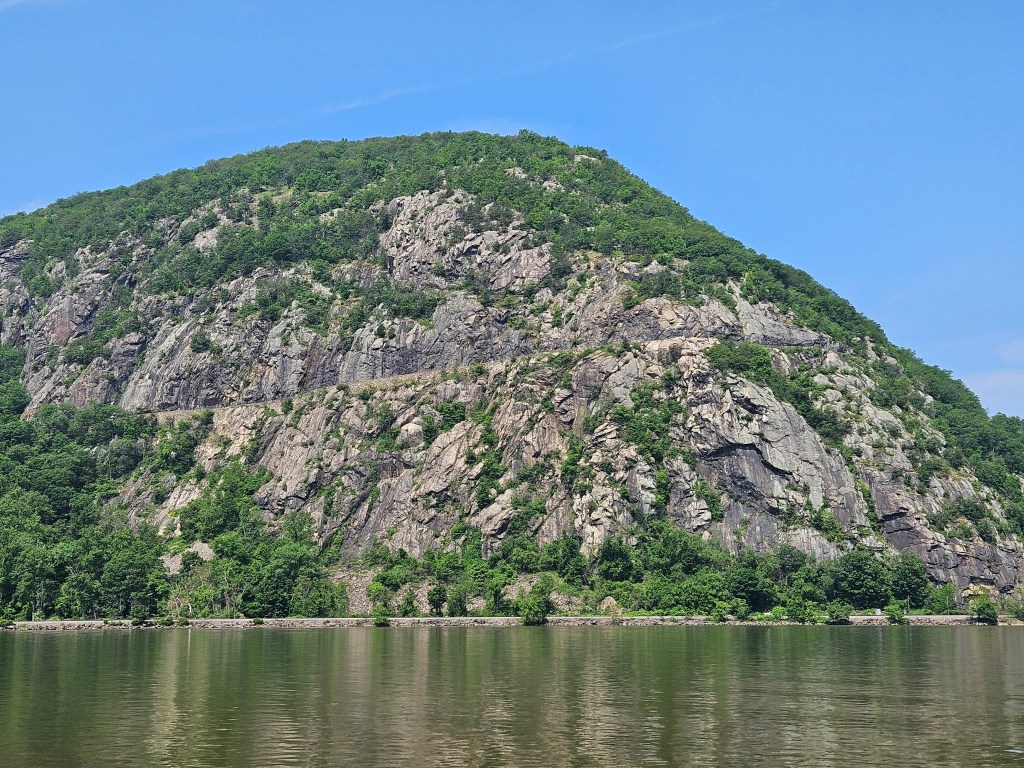
The scenery on today’s ride was beautiful with the small rolling hills, starting to grown into larger hills and then small mountains with jagged cliffs. This area is known as the Hudson Highlands. One of the most well known mountains in this valley is the Storm King Mountain.
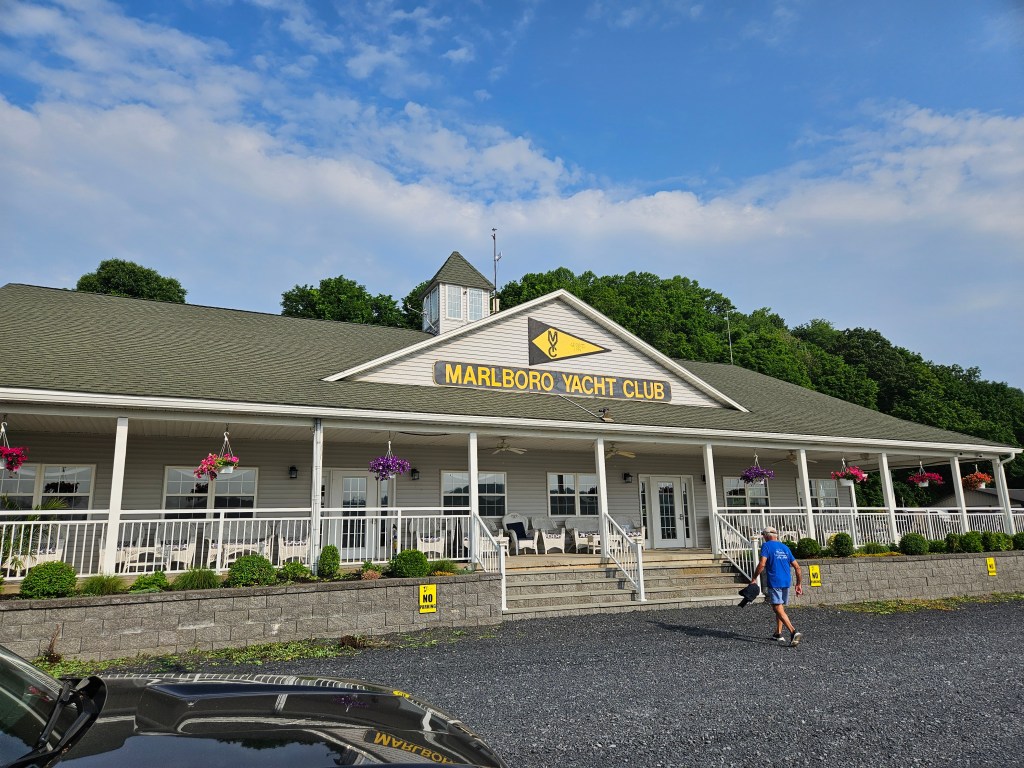
Then we reached our destination for at least the next 5 days, The Marlboro Yacht Club. It’s a small club but with excellent reviews & only $2.50/ft, much better than the $5-6/ft in New York & Atlantic City.
We are bedding down here because the Erie Canal Locks #16 & 17 are still not open. There is supposed to be another update from the NY Canal System on Monday June 9th.
Back to the Marlboro Yacht Club, our home for the next 5 days.
I cannot say enough good things about the folks at this Yacht Club. Within 1 hour of docking, we had the met the following people – who came up to us to introduce themselves.
Volunteer Dock Hands Matt & Gary, Commodore John, Harbormaster Sean, Boater Daphne, Photographer Felix, Mechanic Brandon, Boater Jeff, Boater Vee, Boaters Mike & Maria, Boater George. Later at a party at the clubhouse, we met MYC members – Glen, Amy, Anthony/Cairo, John/Megan, Amanda/Nick & several other Loopers. I’m sure that I am forgetting a few names, but you get the point.
So much for New Yorkers not being friendly. But these folks are “Upstate New Yorkers” and there is a lot of difference between them and the big city folks who looked away from us when we were in NYC.
Later that afternoon, we had about a 30 minute conversation with Commodore John Gilberto, while he was “trying” to trim the shrubs.
John has now been Commodore for 8 years. Prior to his tenurere the place was starting to get a bit tired. Since he has taken over, the following good things have happened to the Yacht Club.
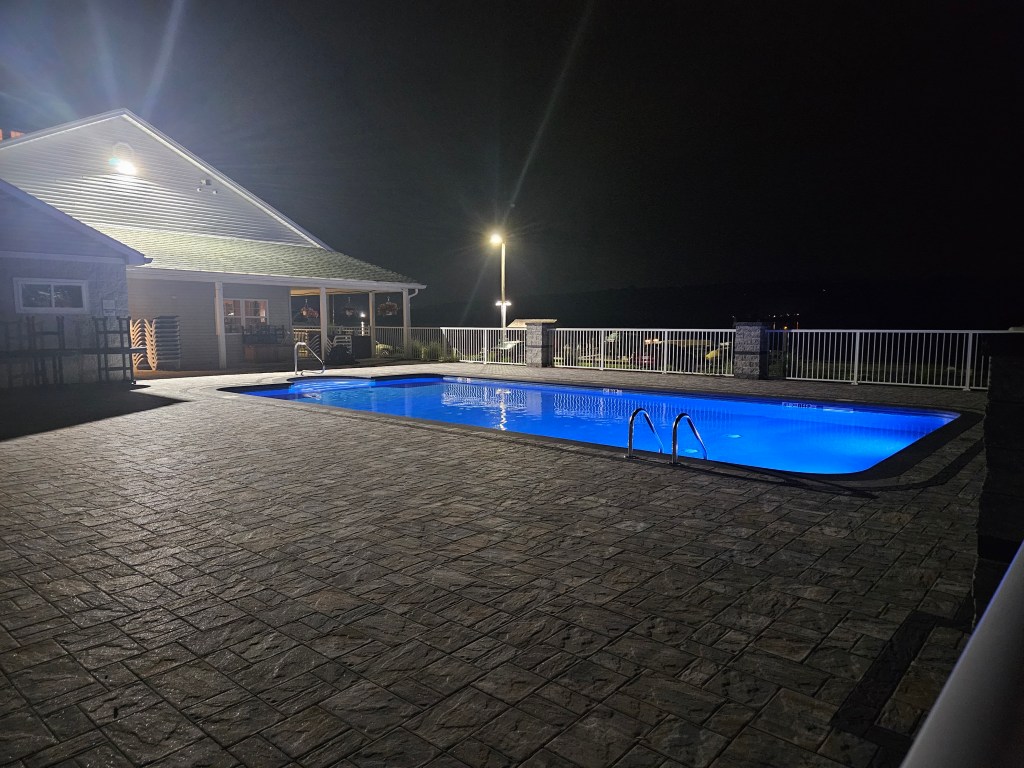
John & his support team have re-done the entire exterior, installed new fuel pumps, installed a NEW POOL, & purchased new travel lift equipment.
Every fall, the Marlboro Yacht Club Members band together to Pull Out all of the Docks & Pilings. Then every spring, the Pilings & Docks are Re-Installed. This annual ritual is required due to significant ice forming on the Hudson River & the fact that the Ice shifts up & down the river.
Finally during John’s tenure as Commodore – the MYC actually had 1 episode of a Peacock Series filmed here. The Peacock Series is called – Pokerface, starting Benjamin Bratt. The series was released in 2023, and EPISODE #10 was filmed at the Marlboro Yacht Club in 2022. We’re gunna try to watch it before we depart.
When I complimented John on the job well done at MYC, he did what most good leaders do – and said that it was his team, who made all the great things happen.
Oh yea, one last note – in addition to John’s duties as Commodore, he also holds down a day job in Sales, managing about 12 people. I don’t know how he does it, he must be an excellent time manager.
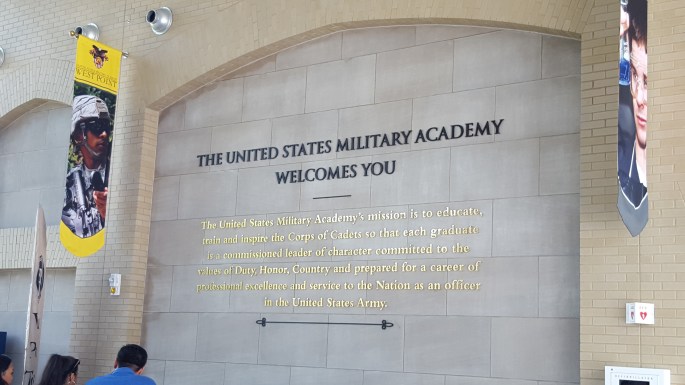
On Friday, June 6th we went on a tour of the West Point Military Academy. More to come on that in a separate post.
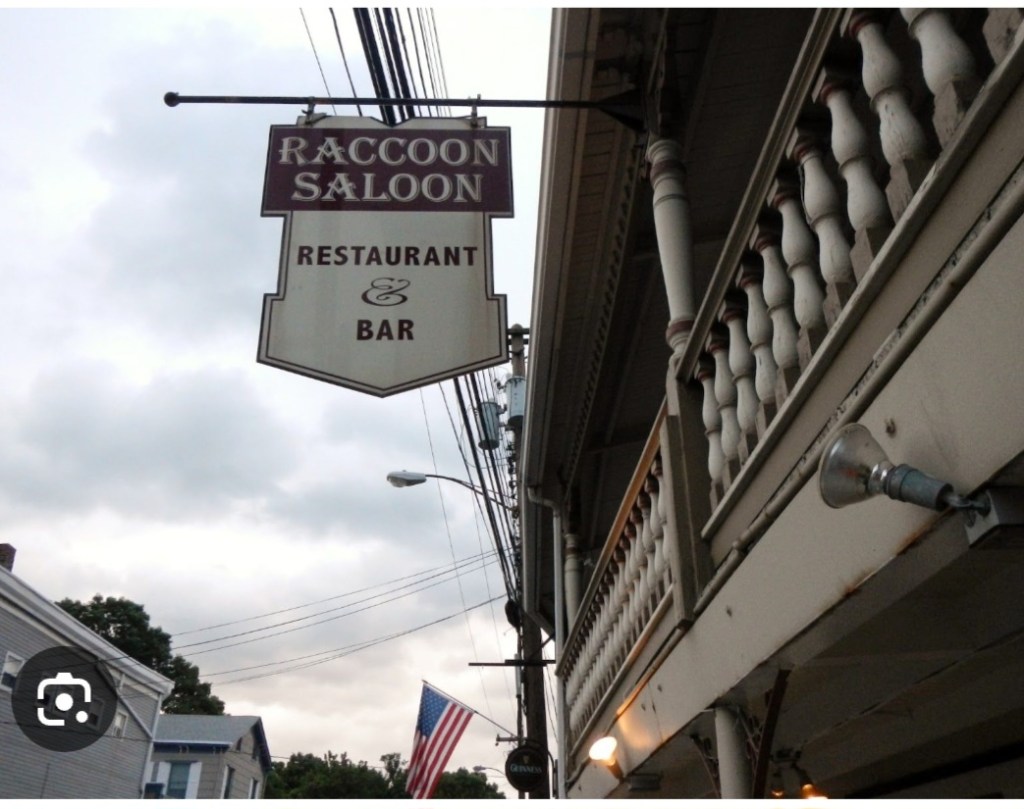
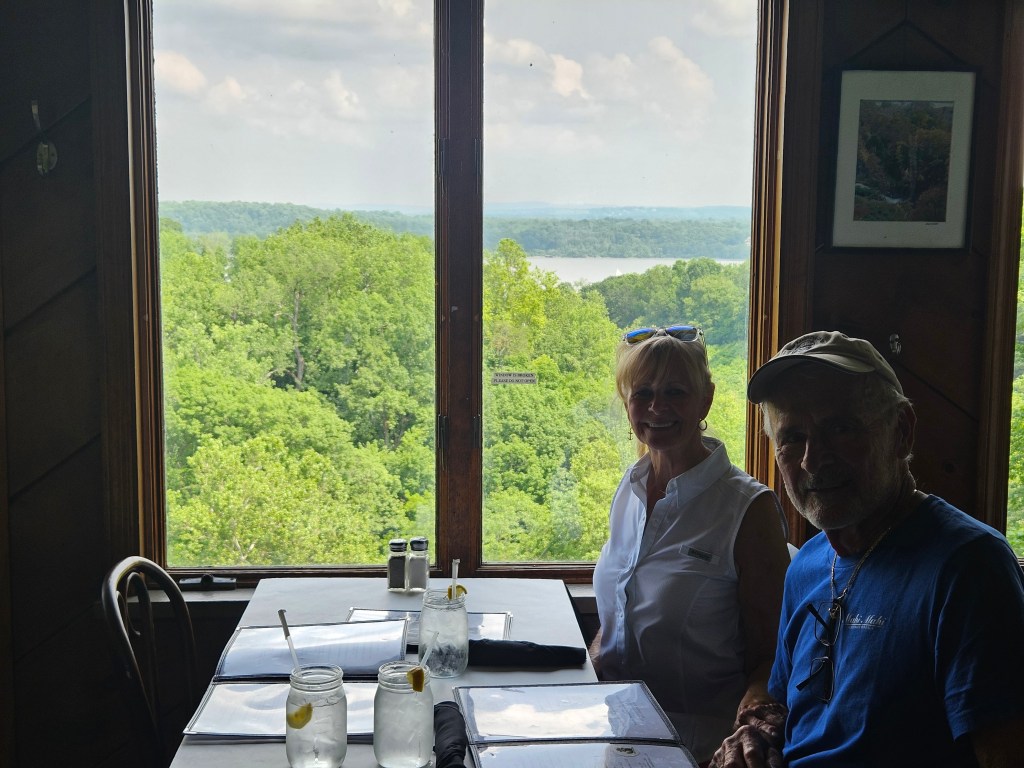
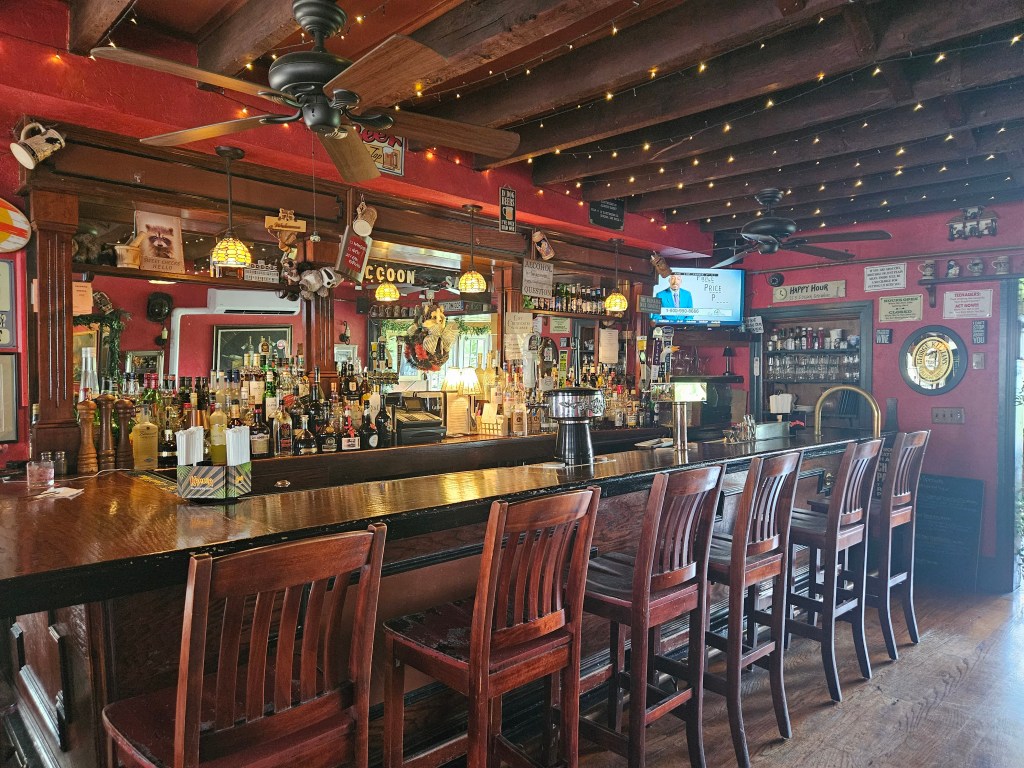
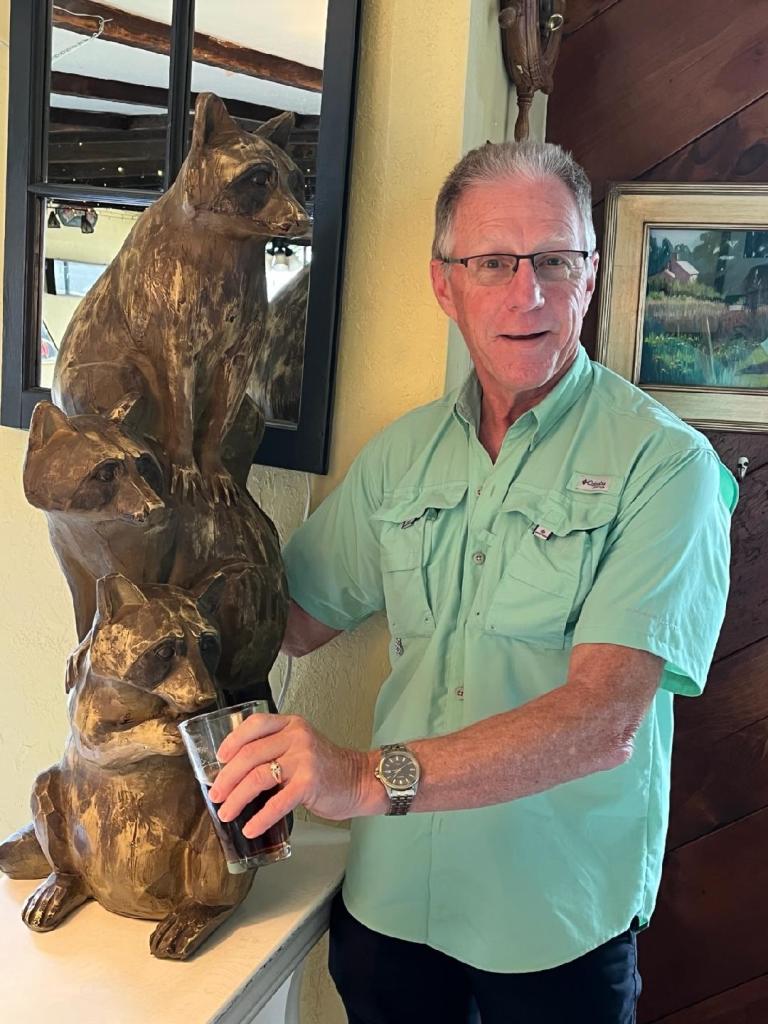
After West Point, we took the long 40 minute Uber ride back to Marlboro, and had lunch at a place right up the hill from MYC. The restaurant/pub is called The Racoon Saloon. It is up on a high cliff above the Hudson River & has a beautiful waterfall behind the restaurant.
The Racoon Saloon has a cool history going back to the 1820’s, when it was built as a farmers hotel.
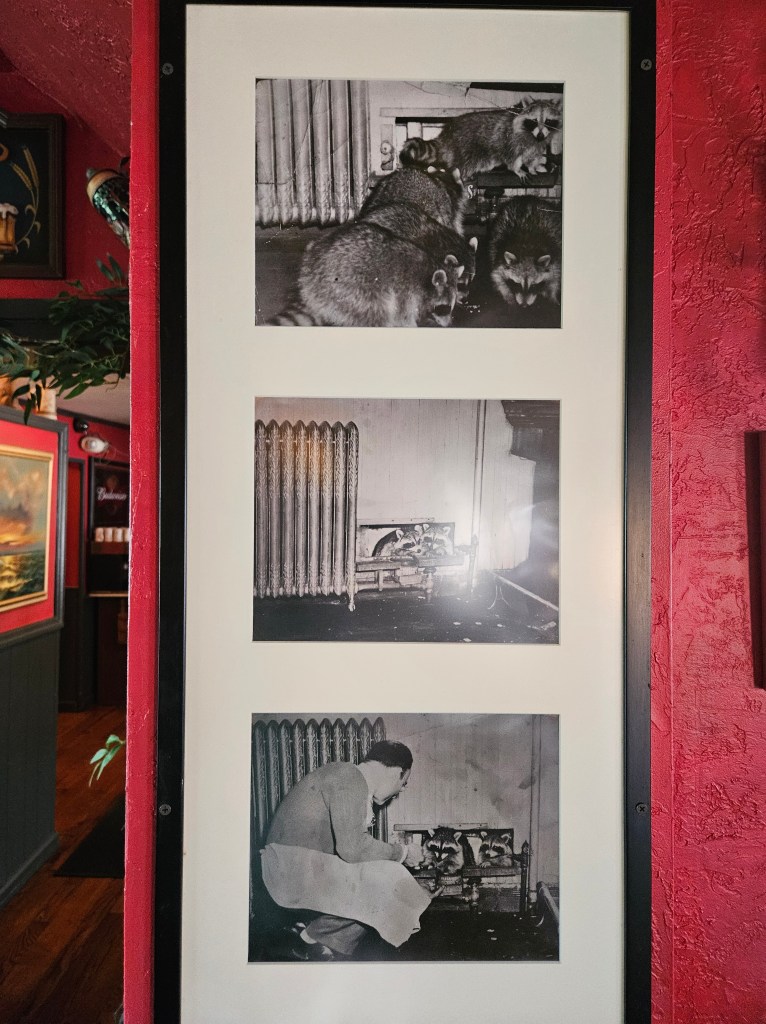
The Raccoon Saloon got its name from the family of raccoons that once lived there – coming up through an opening in the wall and being fed by the enthusiastic patrons.
As we were leaving, we chatted for a few minutes with a guy & girl at the bar. We were asking about the closest grocery store. It turns out that Marlboro is not the epicenter for groceries. The guy at the bar then offered to take us to a real grocery store about 30 minutes away. I offered to pay for his drink at the bar, he politely refused my drink offer, and told us that he was the current owner of the Racoon Saloon. Five minutes later we were in Ronan’s car and on our way to the grocery store, then back all the way to the marina. Again – incredibly nice people.
On Friday night June 6th, we attended a party at the Yacht Club & met a bunch more very nice people. I guess that it was not really a party, just another weekly social event at the yacht club.
Last night (Sat-Jun7), we went to dinner with Commodore John Gilberto & his wife Rose. I actually texted John early in the day to see if they were interested & available for dinner. They responded quickly & enthusiastically. They took us to a wonderful Italian restaurant in Poughkeepsie NY called Cosimo’s Trattoria & Bar. The food was delicious – we shared Calamari & I had Veal Parmesan. And then – John & Rose picked up the check, for all 5 of us !!!
It was a great time getting to know John & Rose better and sharing family stories & boating stories. Rose is also quite accomplished, currently acting as the Superintendent of the Marlboro School System.
After dinner we returned to the Yacht Club and as a group of about 30 people, watched the movie “Nonnas” – about an Italian restaurant that employs grandmothers as chefs. The film is inspired by the true story of Jody “Joe” Scaravella’s and the real-life Enoteca Maria restaurant in New York City. It was a very cute movie.
As I have mentioned a few times, Monday will be a key day for us, as we hope to find out if Locks 16/17 on the Erie Canal will be opened as planned on June 11th. If not, we’ll have to start discussing – 1) storing the Mahi & flying home for a few weeks or 2) going about 400-500 miles out of our way, up to Montreal and back down to Lake Ontario. More to come in this subject.
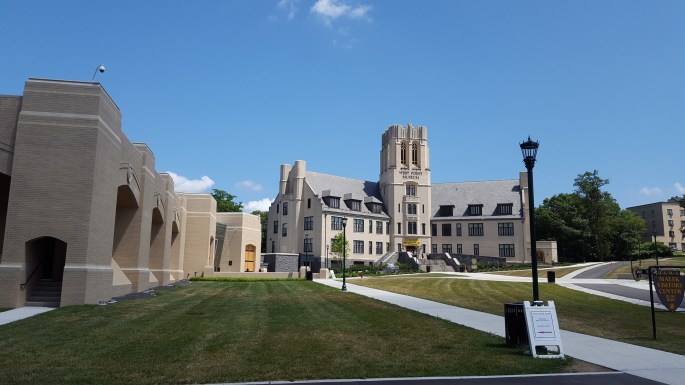
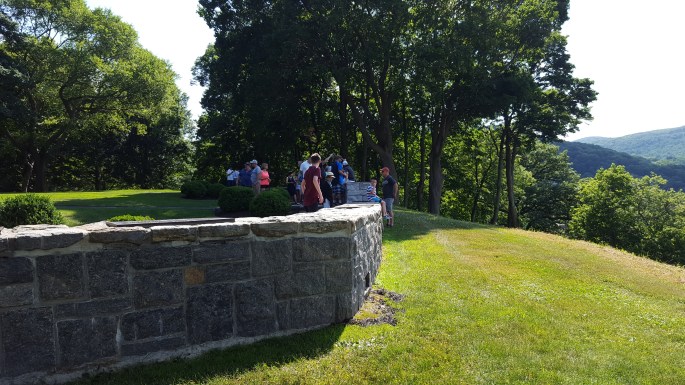
The West Point Academy (United States Military Academy) West Point is the oldest continuously occupied military post in the United States. Located on the Hudson River, West Point was identified by General George Washington as the most important strategic position in America during the American Revolution.
Until January 1778, West Point was not occupied by the military. On January 27, 1778, Brigadier General Samuel Holden Parsons and his brigade crossed the ice on the Hudson River and climbed to the plain on West Point and from that day to the present, West Point has been occupied by the United States Army. It comprises approximately 16,000 acres including the campus of the United States Military Academy, which is commonly called “West Point”.
The United States Military Academy (USMA), also known as West Point – is a four-year educational federal service academy. It is one of the five U.S. military service academies and the oldest military academy in the nation (1778). Like the Naval Academy, West Point provides a 4 year FREE education, for 5 years of military service.
We went on a 90 minute, semi-private tour of only 6 people 🙂
Unlike Annapolis, West Point is on a very large campus, and the tour was given on/off of a nice air conditioned bus. The tour started at the visitors center where everyone had to get their ticket & security screening.
On the bus ride out, our tour guide Mary talked about some famous grads of West Point including ; Generals Ulysses S. Grant, Robert E. Lee, Douglass MacArthur, Dwight Eisenhower, & George Patton.
Interesting – both Ulysses S. Grant & Robert E. Lee were both West Point Grads. But Robert E Lee, lived in Virginia and thus served for the Confederate Army.
Douglass McCarthur was 1st in his class at West Point & the youngest general.
Like Annapolis, West Point also has their class of Astronauts ; Frank Borman, Buzz Aldrin.
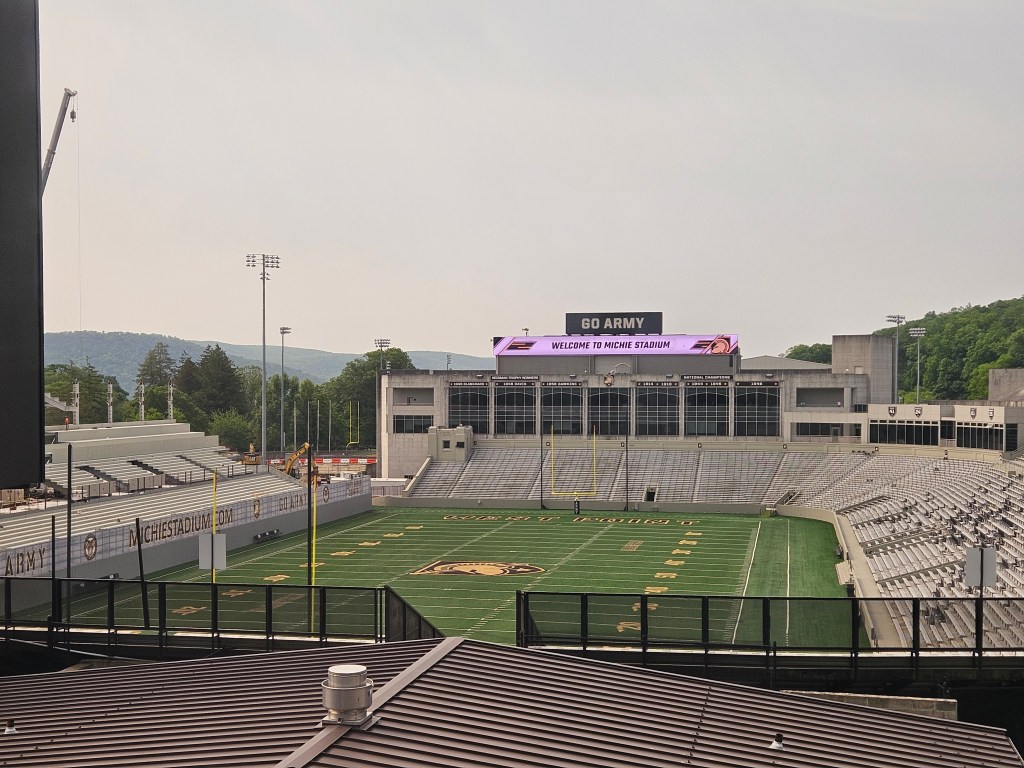
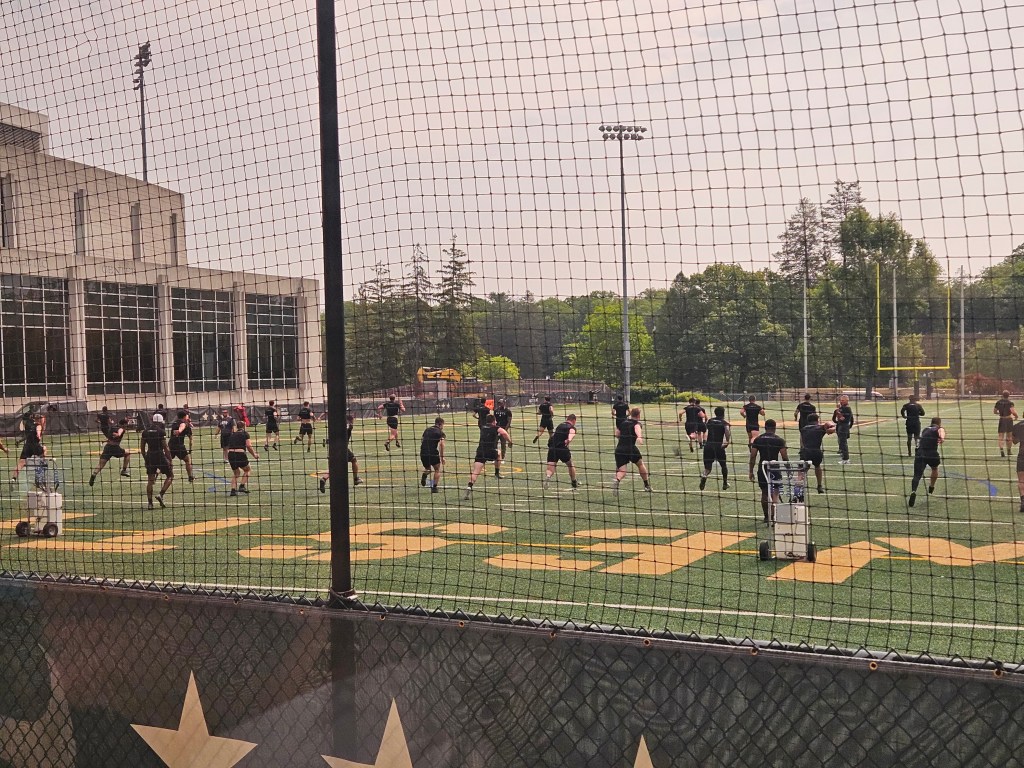
On the bus ride out, we passed by the Army Football Field, Michie Stadium. Michie Stadium, built in 1924, is named for Dennis Mahan Michie (USMA Class of 1893), who organized, managed and coached the first football team at West Point in 1890. We also got to see about 30 seconds of the Army Football Team.
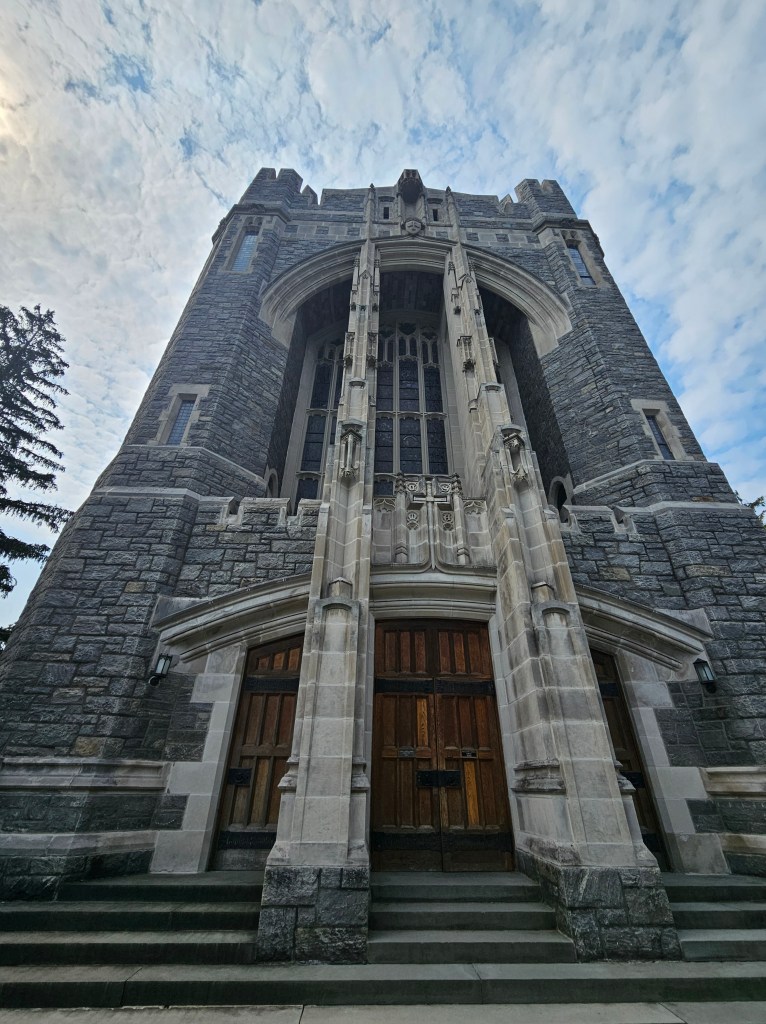
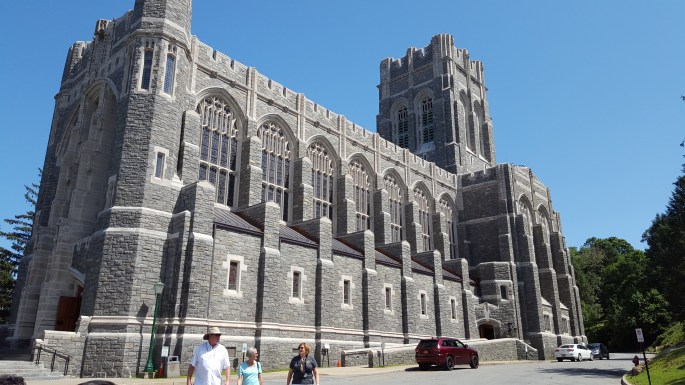
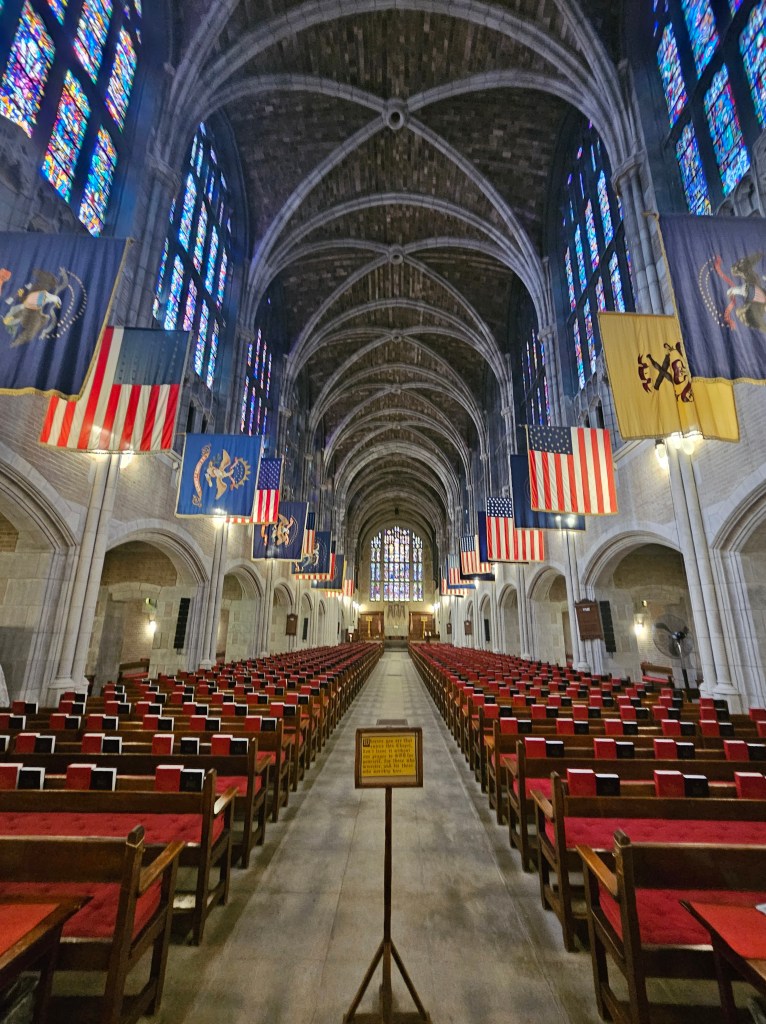
The tour began at The Cadet Chapel (1830). The Cadet Chapel is one of several churches on campus and is a non-denominational church. It was built by marble specialists from Italy, who were awarded citizenship after their hard work. The construction took only 2 years.
Some of the features of the Chapel – 1. Willet Stained Glass – just over 20,000 pieces of stained glass. The Willet company was awarded the business over Tiffany.
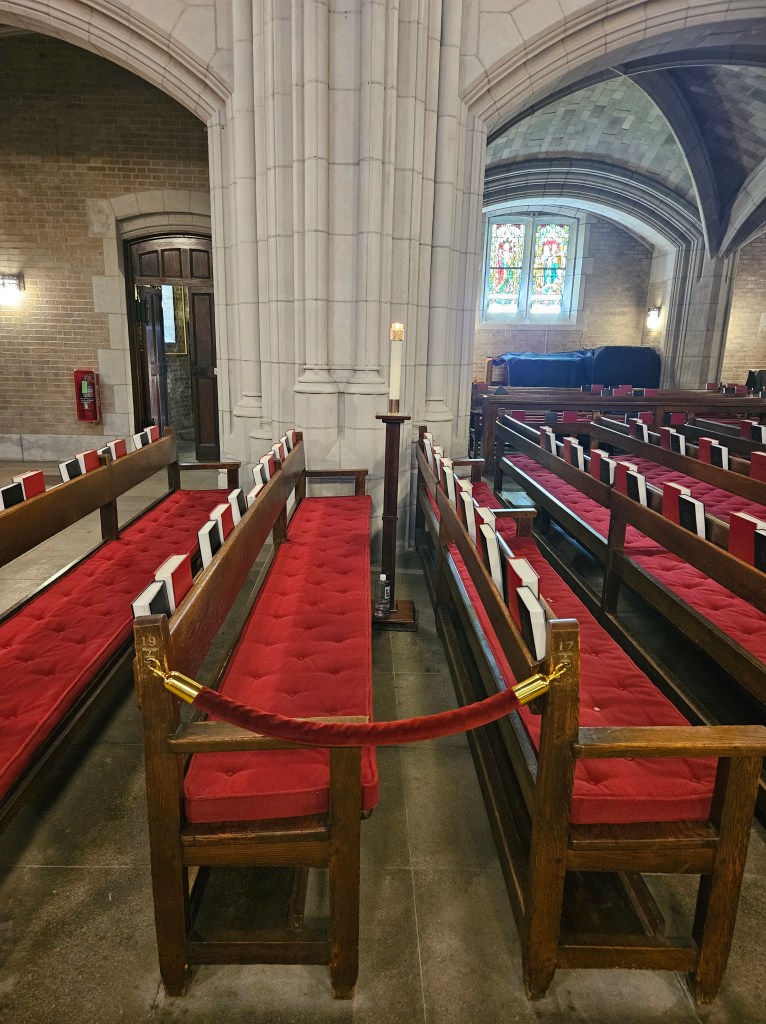
Fallen Heroes Row – identified with a candle & equipped with a cable closing off the row. The closed pew is to honor/rember fallen West Point heroes.
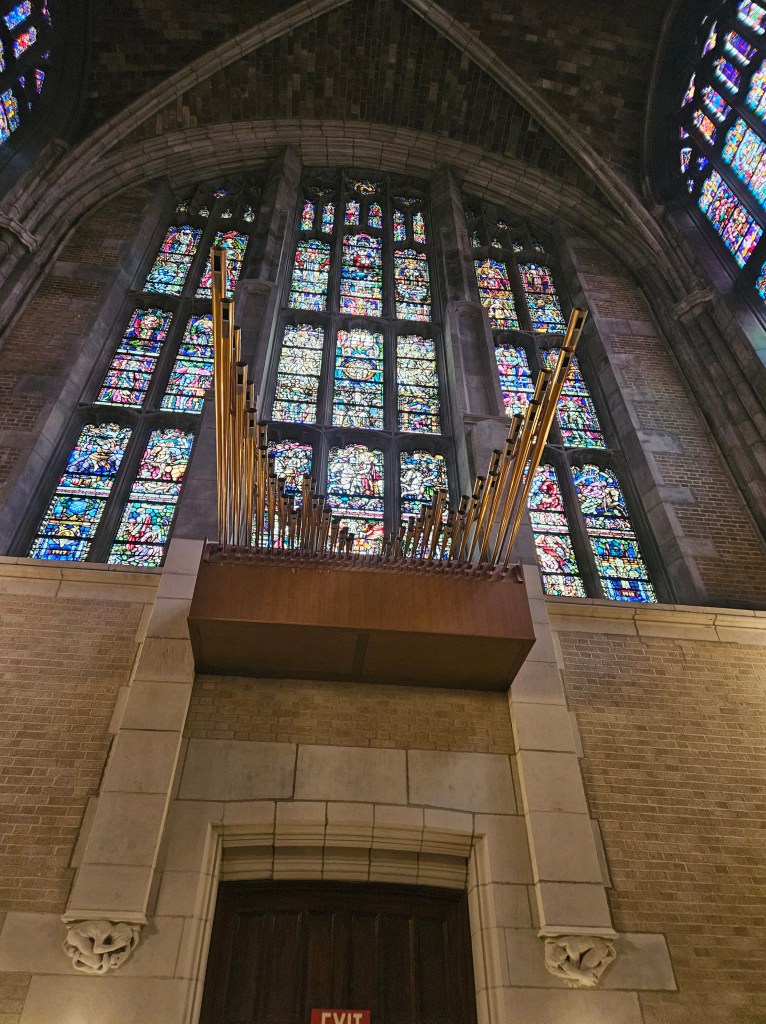
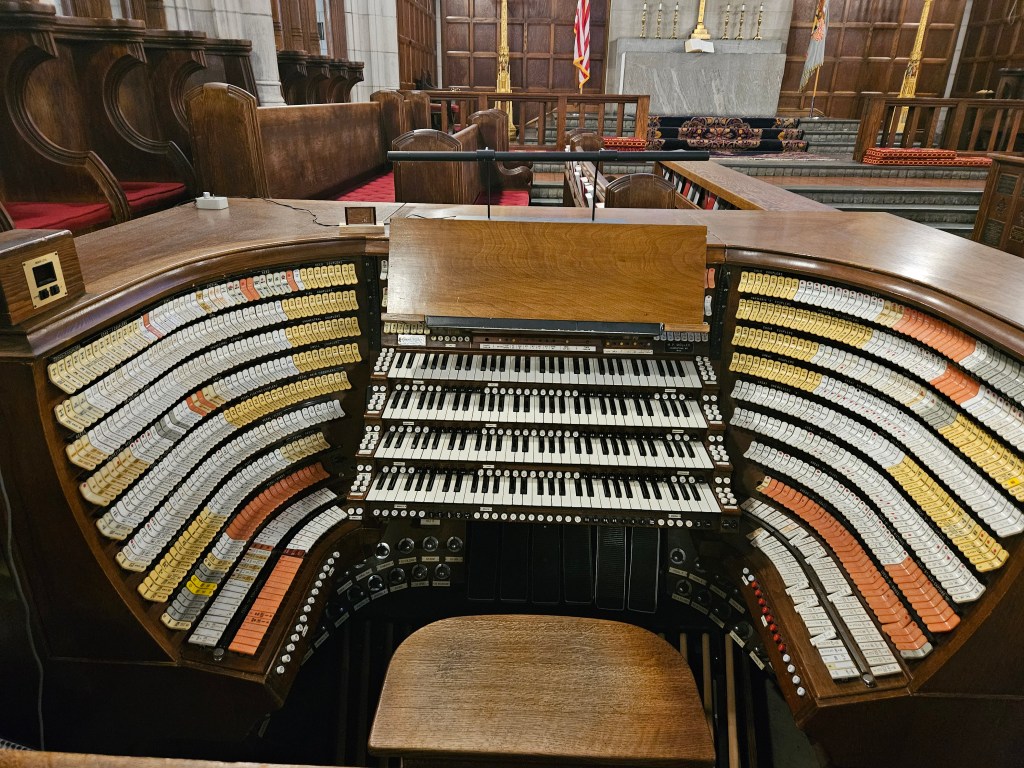
The Cadet Chapel Organ – The organ has an impressive 23,511 organ pipes & a keyboard that looks like a fighter jet control station. The organ pipes are as short as a pencil & as long as 23ft. Mary said that there have been only “FOUR” organists in the history of West Point, it is a very prestigious position that one gets awarded and never gives up until near death.
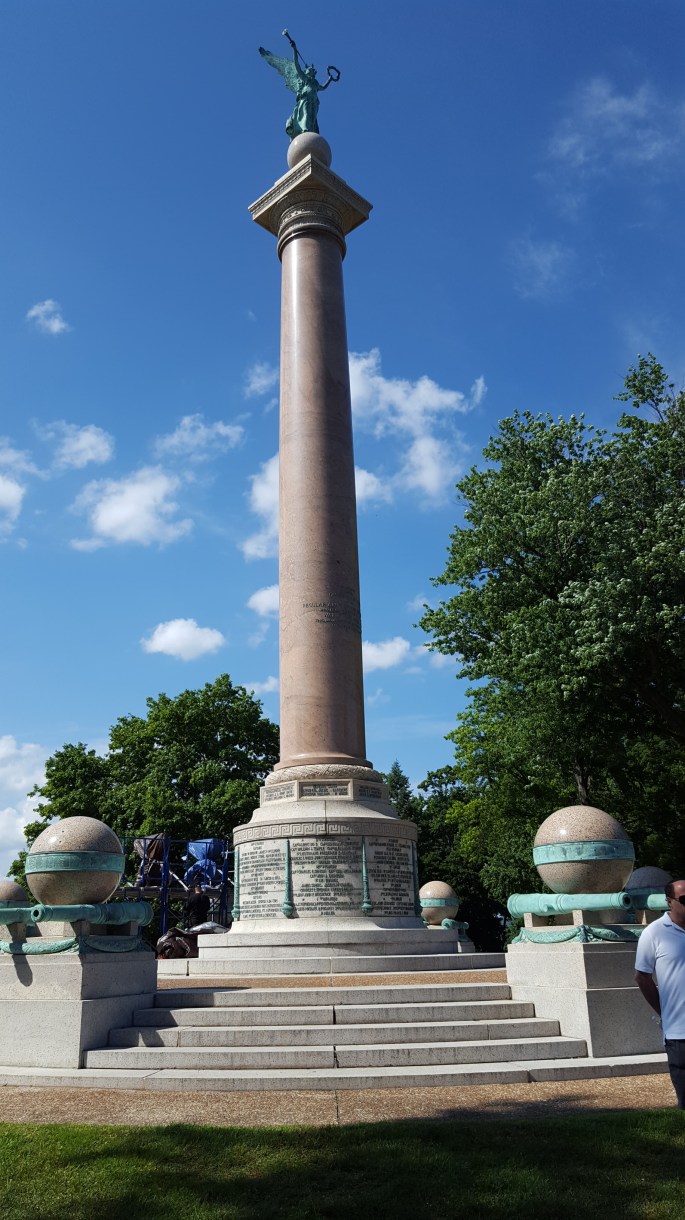
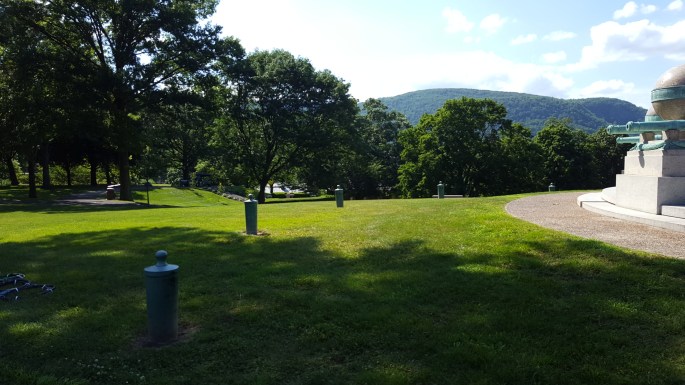
Our next stop on the Tour was The Battle Monument. The Battle Monument (Civil War) The Battle Monument includes upside down torches at the base of the statue, with 8 large bronze balls. Inscribed on the 8 bronze “cannon balls”, are straps circling the the balls which show the names of 2,230 Officers and Soldiers who died for the Union Army during the Civil War. On the perimeter of the statue in the lawn, are cannons buried upside down into the ground, which all are intended to say “let us never be at war with our own brothers again”.
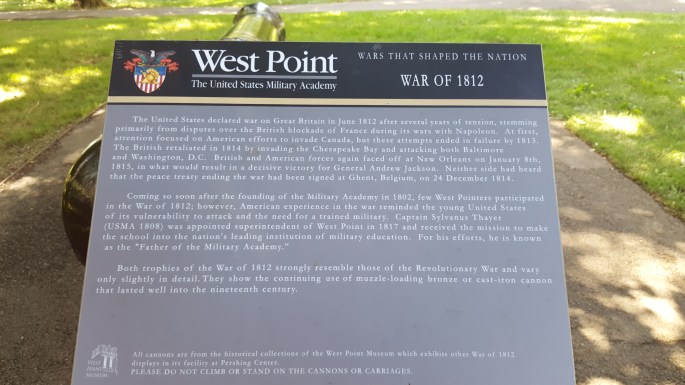
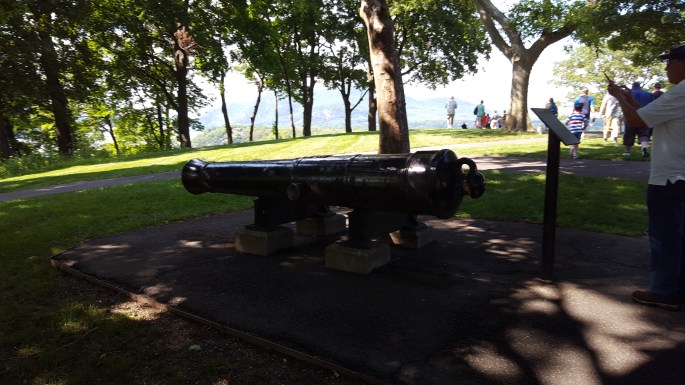
Near the Battle Monument, there are a bunch of cannons. Our guide Mary gave the story that there is one cannon from every war the Army had victory. The cannons are real cannons taken from the enemy after the end of significant wars.
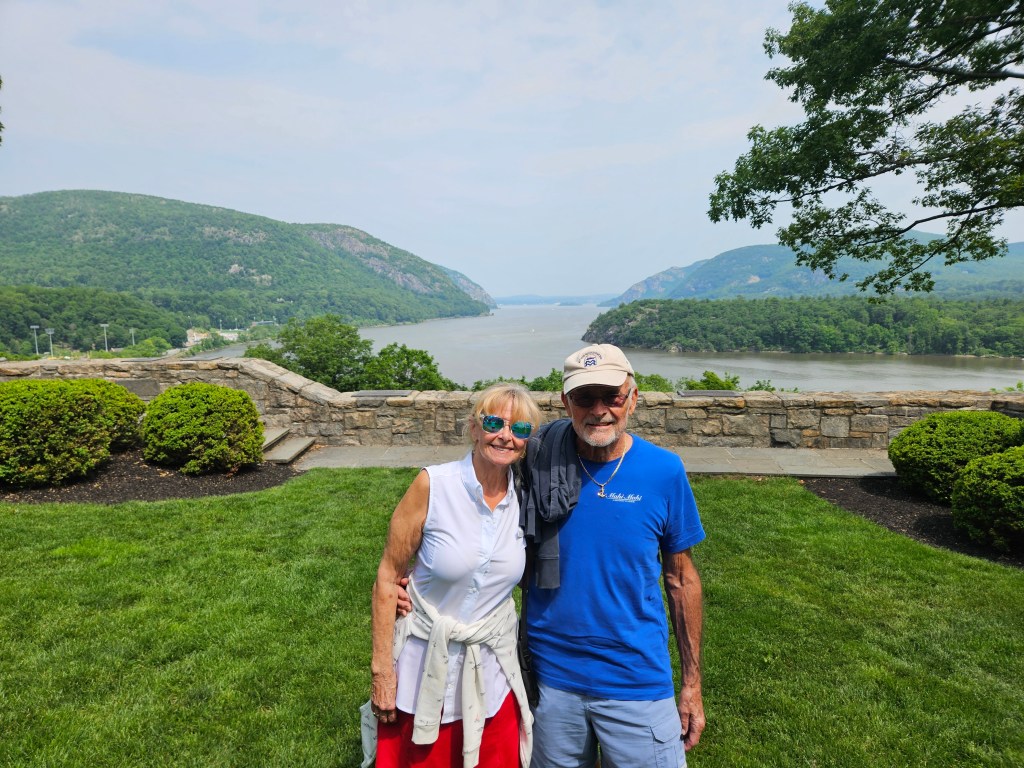
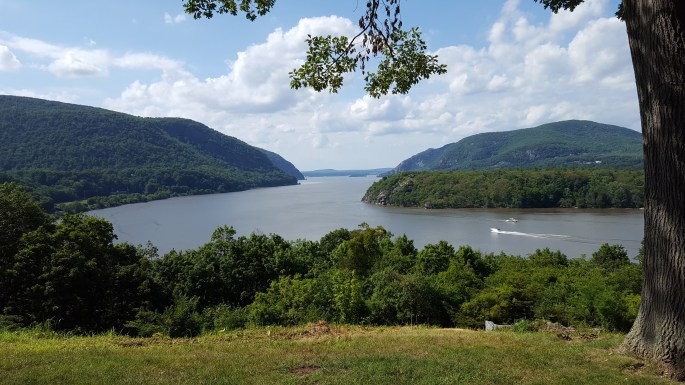
The “Point” of West Point, The S-Turn, and The Chain. After looking at all the monuments & cannons, we went to the riverfront and were informed that The United Sates Military Academy is called West Point because ; It resides in the city of West Point New York, but also because of its pointed location on the Hudson River. It is on a beautiful bluff, high above a sharp “S-turn” on the Hudson River. The beautiful photo supplied by Deena.
The sharp, nearly 90-degree turn in the river forced sailing ships of the 18th century to slow down significantly to navigate it.
This geographical feature, combined with the high ground surrounding West Point, created a commanding position for the Continental Army to control the river and prevent British ships from sailing north, thus dividing the eastern & western colonies.
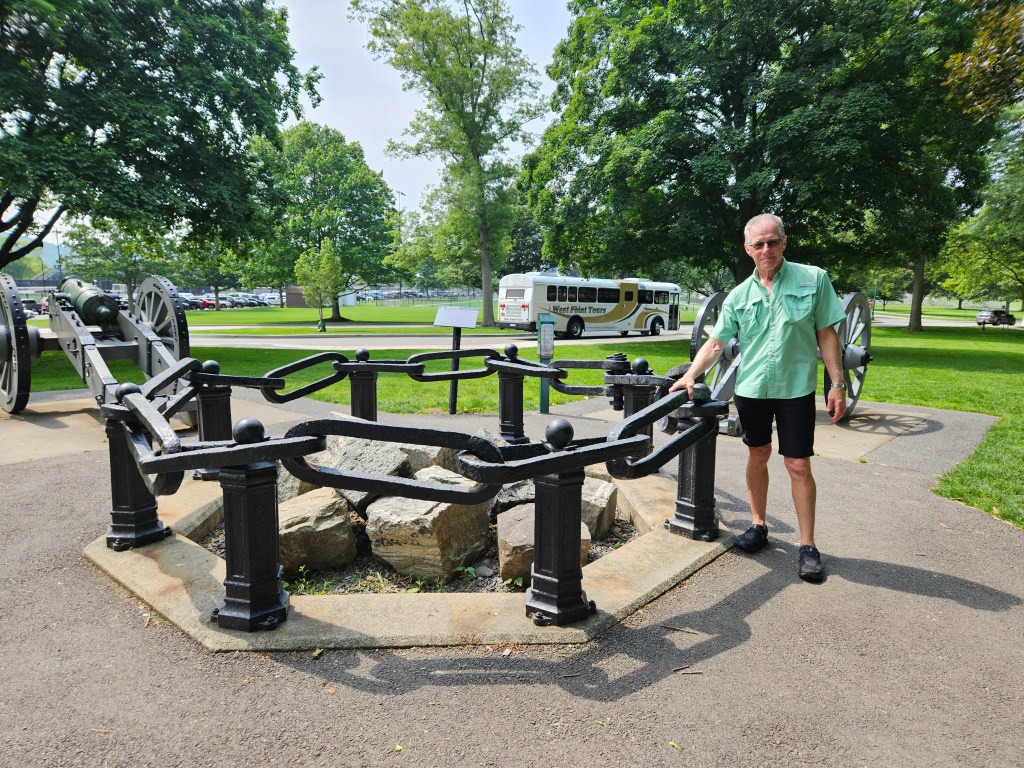
The West Point Chain – The “S-turn” also provided a very narrow strategic location for the Continental Army to install a Large Iron Chain across the river to further obstruct enemy ships. While never tested in battle, the chain and its location at the S-turn proved effective in deterring British advancement. The chain was constructed in 1778 under the supervision of Thaddeus Kosciuszko, a Polish engineer, and General George Washington. It was made of 1,200 links of wrought iron, weighed 65 tons, and stretched 1,700 feet There is a monument which has 13 Links of the actual chain.
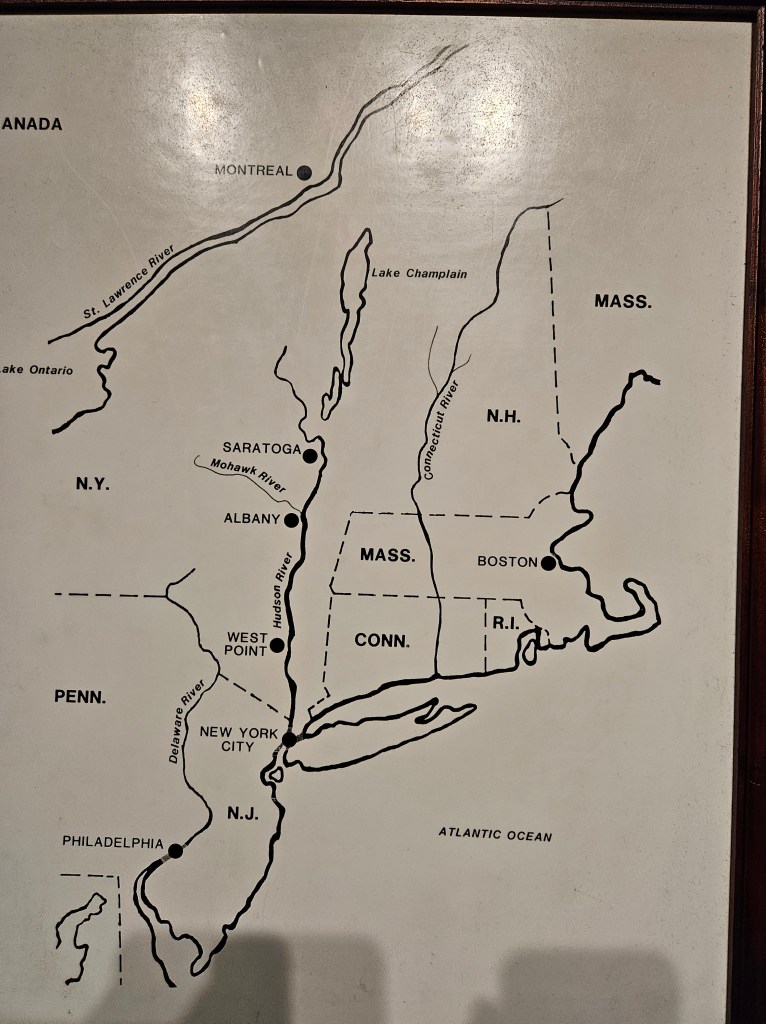
Control of the Hudson River was vital to both the American and British forces, as it served as a major transportation route for troops and supplies. West Point, situated at this strategic bend, was considered the “most important post in America” by General George Washington. Here is a graphic which shows how the western & eastern colonies could have been separated if West Point & the Hudson River had been lost to the British.
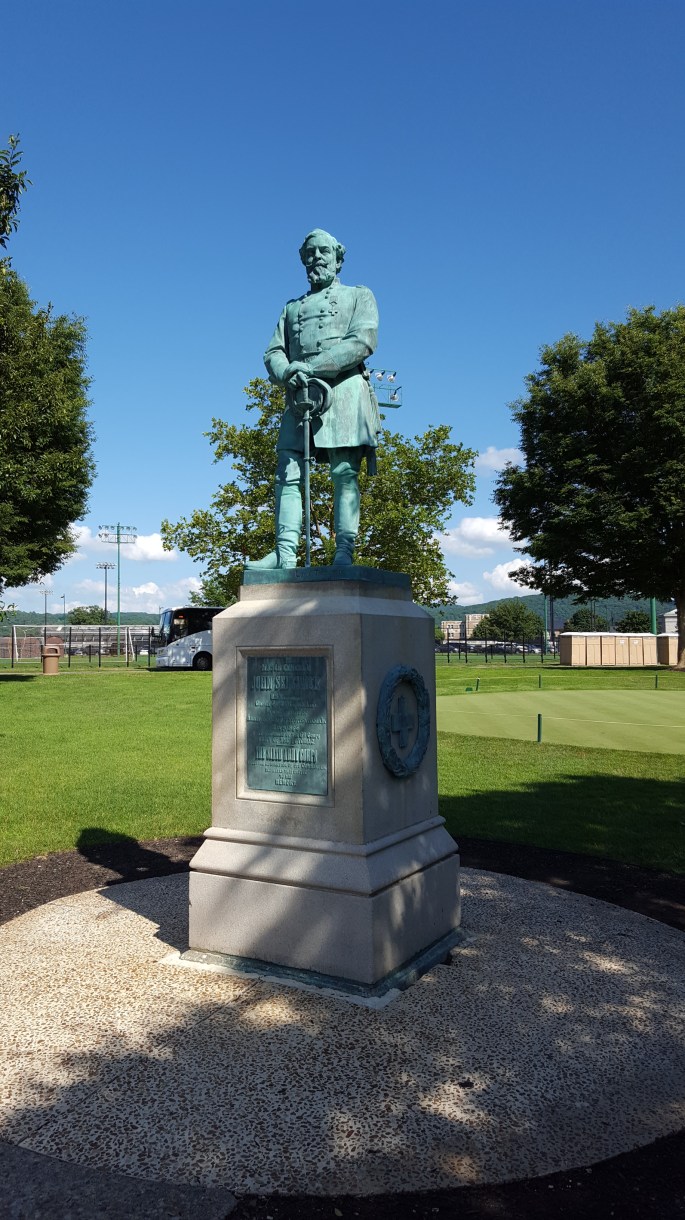
Next stop was the statue of General John Sedgwick. He was wounded but not killed 3 times in battle, leading to the phrase “Lucky Sedgwick” Legend holds that if a cadet is deficient in academics, the cadet should go to the monument at midnight the night before the term-end examination, in full dress, under arms, and spin the spurs on Sedgwick’s boots. With the resulting good luck, the cadet will pass the test. I’m not so sure it works, Sedgwick is also known for his last spoken words “”They couldn’t hit an elephant at this distance” , right before he was killed by a sharp shooter.
During the tour, one of the other folks brought up – Benedict Arnold. Benedict Arnold was a general during the American Revolutionary War who fought heroically for the American Continental Army. He was thought of so highly by George Washington, that he had Washington’s fullest confidence, and was given command of the fortifications at West Point. Thru a series of career events (lack of promotion) which soured Arnold against the new American Military, Arnold felt betrayed for all of his service, was offered money by the British, & planned to surrender West Point to British forces by giving away top secret West Point documents. But in September 1780 the plot was discovered and Arnold escaped with minutes to spare. His name quickly became a byword in the United States for treason and betrayal because he betrayed his countrymen by leading the British army in battle against the men whom he once commanded.
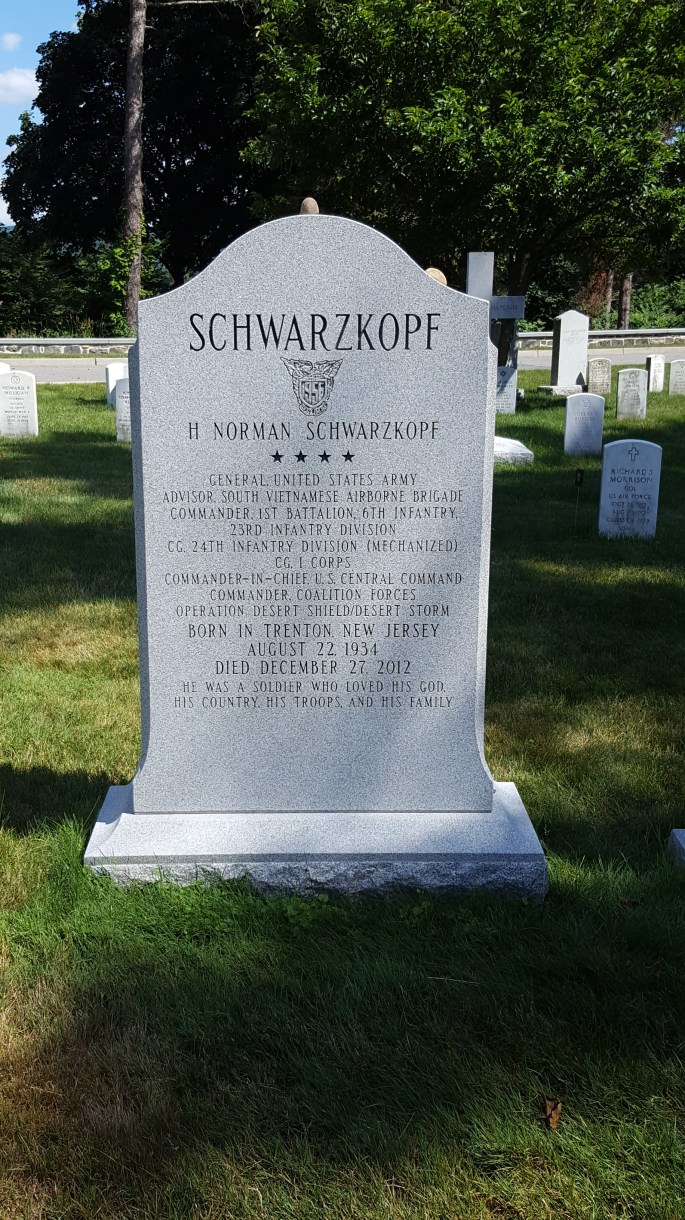
The West Point Cemetery During this tour with Jerry & Deena, we did not go to the cemetery, but I did remember how cool it was from the tour that Jonell & I went on in 2018, so I Goolged a few tid-bits of information & some photos. The cemetery overlooks the Hudson River, and served as a burial ground for Revolutionary War Soldiers and early West Point inhabitants before 1817, when it was officially designated as a Military Cemetery. Now the Cemetery allows burial for anyone who attended West Point and their family. The cemetery has many famous “old & recent” customers like General George Armstrong Custer & General Norman Schwarzkopf.
It was another great history lesson, today at The United States Military Academy.
Have you heard of the movie – Plains,Trains & Automobiles.
Well how about – Uber, Trains, Taxi, and Subway.
An early 7am rise again this morning, but not for travel by boat, we were off to see the Big City, the Big Apple, New York-New York !!!
We started with an 8am Uber pickup at the marina, for a short ride to the Crouton- Hudson train station.
We boarded the train about 8:30am for an hour long ride into NYC & Grand Central Train Station.
We arrived safely at Grand Central Station about 9:30. The Station did not look so Grand.
From there, we next took a $45 taxi ride, from Grand Central to the 9/11 Memorial & Museum. The taxi ride was only 6 miles, but 45 minutes long, and $45 🙁
It was well worth the effort, the visit to the museum & memorial was very somber, but also very awe inspiring to hear the stories of heroism on that infamous day.
It will be easiest to tell the story with the pictures, so I will just show the photos and attach descriptions of each exhibit at the museum.
Before we start, the tour guide mentioned that the 9/11 Museum & Memorial is dedicated to the 9/11 Victims & First Responders at The North & South World Trade Centers, but it is also dedicated to memories of ; The 1993 World Trade Center Bombing, The Pentagon Attack, & the Flight #93 Heroes who most likely saved The White House or The Nations Capitol Building.
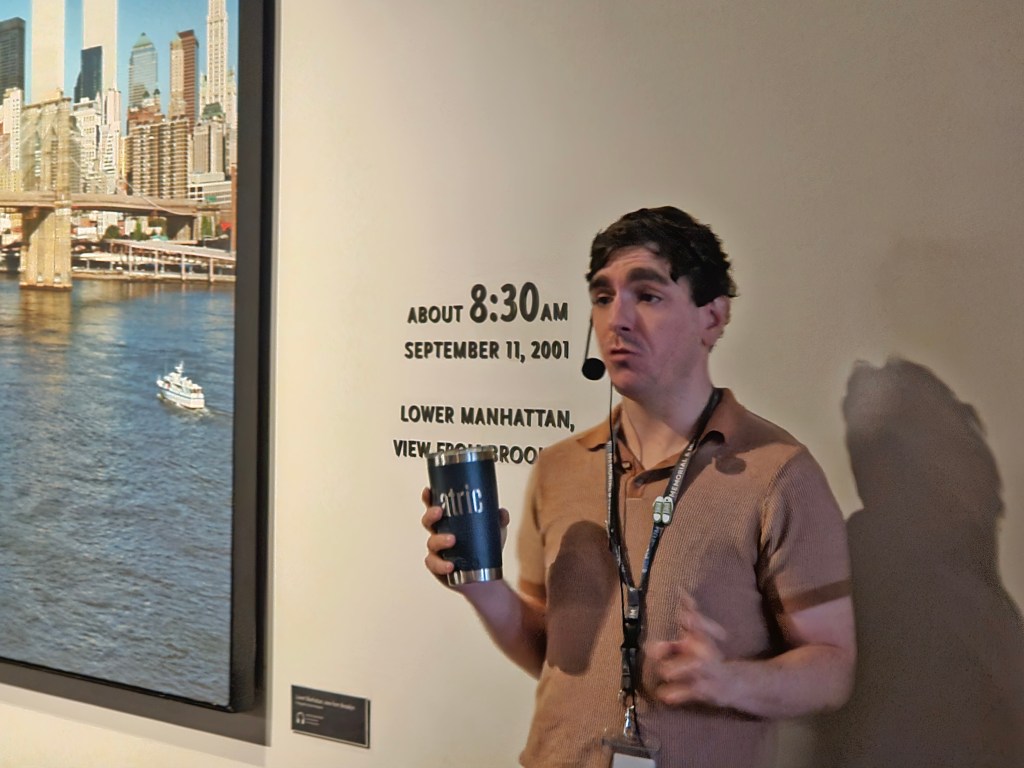
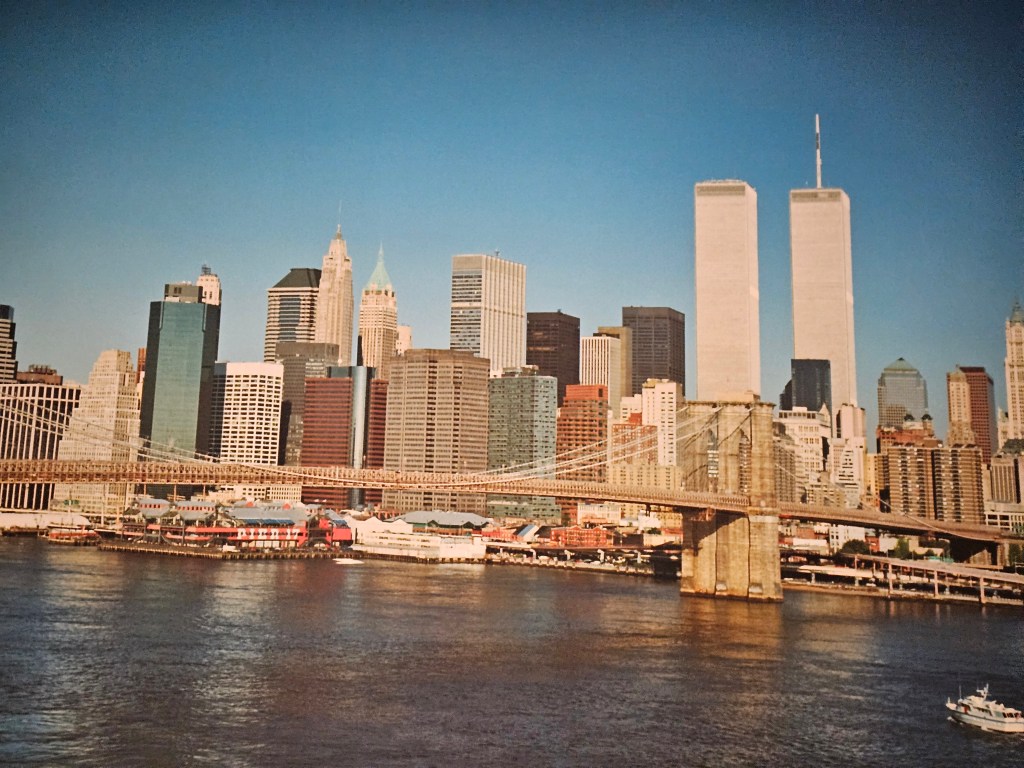
The morning of September 11, 2001 it was a beautiful blue sky morning.
Some quick Facts / Timeline
4 Airplanes, 3 Locations Hit, 1 Plane Crashed 7:59am = AA Flight #11 from Boston to LA takes off (#1) 8:14am = United Flight #175 from Boston to LA takes off (#2) 8:20am = AA Flight #77 from Dulles (Washington) to LA takes off (#3) 8:41am = United Flight #93 from Newark to San Fran takes off (#4). 8:46am = AA #11 crashes into the North Tower, floors 93-99 9:03 am = United #175 crashes into the South Tower, floors 75-85 9:37am = AA #77 crashes into the Pentagon. 9:59am = The South Tower Collapses. 10:07am = Passengers of United #93 induce a crash, most likely saving the US Capitol !!! 10:28am = The North Tower Collapses.
It became 102 minutes of time, which changed the world forever !
The 9/11 Museum & Memorial was opened exactly 10 years after the event, on September 11, 2011.
Photos & descriptions from the 9/11 Museum Tour
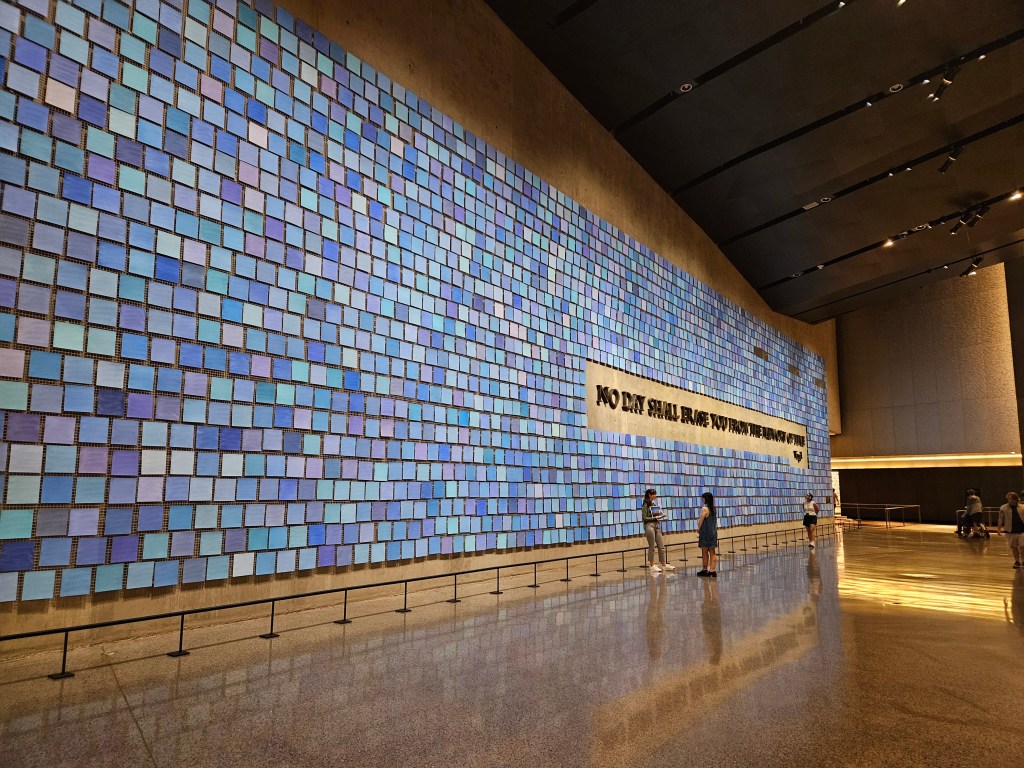
The Memorial Wall & Virgil Quotation “No Day Shall Erase You From the Memory of Time.”
This quote is indicative of the museum’s mission to honor and remember the victims of the attacks of September 11, 2001 and February 26, 1993. The quote is from a poem written by a Roman poet named “Virgil”. Each letter was forged from pieces of recovered World Trade Center steel by New Mexico artist Tom Joyce.
These words are part of a larger art installation in the 9/11 Memorial Museum created in 2014 by artist Spencer Finch, titled “Trying to Remember the Color of the Sky on That September Morning.” The installation is the focal point for Memorial Hall, the area between the two main exhibitions at bedrock in the museum.
Every one of the 2,983 watercolor squares is its own shade of blue – one for each of the 2001 and 1993 attack victims – and the artwork as a whole revolves around the idea of memory. Our own perception of the color blue might not be the same as that of another person. But, just like our perception of color, our memories share a common point of reference.
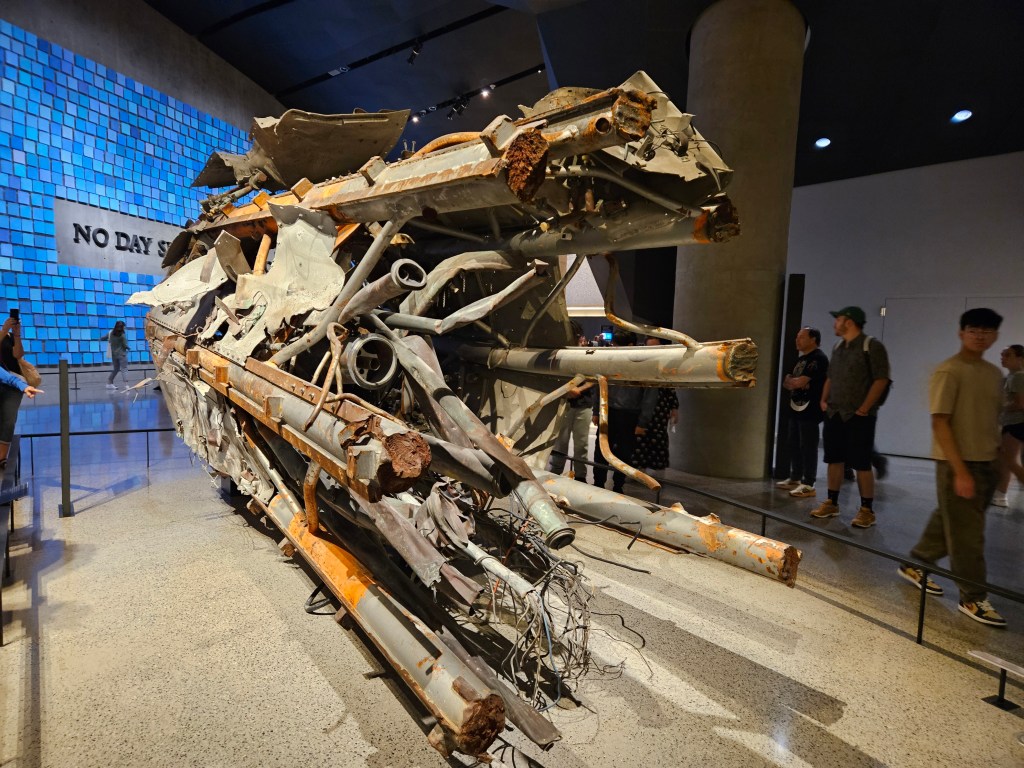
The North Tower Antenna
At our next stop, the tour guide showed us a Section of the North Tower Antenna. This 19.8-foot-long fragment was about one-twentieth of the 360-foot-tall transmission tower atop the North Tower. The massive antenna provided the signals of most of major New York City broadcasters until it went off-the-air on the infamous morning. The signals then had to be rerouted to the Empire State Building Antenna.
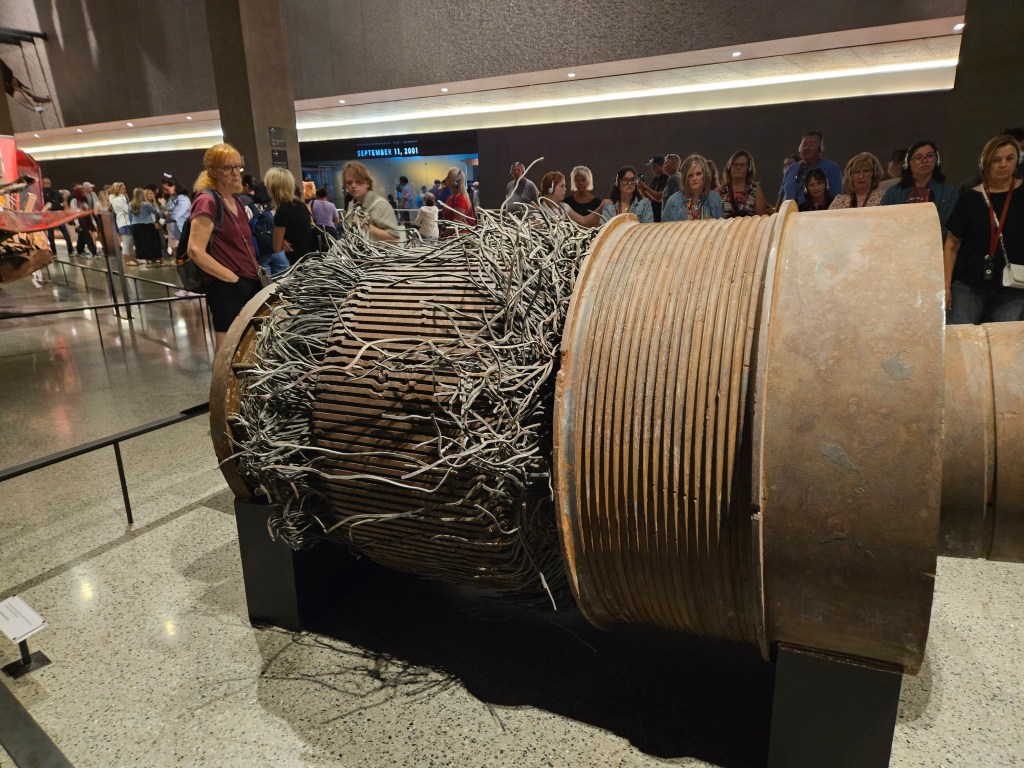
The Elevator Motor
The Twin Towers were the first skyscrapers to use a system of High Speed Elevators. Each tower had 99 elevators, and 4 High Speed Elevators. They were the largest in the world when installed.
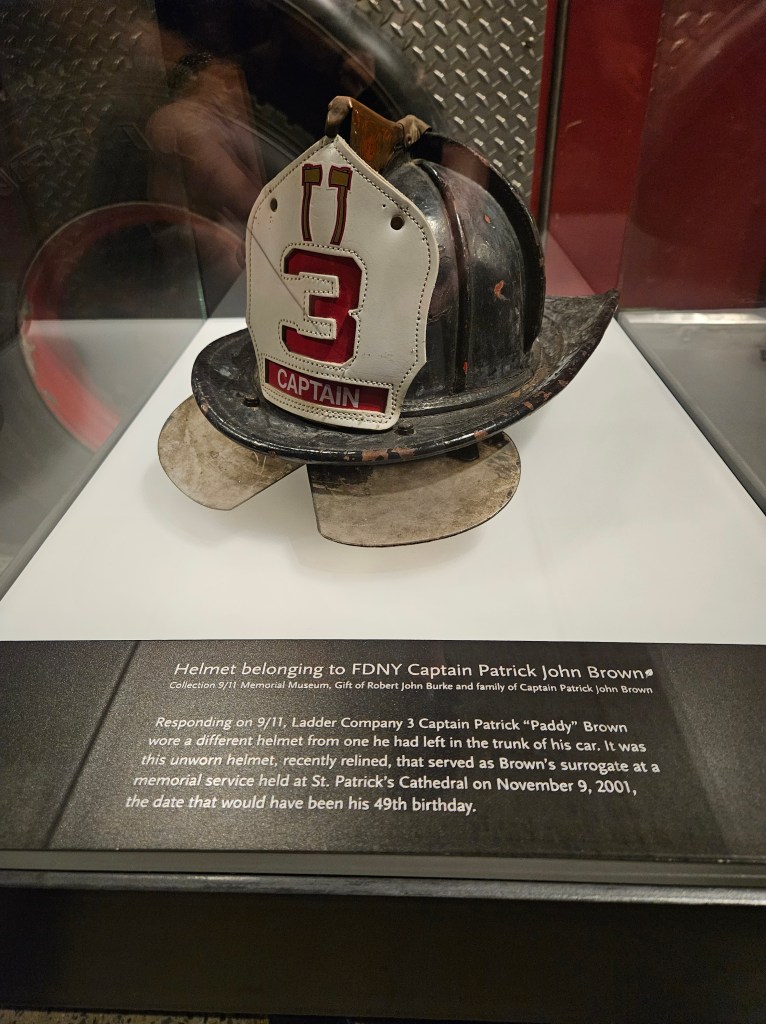
Ladder Company 3
It was 9am shift change time. When the attack occurred all 11 members of Company 3 volunteered, even the guys who had just completed the night shift. All 11 team members are known to have reached the 35th floor by 9:21am, and all 11 men of Ladder Company 3 were killed inside the North Tower when it collapsed at 10:28a.m
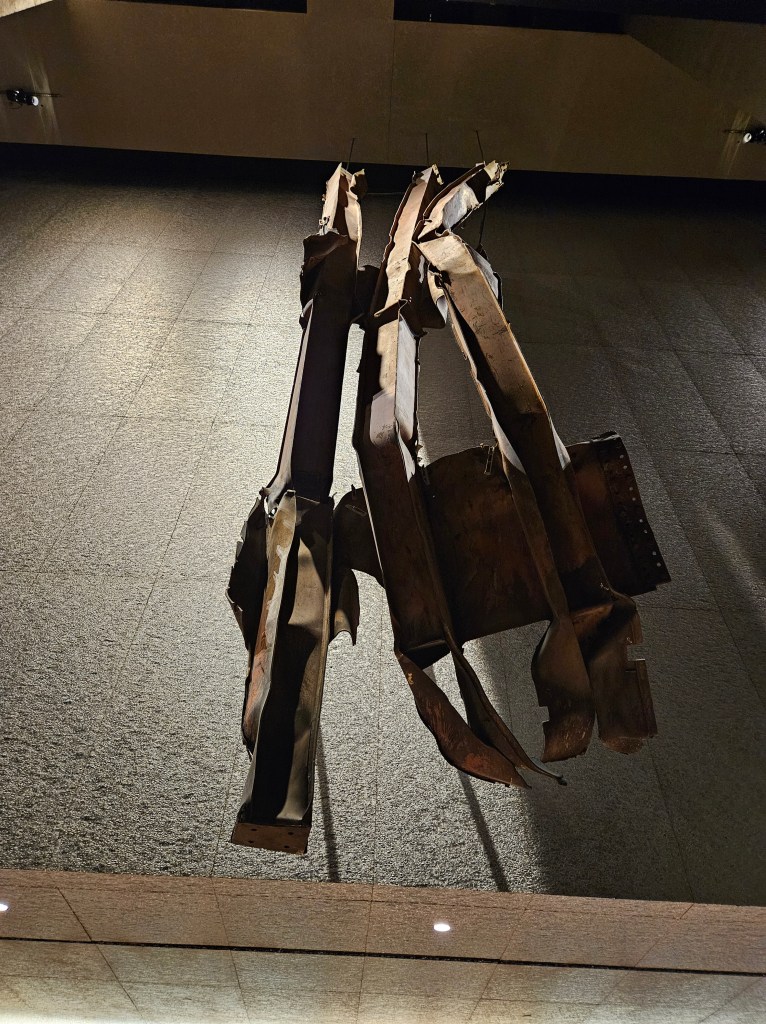
The North Tower Impact Beam
This piece of steel, once part of the façade of the North Tower, was the point of impact where hijacked AA flight #11 pierced the building from floors 93 through 99.
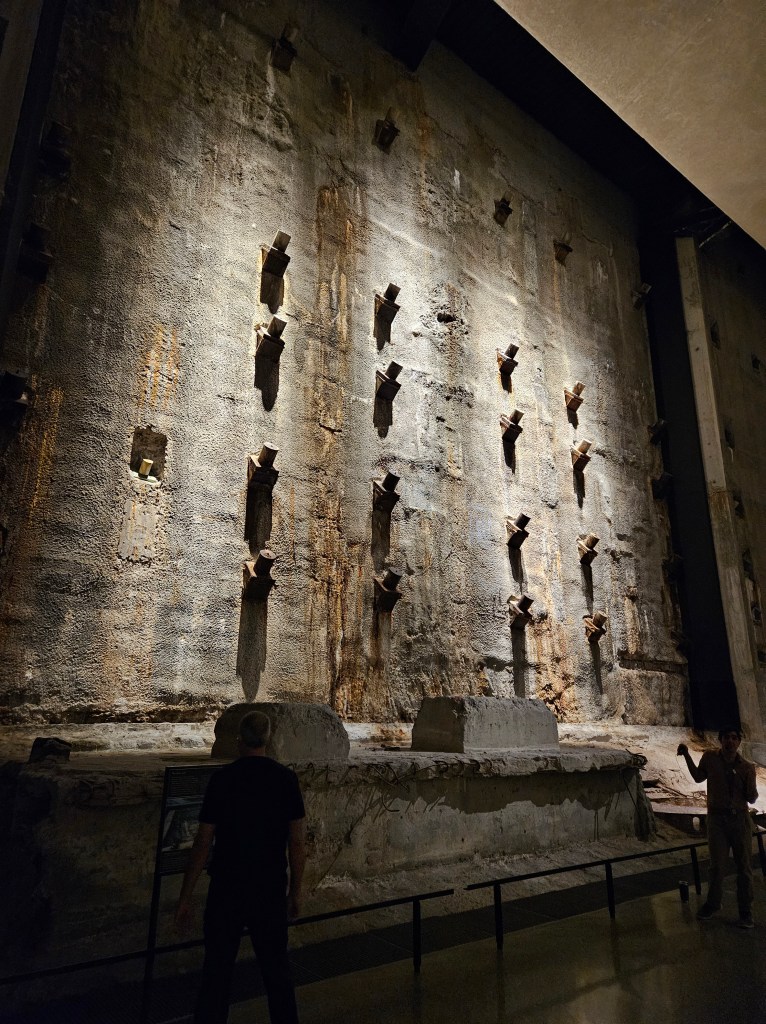
The Foundation Wall
This is the Foundation Wall which separated the base of the North Tower from The Hudson River. If this wall would have breached, it would have flooded all of Manhattan. All of the objects protruding from the wall are part of the structural tie backs into the ground behind the wall, like a normal seawall in a marina.
The Last Column
As the recovery at the World Trade Center site neared completion, the Last Column, a 58-ton, 36ft tall piece of welded plate steel, was removed from the site in a solemn ceremony on May 30, 2002. In the weeks that followed, recovery workers, first responders, volunteers and victims’ relatives signed the column and affixed to it memorial messages, photographs, and other tributes. This actually became the 1st piece of the museum.
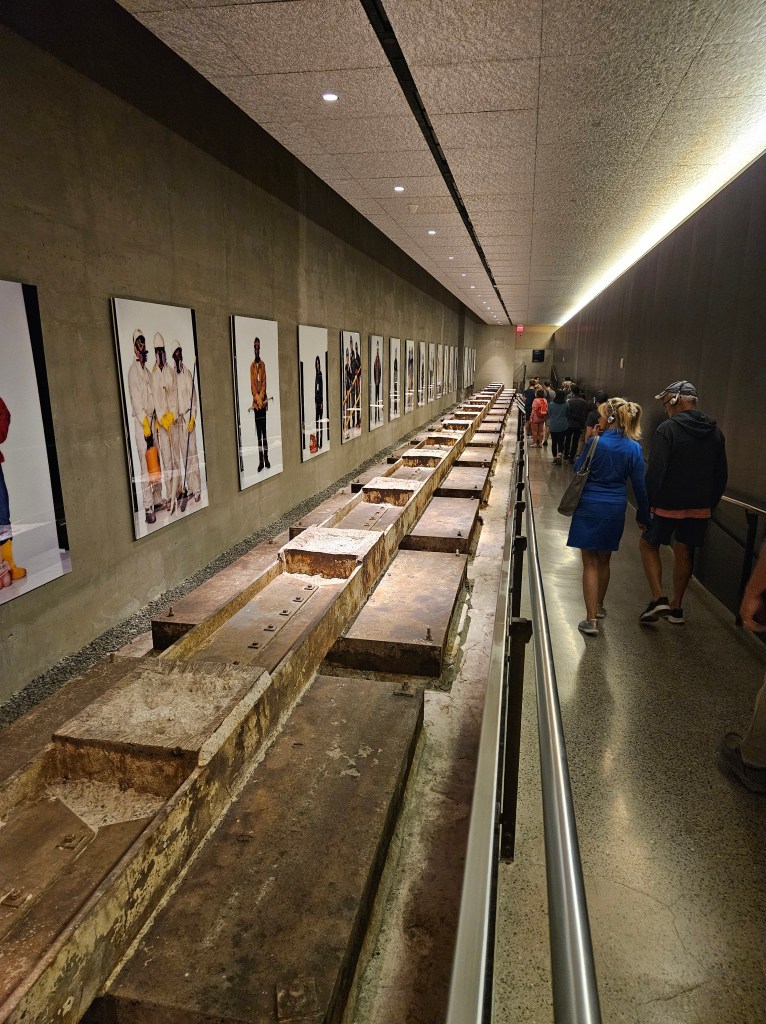
The North Tower Column Remnants
The towers went 1/4 mile into the sky. The towers were supported by these steel columns anchored 70 feet below ground. A total of 84 columns defined the towers perimeter. Recovery workers cut the columns to their current height shown in the photos. Family members viewed this as sacred ground and did not want it dug up to remove the columns.
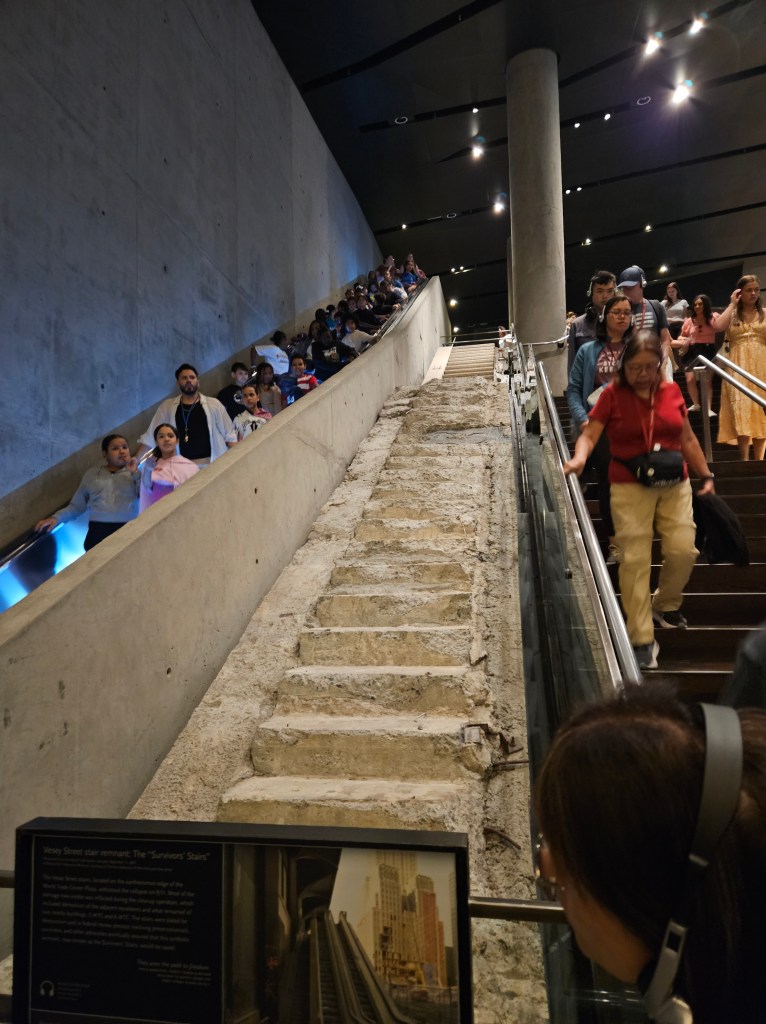
The Vesey Street Stairs
The Vesey Street stairs, are also known as the “Survivors’ Stairs”. Over 15,000 people made it to safety on this path. During the attacks of September 11, 2001, the stairway became a vital safety route for many of the survivors. The stairs were one of very few exit areas which had overhead covering, protecting the lucky people who actually made it out from falling debris. Many people made it out but were killed by the falling debris. The stairs were mostly intact immediately after 9/11, but they were significantly damaged during the nine-month recovery period. The stairway is also the only exhibit above ground of the World Trade Center.
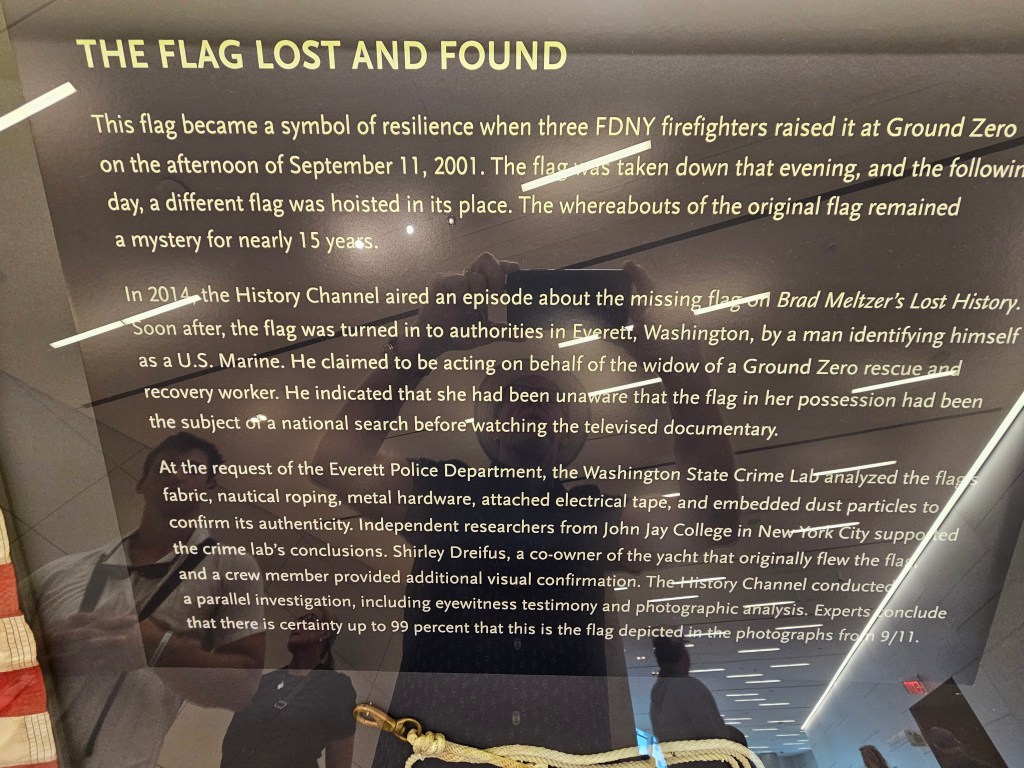
The 9/11 Flag
The tour ended with a walk through a room which held a photo & family mementos of each victim. Photographs were not allowed in this room, but there were 4 very tall & very long walls covered with photos of each victim. In an adjacent room was a non-stop movie running biographies of each of the victims family members describing the personalities of their lost loved one.
The Memorial Pools
After the Museum, we walked outside to The Memorial Plaza & 9/11 Memorial Pools. The Memorial Plaza is an 8-acre park composed of nearly 400 white oak trees, and the largest manmade waterfalls in the United States. Set on the footprints of the original Twin Towers, each pool is approximately 1-acre in size. The names of every person who died in the terror attacks of February 26, 1993 & September 11, 2001 are honored in bronze around the twin Memorial pools (we are showing only one of the 2 twin pools).
The Pools are continiuosly filled with water that cascades down 30 feet into a basin and then further down 20 feet into a void that is never filled and cannot be seen. This symbolizes the loss of life and the lingering void left after the 9/11 attacks
As I stated in the beginning, it was quite a somber day during the tour, but also an uplifting day to see how we Americans can pull together to help each other, and how the “American Spirit” cannot be defeated.
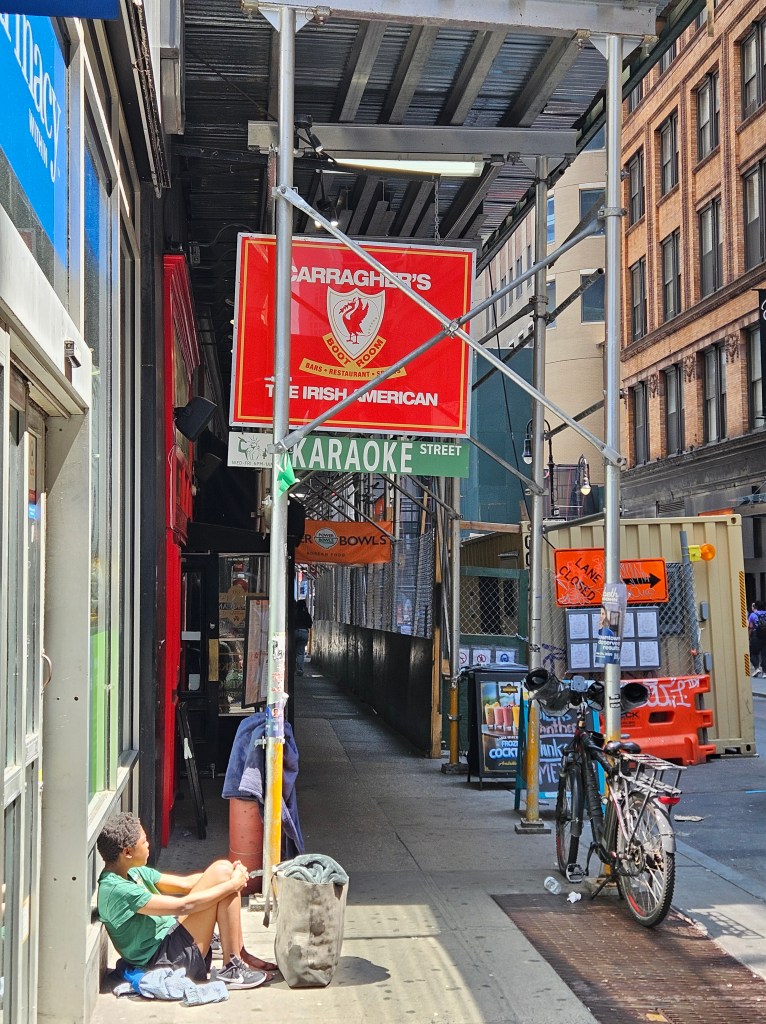
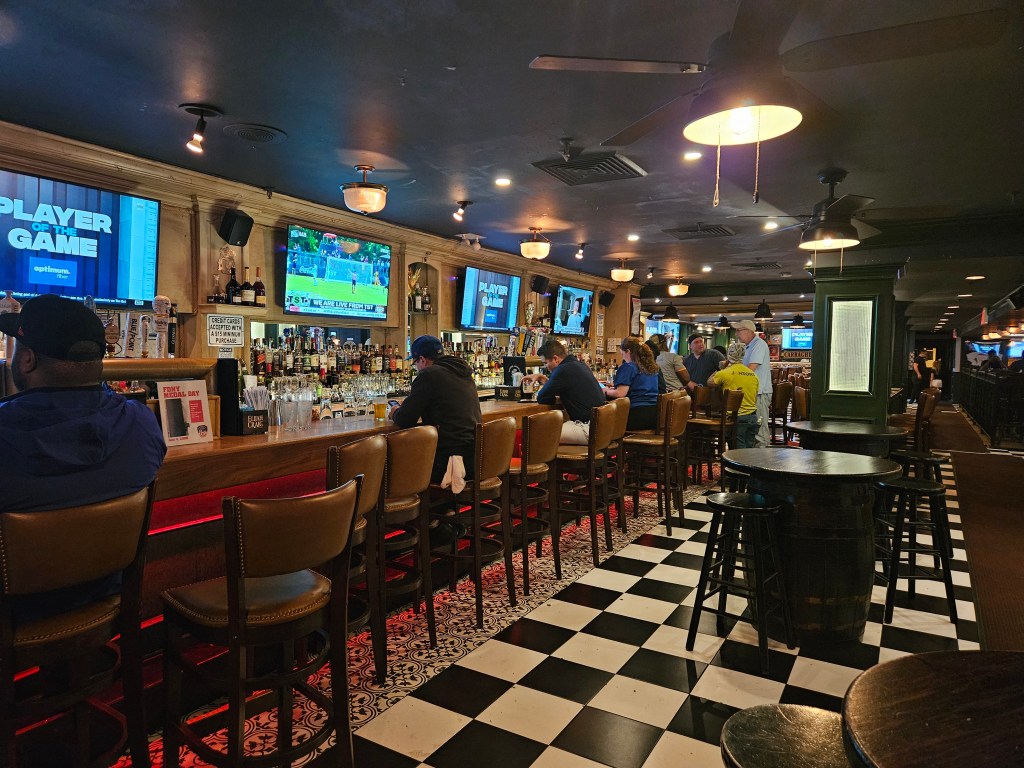
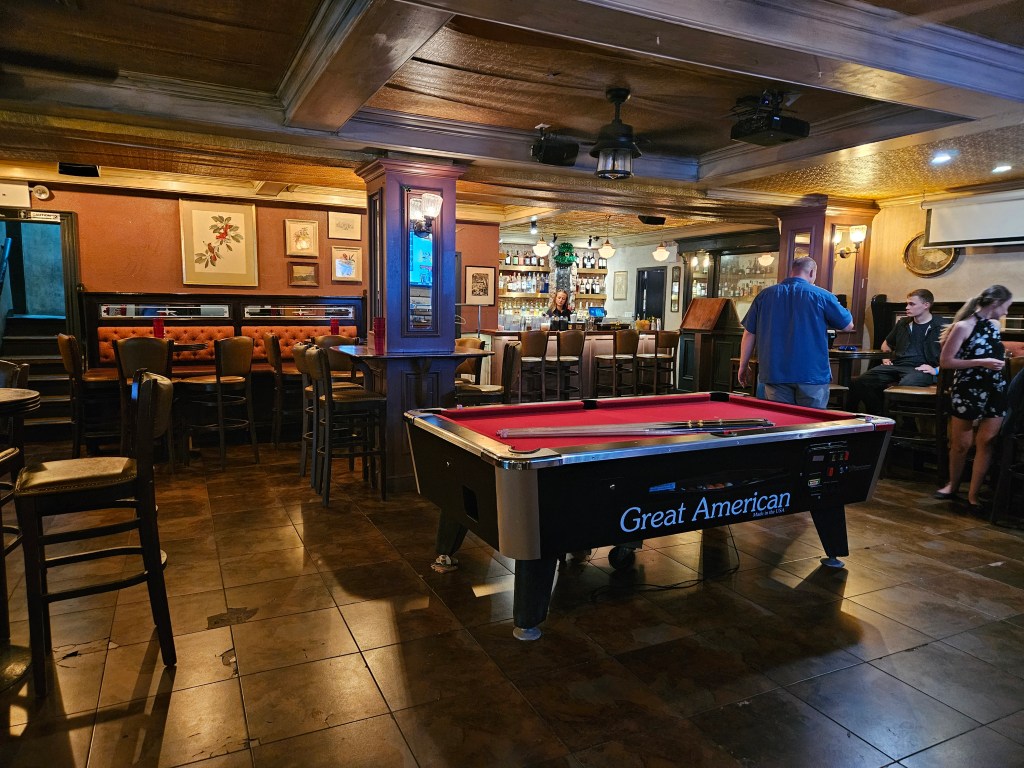
After the 9/11 Museum & Memorial, we were hungry and thirsty. We looked up the closest place to the memorial. Carrigher’s Irish Pub. It didn’t look like much from the street, but the below ground bar looked like something out of a Frank Sinatra movie.
After a quick appetizer of mini Lamb Chops & Smithwicks, we were off for the next adventure – the NYC subway 😱
Mikie was not totally up for the subway, preferring the $45 return to Grand Central via taxi, but Jerry talked me into it.
I was quite sure that with my boyish youthful looks, that I was gunna be raped & pillaged. I was also uneasy because I am the tour guide, and had no idea on where to go, or how to use the infamous subway.
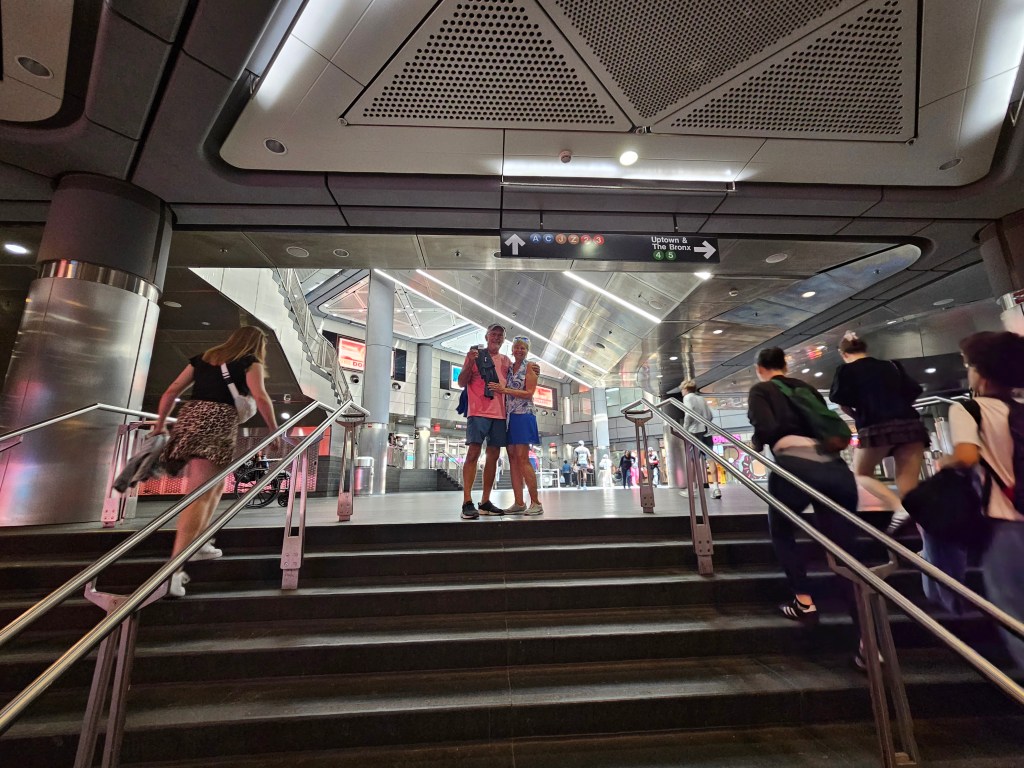
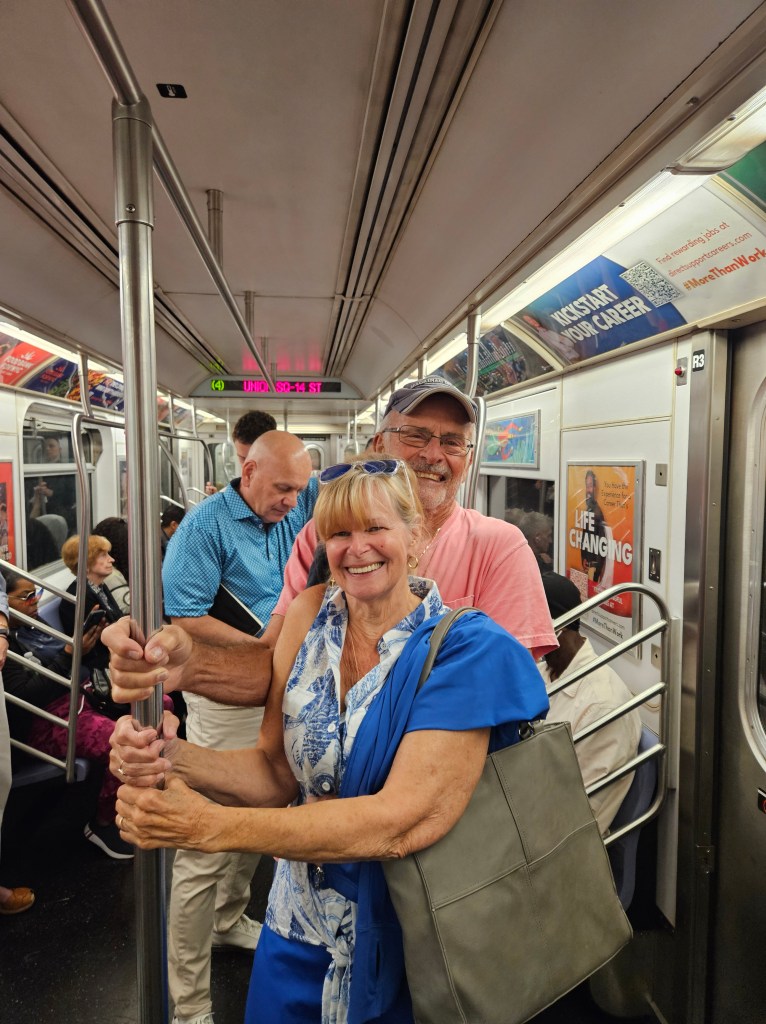
So we started with a discussion with the friendly NYC Policeman. He told us to go to the station at Broadway & Fulton, and take the Green 4/5 line.
Luckily, the police officer was right on, his directions were impeccable.
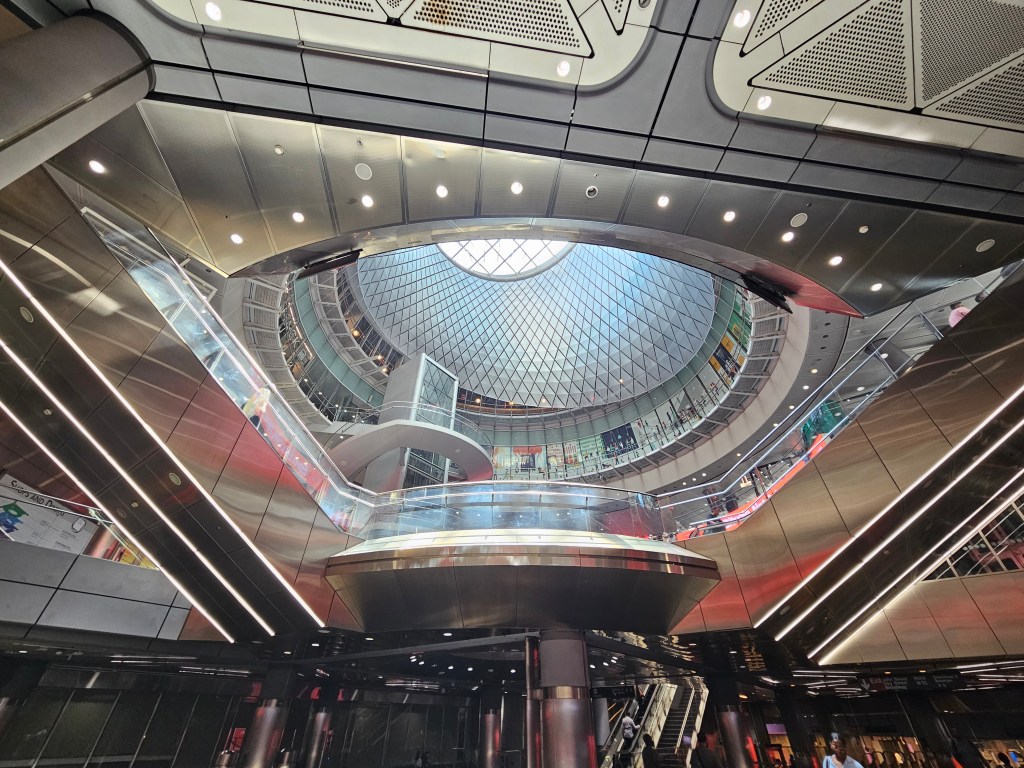
The subway station was not like what I saw in the movies, it was actually nice and clean up top in the main complex.
The subway itself, did look like the scenes in all the murder mysteries.
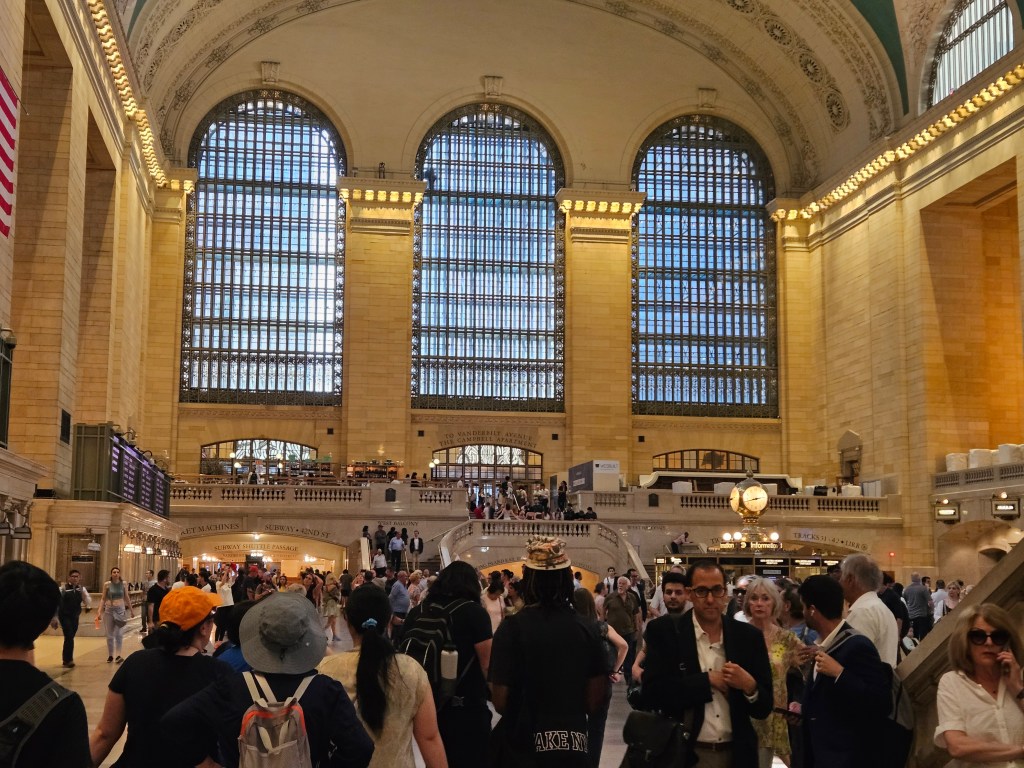
After we used the subway to get back to Grand Central Train Station, then we had to figure out where to go, what line to get on, and how to buy the tickets.
With the help of some Dutch tourists, we figured out how to buy the tickets from the kiosk machine. Then with the help of another one of NYPD’s finest, we found out which line to go to for our train back to the marina. Above ground, Grand Central Station did look Grand.
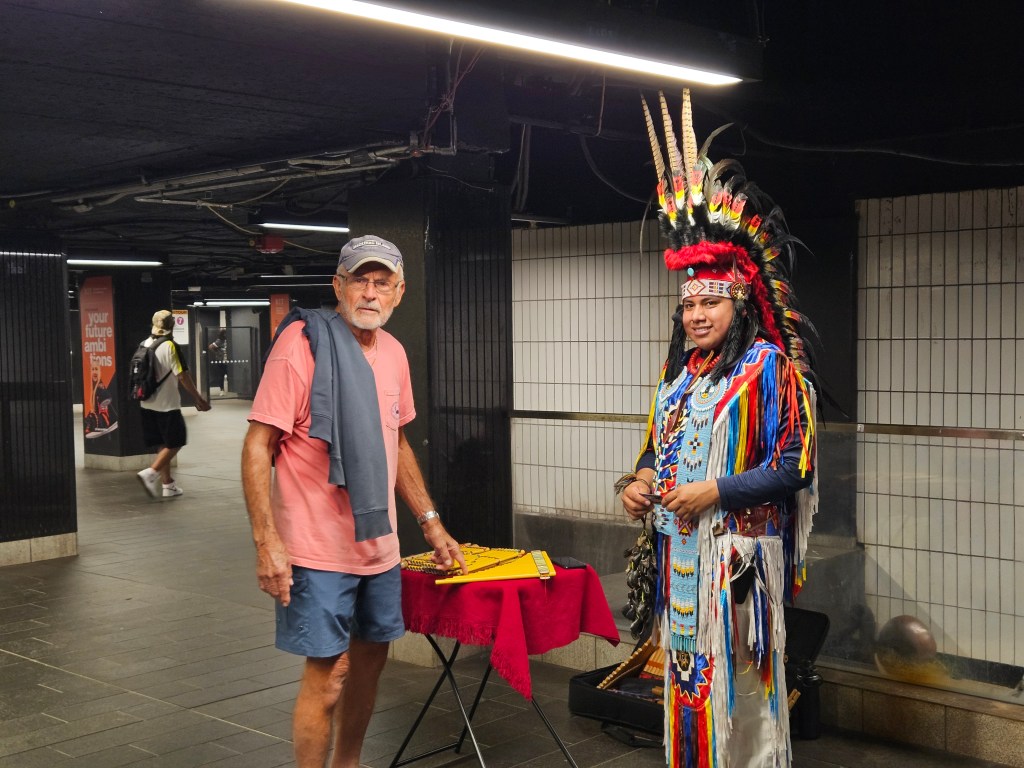
Along the way, we encountered an American Indian guy playing music. Jerry exchanged musical backgrounds and we left the guy a tip.
We got back to Crouton on the Hudson & Half Moon Bay Marina just in time for me to request an Uber, right before my phone went dead 🙃.
As I write this section of the post, it’s only 7:15am. We wanted an early start up the Hudson River, to hopefully avoid the chaos of ships that will build as the day goes on.
The plan worked reasonably well, the boat traffic was not too bad, but still higher than I expected for 7am on a Tuesday
On the way up the Hudson, we passed several attention getting objects.
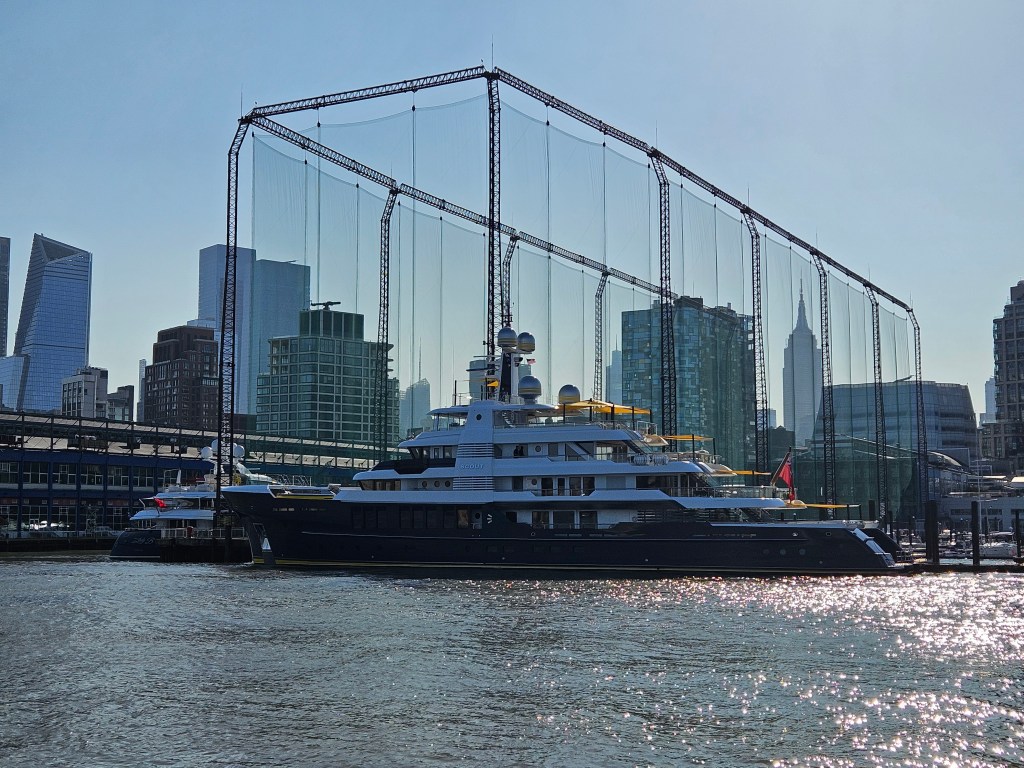
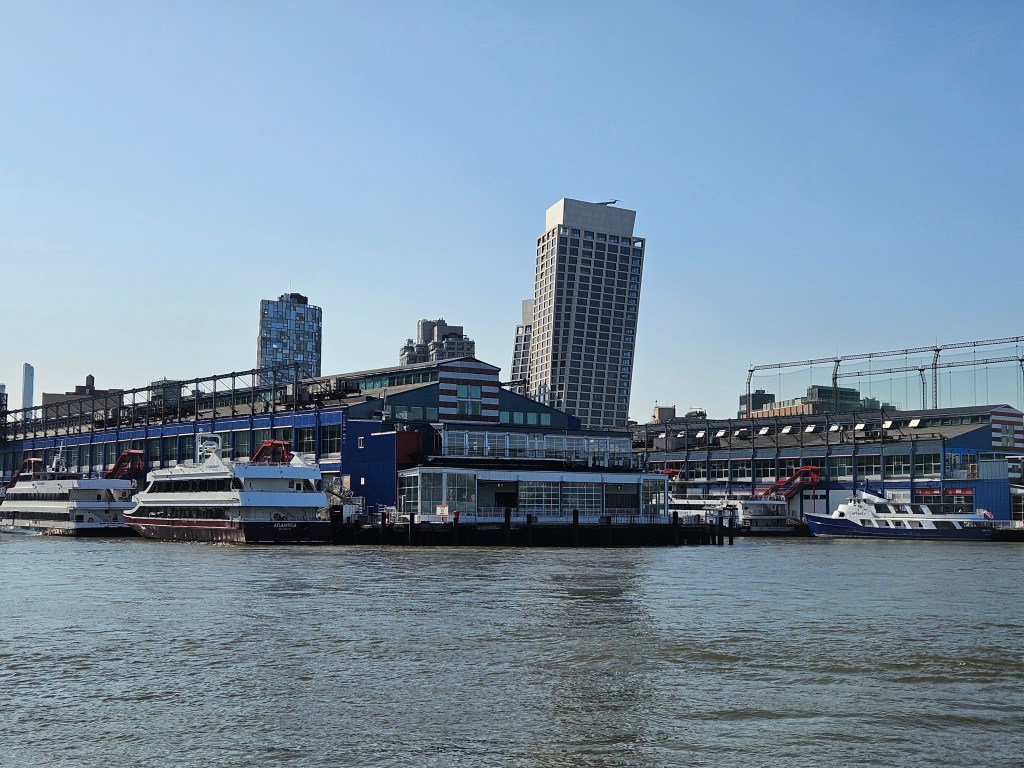
Item #1 = a very large screened in area with several boats & some large ships. It was hard to believe, but this was a Golf Club right on the Hudson River. The Chelsea Piers Golf Club. The members use the net to drive golf balls, like at the driving range.
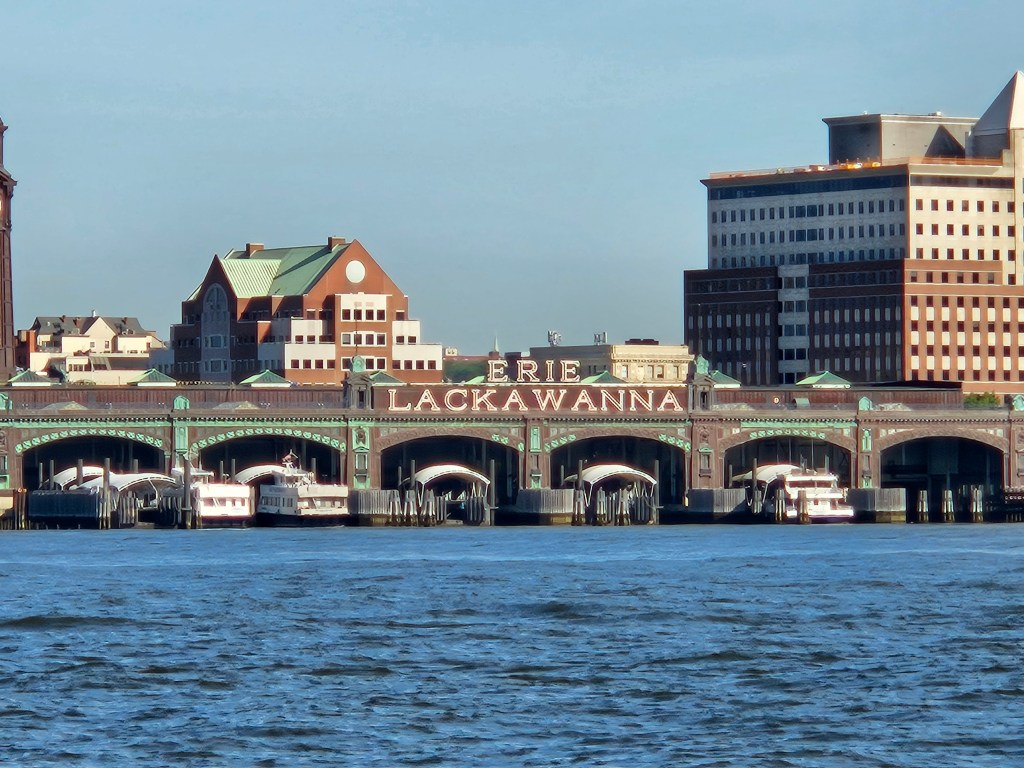
Item #2 = We saw a building with the name Erie Lackawanna. But what could it be, is it a restaurant, a club, boat slips for rich people ? Ms. Google says that Erie Lackawanna was a closed down Railroad Station. They would take product from boats and deliver it by rail car to the local NY/NJ area.
Item #3 = A very large White Head Sculpture. It was uglier than SH – -, and had no place on the river. But I had to take the photo and look it up.
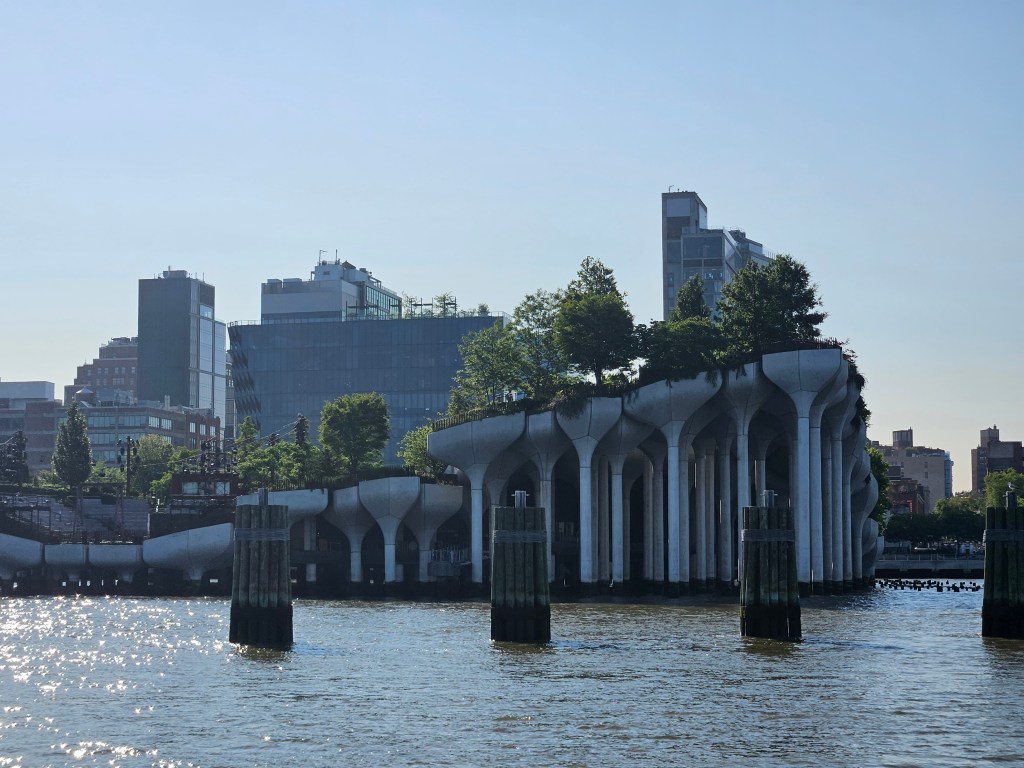
Item #4 = The next objects looked like a large number of HUGH Golf Tees, holding trees & vegetation. Ms Google says this.
Item #5 = An Aircraft Carrier with an Atrium. Ms Google tells me that this is the USS Intrepid, that has been converted into a museum.
Item #6 = The Leaning Tower of America ? Ms Google tells me that this is just an architectural firm having fun with shapes. There are actually 2 buildings, but the 2nd one is hidden in my photo.
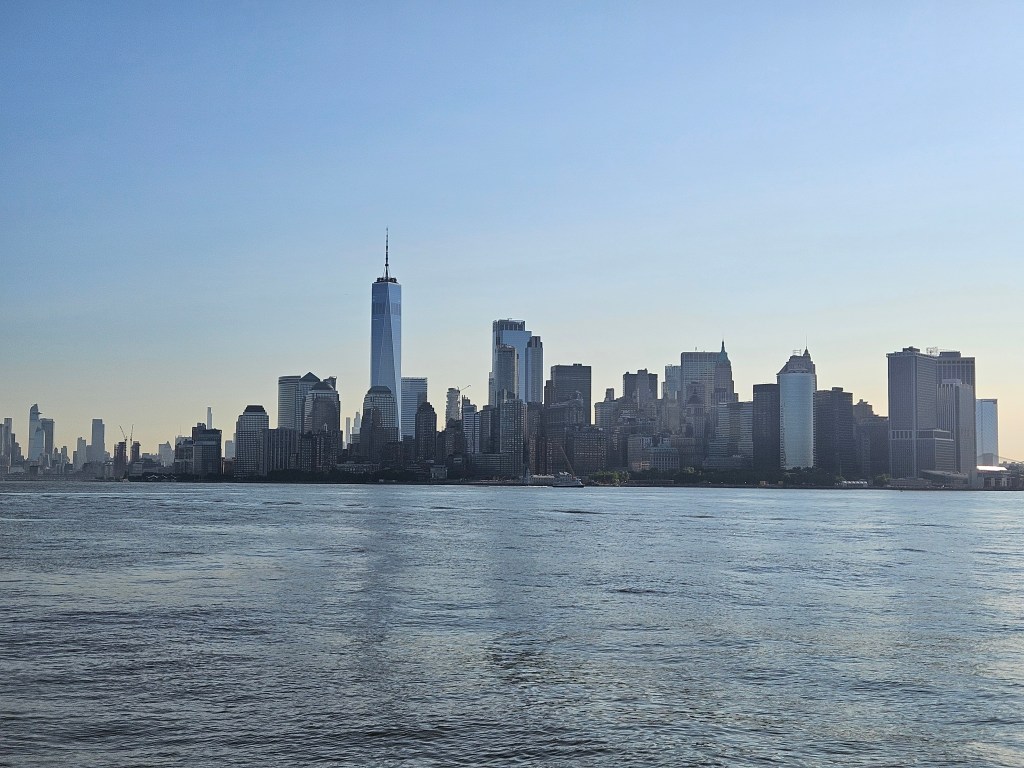
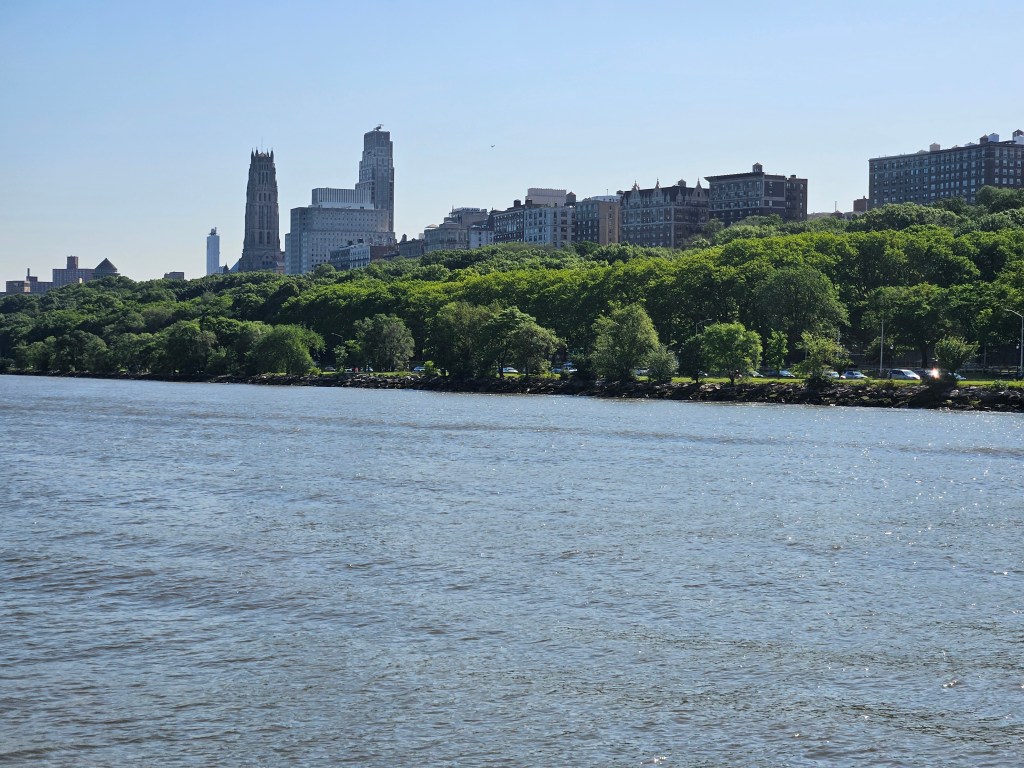
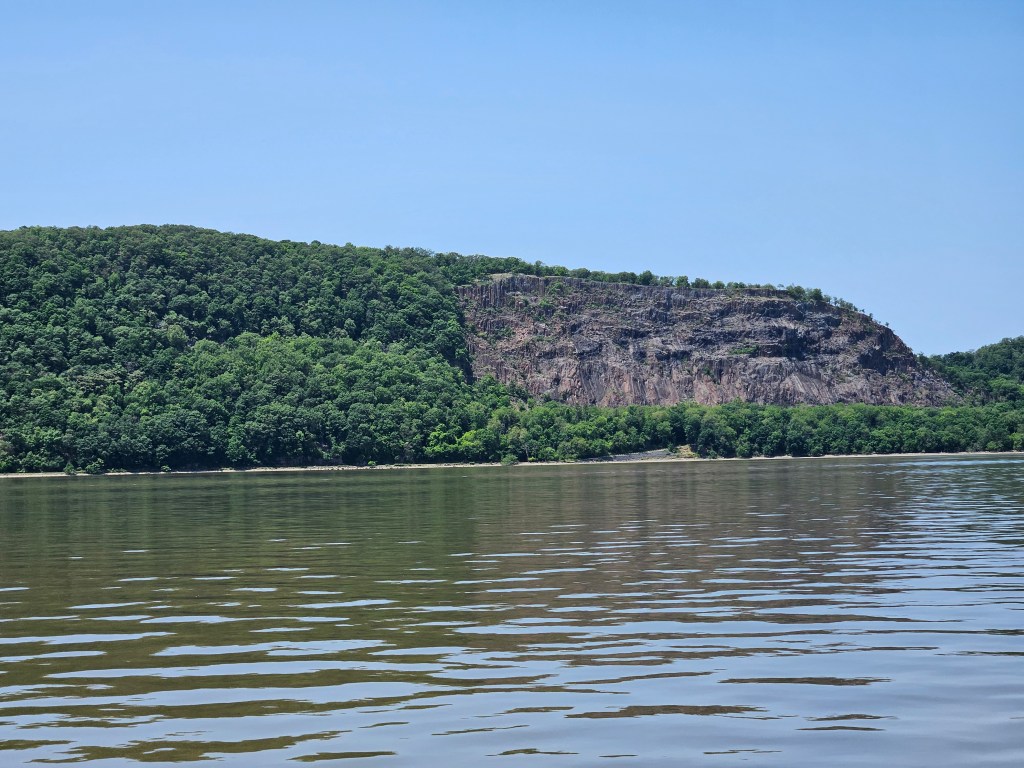
One of the other things we noticed is how the landscape changed dramatically after we crossed under the George Washington Bridge. Prior to cruising under, the scenery was all buildings and impressive structures. After cruising under the GW bridge, we started seeing more trees, until finally – trees and rocky cliffs were the dominant sites. Here are some photos showing the change.
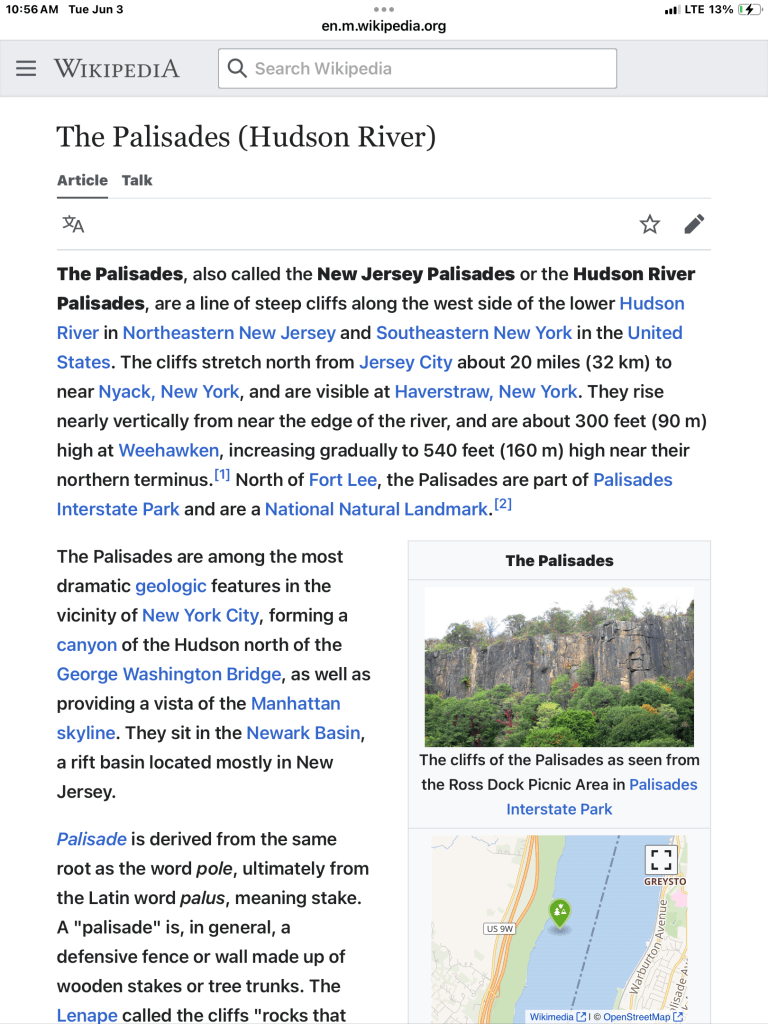
Deena helped me with some research of the jagged cliffs on the NJ shore, they are called the Palisades Cliffs.
All along the Hudson River past NYC, we saw trains coming by every half hour. It’s really small on the video, but it was cool in real life with the horn blasting every 5 minutes.
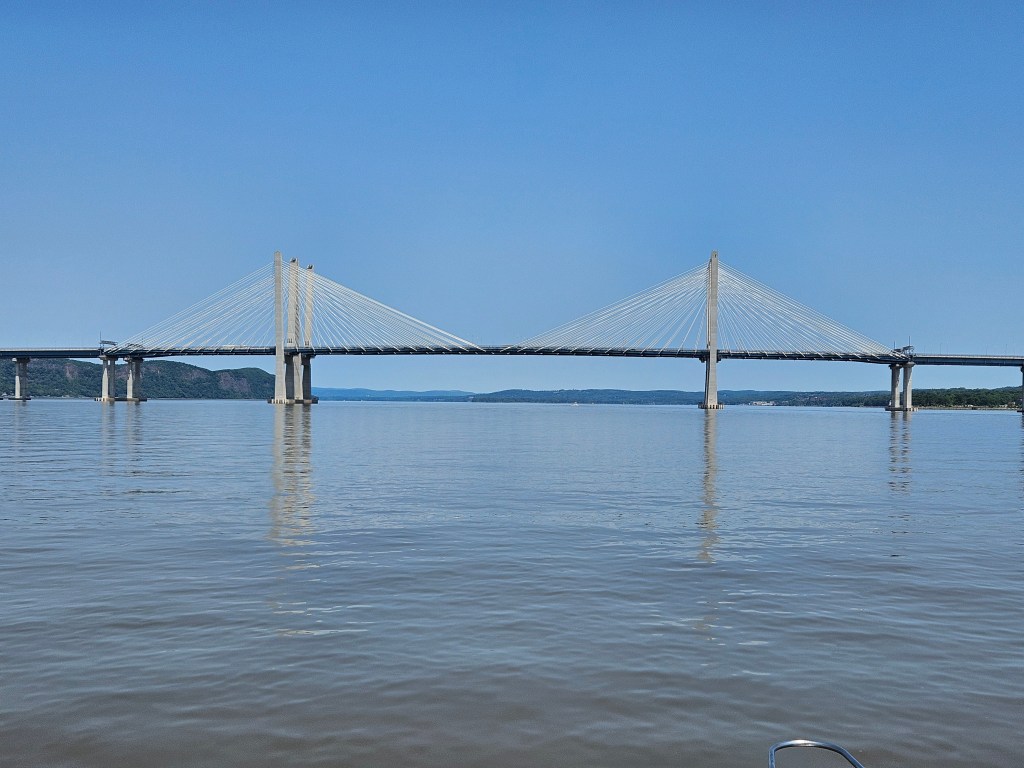
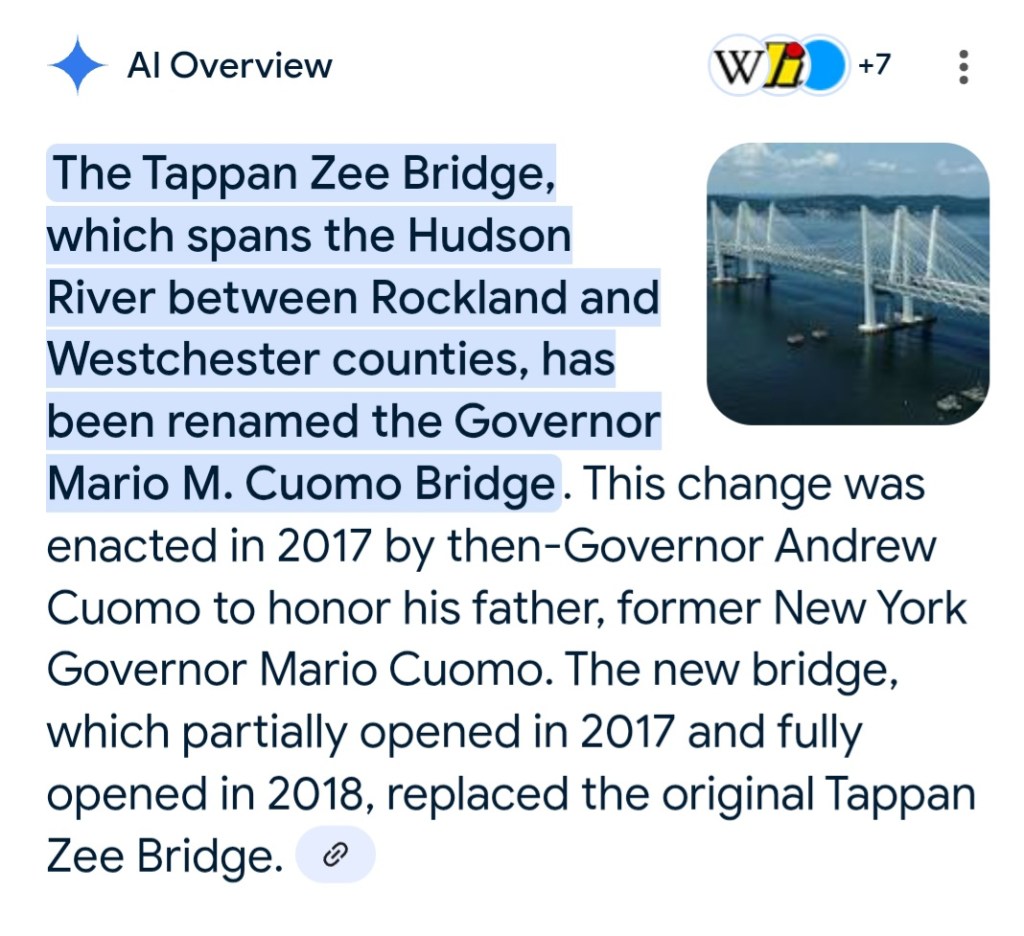
Towards the end of our ride, we passed under the Tappan Zee Bridge, but it appears that the Bridge was recently renamed after Mario Como, the former Governor of NY who was ousted from office after the 2020 Covid scandals (sorry for the political commentary, this is a fun post, but please don’t name bridges after politicians).
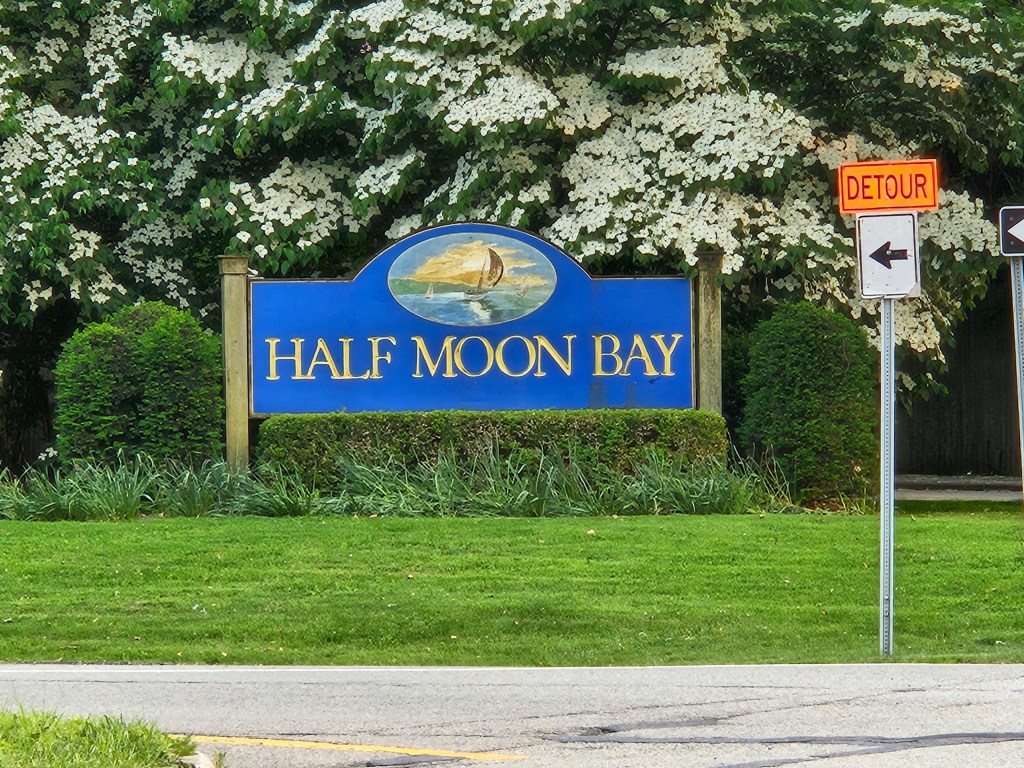
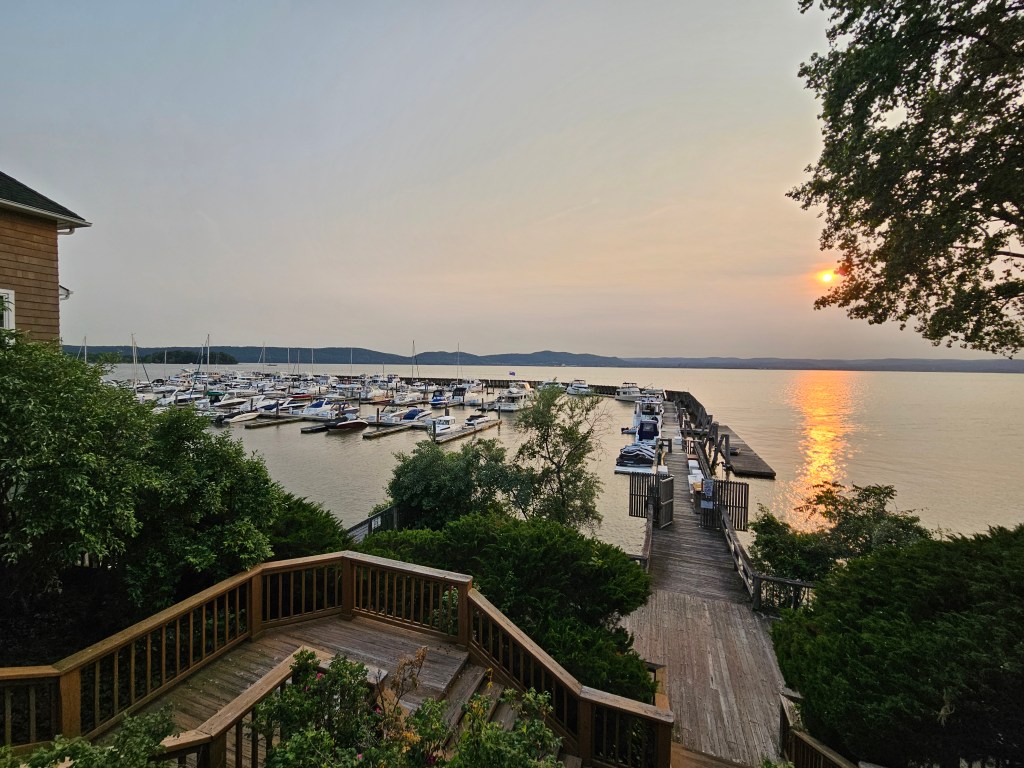
We arrived in a city called Crouton on the Hudson, about 35 miles north of NYC (Adam & Patty, do you remember). The marina is called Half Moon Bay. It is a beautiful setting tucked off to the side of the Hudson River. With a quaint little town.
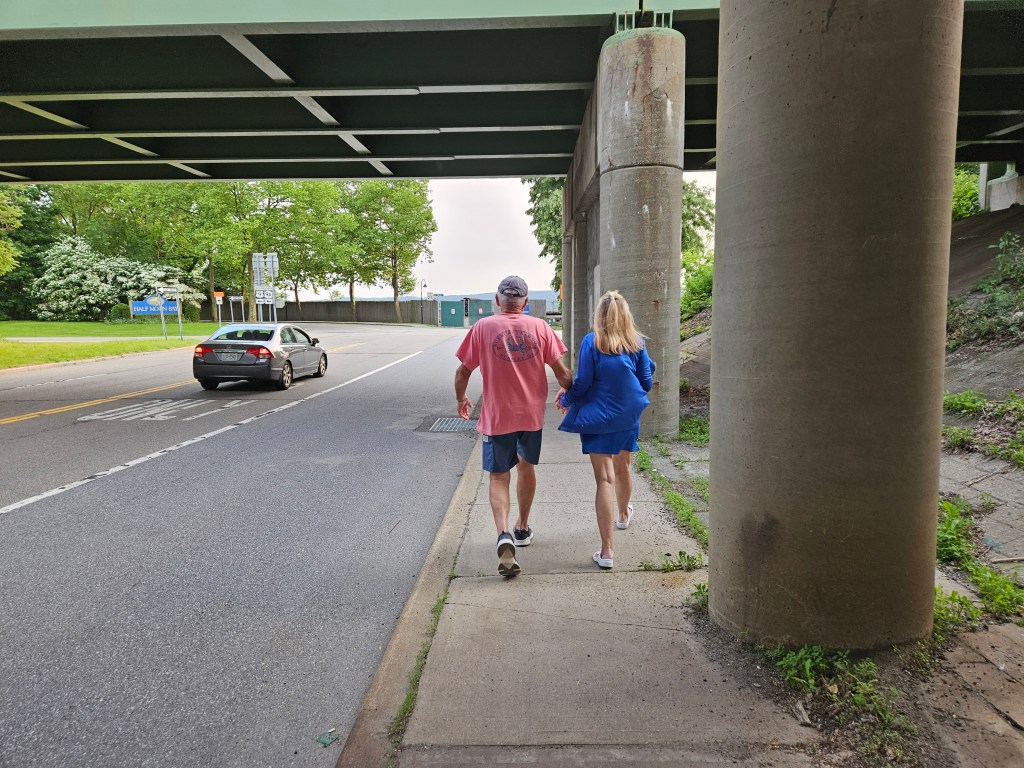
We strolled about 15 minutes into downtown Crouton on the Hudson. I found myself once again following the Luv-Birds, wishing that Nellie was here with us.
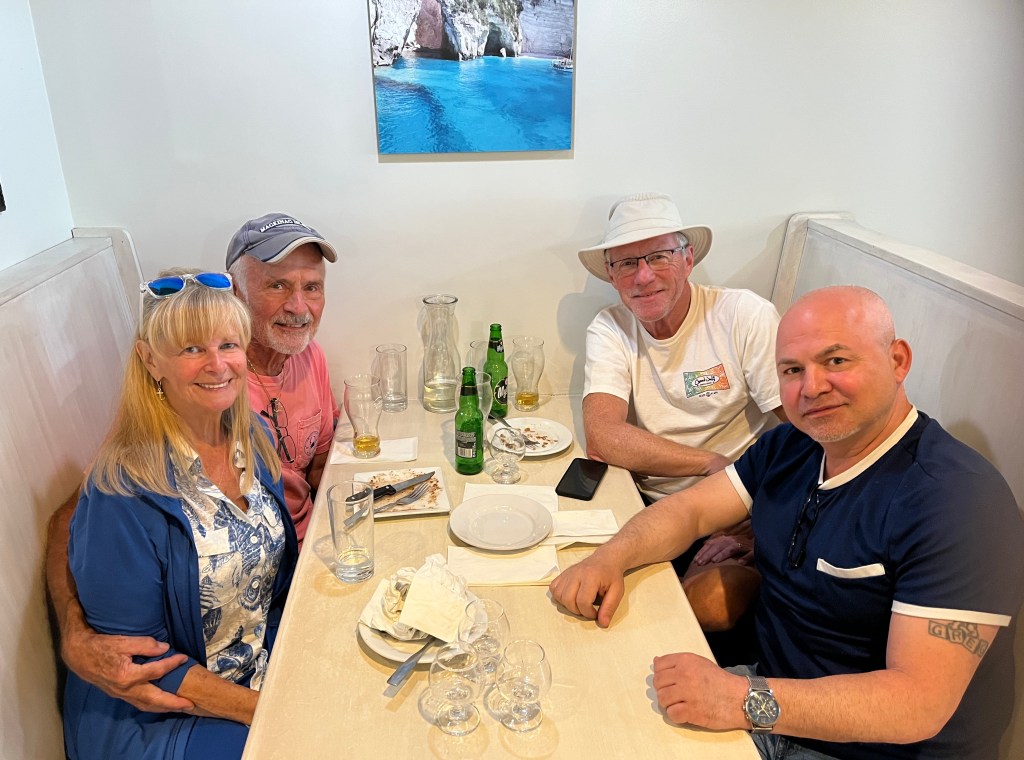
We were going to go to a mom/pop Diner restaurant, but stumbled onto a wonderful Greek restaurant on the way. The Piato Greek Kitchen, a family running the place was incredibly friendly – owner Gregory, son Gregory II, and waitress Sade (yes, like the singer). The food was awesome. The owner Gregory sat with us for a while and provided 4 free Ouzo shots.
After the walk home, it was an early night. Jerry and Deena tucked in about 9:30, Mike finished this darn big and hit the sack about 10:30.
An early day tomorrow – train ride into NYC and then visit the 911 Memorial & Museum.








































 gettinlooped2017.com